

TL;DR
What to expect from this article:
An analytical guide designed to help mid-market and enterprise brands navigate the crowded Amazon service provider ecosystem. This article details what makes an agency effective, compares six prevailing agency models and named agencies within them (including Canopy Management, Amazon Growth Lab, My Amazon Guy, SellerPlex, Trivium Group, Ecomcy, and Lumian), and provides a clear partner selection framework based on business needs.
Key Takeaways:
- The modern Amazon ecosystem requires integrated data orchestration across logistics, Amazon Marketing Cloud (AMC) attribution, organic ranking, and advertising lanes.
- Traditional agencies that operate on high account-to-manager ratios often fail to keep pace with algorithmic marketplace shifts, leading to delayed listing updates and missed inventory signals.
- Amazon agencies fall into six broad models: full-service management, operations and catalog specialists, media and analytics specialists, creative studios, global multi-marketplace firms, and integrated AI-native hybrids. The right one depends on your main operational bottleneck.
- An effective evaluation process shifts the focus away from vanity acquisition lists, prioritizing partners that use unified technological architecture and senior operators to protect contribution margins.
- Judge an agency's value by net margin expansion, TACoS compression, and internal bandwidth savings, not by comparing retainer prices alone.
Intro
Succeeding on the Amazon marketplace has become a more complex operational challenge for retail brands. In previous years, e-commerce companies could treat an Amazon agency as a specialized PPC vendor—someone tasked with adjusting keyword bids, managing text strings, and providing monthly performance summaries.
The marketplace has evolved past that limited scope. With the launch of intent-driven search models like the COSMO architecture and conversational tools like Alexa for Shopping (formerly Rufus), organic product discovery is deeply connected with advertising velocity, catalog accuracy, fulfillment metrics, and real-time inventory levels. For established businesses, choosing an Amazon management partner is a significant decision that impacts channel growth and long-term profitability. This guide examines the leading agency structures, core services, and partner evaluation frameworks for 2026.
The Strategic Importance of Agency Selection
The retail landscape on Amazon has become highly competitive, changing the dynamics of channel management. According to Marketplace Pulse research, the market has quietly reorganized itself: in 2023, roughly 15,000 sellers generated half of Amazon's U.S. third-party GMV, but by early 2026, that same threshold was held by fewer than 8,000 sellers — each doing over $5 million in annual sales.
As market share concentrates among sophisticated brands, the cost of operational delays grows higher. A single unaddressed listing suppression, an unresolved FBA receiving error, or a misconfigured advertising campaign can cause significant visibility losses within hours. Many traditional service agencies are built on client acquisition models where account coordinators handle fifteen to twenty brands simultaneously, leaving little time for deep daily account maintenance. When choosing an agency, brands must evaluate the underlying operational structure to ensure the partner can manage complex, fast-moving marketplace changes.
The legacy agency model was built for a slower marketplace. An account manager logged into Seller Central once or twice a week, tuned bids, uploaded flat files, and assembled a retrospective PDF deck. When ad bids, catalog suppressions, and stock levels shift around the clock, that cadence leads to wasted ad spend and lost market share. Monitoring that checks stock continuously can flag low supply before a stockout, which a weekly review cycle can miss.
Core Services and Prevailing Agency Models
When evaluating third-party service providers, brands typically choose between six models: full-service management companies, operations and catalog specialists, specialized advertising and analytics vendors, creative studios, global multi-marketplace firms, and technology-native hybrids. Each makes a different trade-off between breadth of coverage, depth in one function, and execution speed.
1. Full-Service Marketplace Management
Full-service operators manage the entire Amazon ecosystem for a brand. Their scope includes running daily Amazon PPC and Amazon DSP media campaigns, managing search engine optimization (SEO), building detailed store assets, coordinating inventory restock alerts, and handling ongoing account health issues. Traditional full-service agencies put account managers, copywriters, designers, and media buyers under one contract.
- Exemplary Providers: Firms like Canopy Management and Seller Interactive operate within this comprehensive service category. They provide extensive operational breadth, making them reliable choices for mid-market brands that want to outsource their entire back-office Amazon administration to a large, structured organization. Amazon Growth Lab also works in this category, as does Nuanced Media, an Amazon-focused shop in Tucson, Arizona, operating since 2010 and covering the standard PPC, listing, and account management stack.
- Trade-offs: Broad coverage and high-touch relationships, constrained by human bandwidth and priced accordingly.
- What to Look For: Evaluate how the agency handles catalog variations and cross-department communication. Ensure the teams managing your advertising campaigns work directly with the logistics and inventory managers to avoid wasting ad spend on low-stock products.
What a full-service scope should cover
- Advertising beyond Sponsored Products: Sponsored Brands, Sponsored Display, and Amazon DSP campaigns, with bids managed to control costs while acquiring new-to-brand customers.
- SEO and listing optimization: Keyword research, backend search terms, and A+ Content and Brand Story modules that improve conversion rates.
- Account health and compliance: Daily Account Health monitoring, Seller Support cases, stranded inventory, and suspension appeals when needed.
- Product launch and market expansion: Launches coordinated across the Amazon Vine program, early PPC, and external traffic, plus localization and compliance for international Amazon marketplaces such as Europe or Japan.
2. Operations and Catalog Specialists
Operations-focused agencies specialize in flat-file architecture, variation restructuring, listing suppression repair, brand registry enforcement, and account health compliance.
- Exemplary Providers: My Amazon Guy and SellerPlex work in this space, with My Amazon Guy known for catalog troubleshooting and SellerPlex for supply chain and day-to-day Seller Central operations. Buy Box Experts focuses on account health, compliance, and brand protection.
- Trade-offs: Deep Seller Central troubleshooting expertise, with advertising often treated as secondary.
3. Specialized Media and Analytics Platforms
These providers focus on paid search management, full-funnel customer acquisition, and technical data attribution through tools like the Amazon Marketing Cloud (AMC). Niche PPC and media boutiques in this group manage Sponsored Products, Sponsored Brands, Sponsored Display, and DSP exclusively.
- Exemplary Providers: Agencies like Acadia and specialized data platforms like Intentwise fit this analytical profile. They excel at managing high-volume programmatic ad spend, building media funnels, and setting up custom attribution dashboards for brands that already handle logistics in-house. Trivium Group and Clear Ads are advertising-focused agencies covering Sponsored Ads and DSP.
- Trade-offs: High advertising discipline, but a pure ad agency can operate in a silo without visibility into inventory days-of-cover or FBA fees, which risks heavy spend on low-stock items.
- What to Look For: Review their approach to Total Advertising Cost of Sale (TACoS). A sophisticated media partner should focus on how paid campaigns drive organic keyword rankings and overall net profit margins, rather than focusing purely on isolated, campaign-level ACoS targets.
4. Creative and D2C Branding Studios
Creative-led agencies specialize in brand storytelling, main images, A+ Content design, and storefront creation.
- Exemplary Providers: Darkroom fits this profile, pairing visual assets with media campaigns for lifestyle brands.
- Trade-offs: Strong visual assets and conversion-focused listing design, but often less depth in operational work such as supply chain forecasting, repricing, or compliance alerting.
5. Global Multi-Marketplace Firms
These agencies help brands expand across international Amazon storefronts and other channels, handling listing localization alongside PPC and account management.
- Exemplary Providers: Ecomcy, based in Cyprus, works across Amazon, Walmart, TikTok Shop, and international storefronts. SalesDuo focuses on global marketplace expansion across multiple Amazon storefronts.
- Trade-offs: Useful for brands entering US, European, and emerging marketplaces, but multi-region accounts require coordination around localized inventory logistics.
6. Integrated Commerce Growth Systems
The latest evolution in marketplace management involves platforms that combine automated data engines with senior brand managers. This hybrid model uses technology to handle routine data tasks while human specialists focus on high-level growth strategy. AI-native hybrid agencies in this group pair continuously running AI agents with dedicated human strategists, and they need an onboarding audit to set guardrails and approval settings before launch.
- Exemplary Providers: Eva Commerce illustrates this integrated approach, operating an all-in-one growth system that connects Amazon, Walmart, and TikTok Shop into a single unified workspace. Lumian, profiled below, also operates in this model. For a closer look at that choice, see how AI-powered and traditional agencies compare.
- What to Look For: Verify that their software integrations use secure, official Selling Partner API connections, and confirm that their operating model is built to protect bottom-line contribution margins rather than just tracking top-line sales volume.
The Top Amazon Management Agencies for 2026
Lumian publishes this guide. The profiles below are grouped by agency model in the order used above rather than ranked, and each describes the agency based on its own published positioning.
Canopy Management: Full-Service Scale and Media Depth
Headquartered in Austin, Texas, Canopy Management is a full-service agency covering Amazon, Walmart, and Shopify, with work extending into TikTok Shop, Meta, and Google for brands running multiple channels.
- Core Architecture: Broad team coverage across PPC, DSP, Amazon Marketing Cloud, listing optimization, product photography, brand protection, and account health.
- Strengths: Strong track record in media management, structured keyword architecture, and multi-channel expansion.
- Considerations: Execution follows a structured human account-team model.
- Best For: Mid-sized to enterprise brands looking for traditional full-service coverage with a strong advertising emphasis.
Amazon Growth Lab: Systematic Catalog Optimization
Amazon Growth Lab is a California-based full-service agency for established consumer brands, with over a decade of Amazon-specific experience and a systematic catalog optimization model.
- Core Architecture: A proprietary framework optimizing over 750 data fields across visible text, backend terms, and strategic placements, plus a campaign framework built for Amazon's AI-driven discovery (COSMO and Alexa for Shopping, formerly Rufus).
- Strengths: Track record scaling established brands across PPC, listing design, A+ Content, storefronts, and brand protection.
- Considerations: Execution runs on structured human team workflows.
- Best For: Mid-sized to large consumer brands seeking comprehensive full-service management with deep catalog focus.
My Amazon Guy: Catalog Complexity and Troubleshooting
Founded by Steven Pope, My Amazon Guy is a high-volume agency with a large team of specialists focused on catalog operations.
- Core Architecture: Comprehensive services covering catalog flat files, PPC management, SEO, listing design, account health defense, and account reinstatement support.
- Strengths: Deep expertise in resolving complex catalog errors, variation breaks, and account suspension issues.
- Considerations: Built around large specialist teams executing high volumes of catalog and account tasks.
- Best For: Brands managing complex catalog hierarchies, requiring intensive flat-file troubleshooting, or wanting a large team that also handles operational fires like suspensions.
SellerPlex: Operations and Supply Chain Integration
SellerPlex is a full-service agency built for 6-to-8-figure Amazon sellers and DTC brands seeking month-to-month flexibility.
- Core Architecture: Integrates PPC management, account management, supply chain planning, and listing optimization under one service structure.
- Strengths: Strong focus on supply chain coordination and operational delegation for scaling founders.
- Considerations: Operates on human team workflows across its service lines.
- Best For: Growing brands seeking operational support across logistics and day-to-day Seller Central management.
Trivium Group: CPG and Supplement Specialist
Trivium Group, based in Los Angeles and founded by former Amazon seller Mina Elias, is an Amazon Ads Verified Partner focused on profitable advertising architectures for CPG, health, and supplement brands.
- Core Architecture: Sponsored Ads and DSP management with long-term campaign structuring aligned to TACoS targets rather than ad-attributed revenue alone.
- Strengths: Deep advertising discipline and margin-aware ad scaling.
- Considerations: Focuses on advertising management rather than full supply chain execution.
- Best For: Brands, particularly in CPG, health, and supplements, seeking specialized advertising management with strict TACoS goals.
Ecomcy: Global Multi-Marketplace Expansion
Ecomcy is a Cyprus-based global agency operating across Amazon, Walmart, TikTok Shop, and international storefronts.
- Core Architecture: Full-service marketplace expansion, PPC, listing localization, and multi-channel account management.
- Strengths: Strong capabilities for brands expanding across US, European, and emerging global marketplaces.
- Considerations: Multi-region accounts require coordination around localized inventory logistics.
- Best For: Brands scaling across international Amazon marketplaces and emerging social commerce platforms.
Lumian: AI-Native Hybrid Model
Lumian operates as an AI-native agency that combines a Brand Manager, specialist operators, and AI agents. Its specialized software agents monitor account health, draft buyer replies, and track FBA reimbursements 24/7, while senior human operators manage overall channel growth.
- Core Architecture: AI agents handle recurring work behind the account, including campaign and bid analysis, catalog monitoring, and inventory forecasting, following the approval settings agreed for the account.
- Human Governance: In the managed service, each account has a dedicated Brand Manager who coordinates a specialist team (data analysts, ad strategists, content specialists). People own long-term strategy, review high-impact recommendations, and manage escalations.
- Cross-Domain Reasoning: Advertising work is connected to inventory data. When a top-selling SKU approaches a stockout, the team can scale back ad spend to protect organic rank until restocking completes.
- Considerations: It is a newer model than the others on this list, so its track record is shorter.
- Best For: Established brands, with a priority band of roughly $1M to $10M in annual Amazon revenue, that want full operational execution with expert strategic guidance without managing software internally. Brands outside that band may still fit.
Lumian’s Dr Vanilla case study reports 50% higher total sales and 96% more sessions over 90 days compared with the preceding 90 days. If your bottleneck is connected execution across ads, inventory, and catalog, Book a Strategy Call to discuss whether this model fits your account.
Agency Comparison Matrix
This matrix summarizes how the agencies named in this guide differ by model, focus, and fit:
Agency | Model | Core Focus | Best Fit |
Canopy Management | Full-service | Full-service and DSP | Established brands needing broad agency coverage |
Amazon Growth Lab | Full-service | Systematic catalog optimization | Mid-sized to large consumer brands wanting deep catalog focus |
My Amazon Guy | Operations and catalog | Catalog and operations | Brands facing complex catalog flat-file issues |
SellerPlex | Operations and catalog | Operations and supply chain | 6-to-8-figure sellers needing supply chain support |
Operations and catalog | Account health and protection | Enterprise brands needing specialized compliance and brand defense | |
Trivium Group | Media and analytics | CPG and supplement advertising | Health, CPG, and supplement brands with strict TACoS goals |
Media and analytics | Specialized PPC and DSP | Brands seeking dedicated, ad-only channel optimization | |
Creative studio | Creative-led D2C growth | Lifestyle brands prioritizing high-end creative and brand storytelling | |
Ecomcy | Global multi-marketplace | International expansion and social commerce | Brands scaling across international Amazon marketplaces |
Global multi-marketplace | Global marketplace expansion | Brands expanding across multiple international Amazon storefronts | |
Lumian | AI-native hybrid | AI-native full-service | Brands wanting continuous execution with expert human oversight |
A Practical Framework for Evaluating Agency Partners
Selecting the right partner requires looking beyond basic case studies and positive reviews. Brands should use a structured evaluation process focused on operational transparency, technical capacity, and structural alignment.
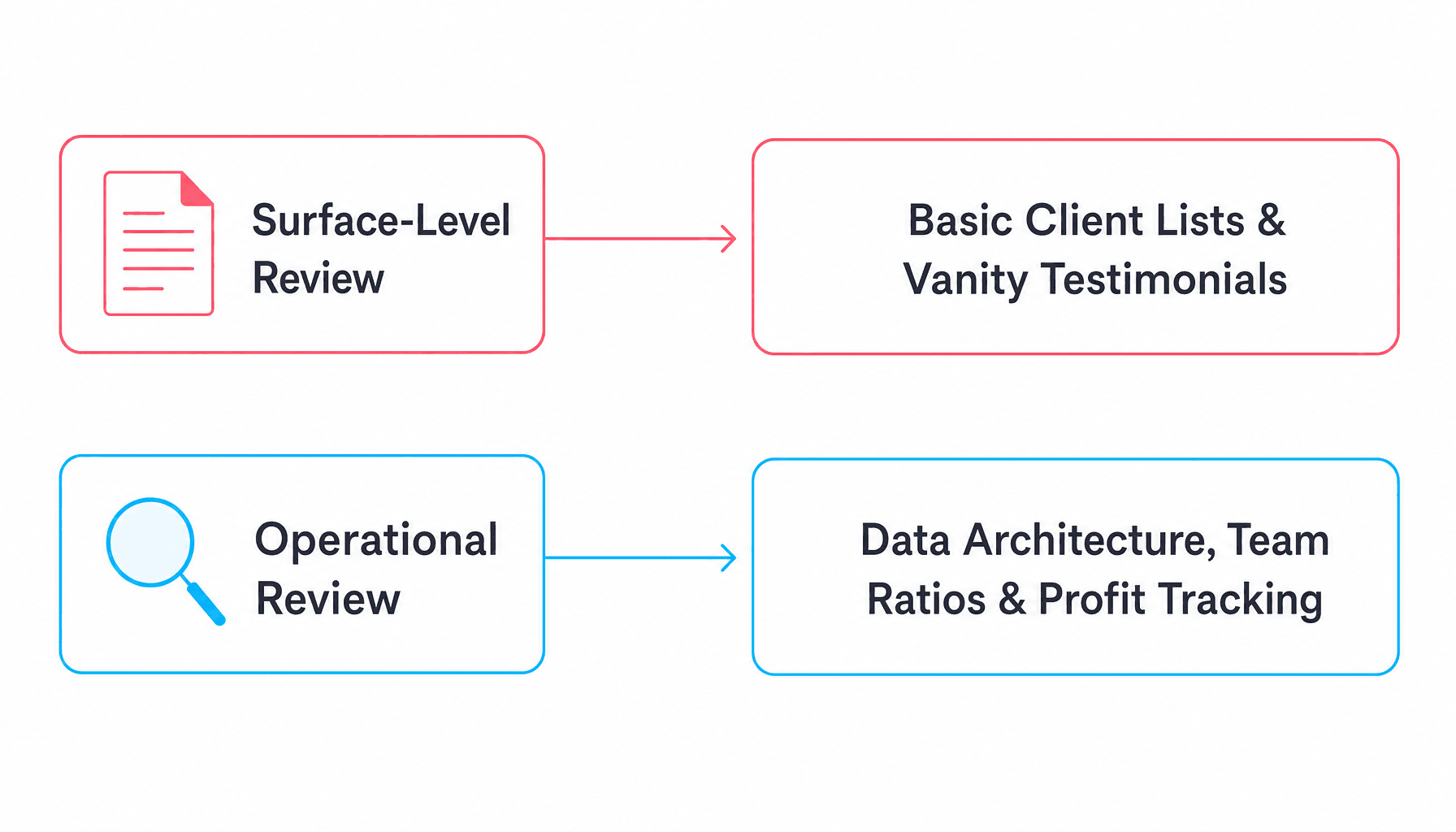
When interviewing prospective agencies, look closely at how they assign account ownership. If a provider routes your business to a junior account coordinator managing dozens of distinct brands, your store may only receive reactive maintenance.
A reliable partner will outline a clear account escalation path, present structured data frameworks for keyword tracking, and show a clear understanding of the relationship between ad spend, organic search placement, and inventory health. Avoid service groups that guarantee specific search rankings or attempt to lock your brand into long-term contracts that lack clear performance-based exit provisions.
Match the Agency Model to Your Situation
If you are still deciding whether to hire outside help at all, compare agency and in-house operating models first. Then name your main bottleneck: execution speed, advertising strategy, catalog health, creative production, supply chain forecasting, or international expansion. Common situations call for different strengths:
- Established brands stagnating in growth: A full-service agency audits historical data, finds untapped long-tail keywords, restructures bloated PPC campaigns, and uses Amazon DSP to recapture lost market share.
- Enterprise brands moving from Vendor (1P) to Seller (3P): The agency manages the logistical transition, sets up FBA, and helps the brand regain control over retail pricing.
- International sellers entering the US market: The agency localizes listings for US shoppers, manages US-based logistics, and adapts campaigns to the local advertising landscape.
- Startups launching flagship products: The first 90 days on Amazon matter. Agencies plan launch pricing, ad spend, and review velocity built through Amazon Vine and neutral review requests that stay within Amazon's terms of service.
13 Essential Questions to Ask Potential Amazon Agencies
To assess the technical capabilities and operational setup of a prospective partner, use this diagnostic framework during your evaluation meetings:
- What is the precise account-to-manager ratio for the team handling our day-to-day operations? (Look for partners where managers handle fewer, high-volume brands to ensure deeper focus. At an AI-native agency, also ask which work software does, which work senior staff do, and where people step in.)
- How does your media team track inventory health before scaling programmatic ad spend? (Ensure they have automated systems to lower ad spend on low-stock items.)
- Can you explain your methodology for separating organic brand demand from incremental growth? (A professional agency should use structured testing to show how ads generate new customers rather than just bidding on your own brand name.)
- What specific reports and API streams do your automated optimization systems pull from? (Confirm they use official, secure Selling Partner API integrations rather than basic web scraping.)
- How does your team handle unexpected listing suppressions or account health notifications on weekends? (Look for providers that use continuous monitoring tools to catch catalog issues before they cause extended downtime, and ask for their process for stranded inventory and intellectual property claims.)
- What is your target metrics focus: are your optimization models built around ACoS, or do they prioritize TACoS and contribution margin? (Prioritize partners that focus on total profitability rather than isolated ad efficiency metrics.)
- Who owns the creative assets, store designs, and A+ Content layouts built during the partnership? (Ensure your contracts state clearly that your brand retains full ownership of all intellectual property and design assets.)
- What technical data systems do you use to manage advanced advertising metrics through the Amazon Marketing Cloud? (Confirm they have the technical capability to build custom attribution models for full-funnel campaigns.)
- How often do active adjustments happen on our account? (If campaign optimizations, negative keyword harvesting, and Buy Box checks run on a weekly schedule, the account goes unmonitored for days at a time.)
- Can we see live dashboards and a time-stamped log of every bid change, listing edit, and budget shift? (Static monthly slide decks can hide underlying margin erosion.)
- What guardrails limit automated and manual changes on our account? (Look for maximum keyword bid caps, daily campaign budget limits, gross margin price floors, and approval queues for high-stakes changes.)
- Can you share a recent case study from our category? (An agency that does well in consumer electronics may struggle in a highly regulated category like supplements.)
- Do you build a custom strategy, or apply a standard template to every client? (Margin structures, supply chain constraints, and competition differ by brand, and the plan should reflect yours.)
Metrics to Hold Your Agency To
Gross sales alone can mislead when advertising costs erode margins. Alongside TACoS, track these measures:
- Conversion Rate (CVR): Whether split-tested main images, refined copy, and stronger A+ Content lift conversion over time.
- Inventory Sell-Through Rate: Whether marketing pushes line up with stock levels, so you are not paying long-term storage fees on stale products.
- New-to-Brand (NTB) Metrics: The share of orders from first-time buyers, which shows whether the agency is expanding your audience rather than retargeting existing customers.
Red Flags to Avoid When Hiring an Agency
- Opaque Reporting: The agency sends aggregated monthly PDF decks without giving you direct access to real-time dashboards or time-stamped action logs.
- Disconnected Ad Management: The ad team works apart from supply chain data and keeps running aggressive PPC campaigns on listings nearing an FBA stockout.
- Credential Sharing: The agency asks for your Seller Central master password rather than connecting through Amazon's official SP-API OAuth 2.0 authorization.
- No Safety Guardrails: The agency runs automated tools or manual scripts without gross margin price floors or maximum bid caps, exposing your account to accidental price drops or budget overruns.
- Fees That Reward Overspending: Aggressive percentage-of-ad-spend fees can encourage an agency to overspend your budget. Look for pricing aligned with total account profitability.
A Four-Step Selection Process
- Audit Your Internal Gaps: Confirm whether your main bottleneck is execution speed, creative production, advertising strategy, or supply chain forecasting before you shortlist agencies.
- Request Live System Demonstrations: Ask candidates to show their real-time monitoring, risk guardrails, and audit logging on a live or sandbox environment.
- Verify Security Protocols: Ensure the agency connects only through Amazon's official SP-API framework, with encrypted data handling that complies with Amazon's Data Protection Policy.
- Align Financial Incentives: Structure commercial terms around net profit expansion and TACoS compression rather than top-line sales alone. For a breakdown of fee models, see our guide to Amazon agency pricing in 2026.
Conclusion
The evolution of the Amazon marketplace has changed the standards for e-commerce service providers. Brands can no longer rely on simple advertising optimization or basic listing updates to stay competitive. Success requires partnering with organizations that understand Amazon as a fully integrated operating system—where retail media, supply chain management, compliance tracking, and technical data attribution directly influence one another. By choosing partners that offer transparent account management, advanced technical integrations, and operational models focused on total profitability, brands can protect their margins and scale securely across global marketplaces. If Lumian is on your shortlist, Book a Strategy Call.
Frequently Asked Questions
How do I choose the best Amazon agency for my brand?
Start with your main bottleneck, such as execution speed, advertising, catalog issues, creative, or international expansion, and shortlist agencies whose model fits it. Then check each candidate's track record in your category, ask how it handles both organic and paid growth, request a recent case study from a similar brand, and run every candidate through the same set of evaluation questions.
What are the benefits of working with an Amazon agency?
An agency saves internal time, gives you specialized expertise across advertising, listings, and account health, and helps reduce the risk of Amazon policy violations. It also brings tools and analysis that are difficult to replicate in-house, which helps your brand keep pace with marketplace and algorithm changes.
What is the main difference between an AI-native agency and a traditional full-service Amazon agency?
A traditional full-service agency relies on human account managers who often audit and adjust accounts once or twice a week. An AI-native agency uses AI agents to monitor account data continuously and prepare work such as bid changes, with approval settings deciding which changes wait for human sign-off. Dedicated human strategists own brand strategy, margin management, and governance.
How much does it cost to hire a full-service Amazon agency in 2026?
Traditional full-service agencies typically charge monthly retainers from $3,000 to $10,000+, often plus a percentage of ad spend. Hybrid AI-native agencies scope pricing to account complexity and sales volume, so ask for a current quote.
How do modern Amazon management agencies structure their service fees?
Most professional agencies use a fee structure that combines a fixed monthly base fee with a small percentage of gross marketplace sales or managed ad spend. This structure aligns the agency's goals with the brand's growth targets. Avoid fee structures that charge large upfront setup costs without clear operational milestones.
What is the difference between an account coordinator and a senior brand operator?
Account coordinators typically manage client onboarding, assemble standard performance reports, and route tasks to different departments, often handling up to twenty accounts simultaneously. A senior brand operator focuses on high-level growth strategy, manages capital allocation across ad networks, and works with fewer accounts to provide deeper operational focus.
How do automated operational agents assist human account managers?
Automated software agents handle routine, repetitive data tasks like scanning for listing suppressions, processing FBA inventory ledgers, and drafting basic customer service replies. This automation allows human managers to spend less time on administrative data entry and more time on high-level growth strategy and inventory planning.
How do I know if an agency actually uses AI or just claims to?
Ask for a live demonstration of three things: the real-time monitoring feed rather than a weekly report, a log of timestamped automated actions, and the approval queue where high-stakes changes wait for sign-off. If an agency cannot show these, ask which parts of the work are automated and which are done by hand.
Will hiring an Amazon agency require sharing my Seller Central password?
No. Reputable agencies connect through Amazon's official Selling Partner API (SP-API) using OAuth 2.0 authorization, granting scoped read and write access without exposing primary credentials or banking details.
Why is tracking TACoS more important than tracking standard ACoS?
ACoS tracks advertising efficiency in isolation by dividing ad spend by direct ad sales. TACoS measures total advertising cost of sale by dividing ad spend by your total revenue, including organic sales. Tracking TACoS provides a clearer picture of how your advertising campaigns influence your overall brand visibility and organic search growth.
Should an enterprise brand choose a specialized PPC vendor or a full-service agency?
If a brand already has internal teams handling logistics, customer service, and catalog compliance, a specialized media vendor can be an effective choice to optimize ad spend. However, if your team finds itself stretched across daily operations like tracking shipments, resolving listing issues, and managing compliance, a full-service partner is often better suited to manage the entire channel.

Co-Founder & CEO, Lumian