

Somewhere right now, a shopper is watching a creator demo a product on TikTok. She doesn't tap the yellow cart. She closes the app, opens Amazon and buys it where her Prime account, her saved card and her trust already live.
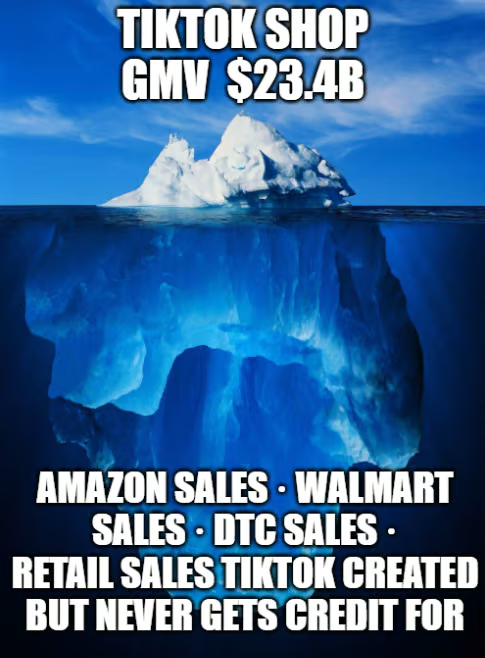
TikTok never gets credit for that sale. Neither does the dashboard you use to judge the channel.
Fenty Beauty ran an incrementality study and found that incremental sales generated outside TikTok Shop were roughly 6.7x its on-platform sales. Liquid I.V. found 62% of TikTok's incremental impact landed on Amazon.
This is the TikTok halo effect: the channel's biggest output is revenue it never reports. And it's happening at scale. TikTok Shop is projected to do $23.41 billion in U.S. sales in 2026, up 48%, which means the invisible halo around that number is far larger still.
TikTok understands this about itself. Its leverage is attention and not fulfillment.
When we at Lumian work with Amazon brands trying TikTok for the first time, the first thing we change is the question. Not "what's my Shop ROAS?" but "what did TikTok create across everything we sell, everywhere we sell it?" Where demand is created and where revenue is captured are now two different addresses.
The most important number about TikTok Shop is the one it will never report. The sales it sends everywhere else!
At Lumian, we help the fastest-growing Amazon brands find and scale their TikTok halo. Talk to our CEO to learn how we can help.
In this week’s issue:
Marketplace: Prime Air, Walmart Growth, YouTube x Amazon
Seller Central Updates: Account Transfer + Future Payouts
Marketplace Madness
What happened:
Amazon is massively expanding Prime Air, its drone delivery program, from a small handful of markets to nearly 500 US cities by the end of 2026. Drones can deliver items under 5 pounds in as fast as 30 minutes, free for Prime members on orders over $50. The service already runs in seven states, with 11 new cities launching soon and more states like Georgia, Ohio, and New York on deck.
Why it matters:
Walmart and Google's Wing are racing to build a competing network, so this is Amazon defending its speed advantage as much as extending it. If your products are small and light, 30-minute delivery could become a real conversion lever. Longer term, this raises the ceiling on what "fast delivery" means. There’s always a flip side to that, of course!
What happened:
Walmart posted a strong Q2 and raised its full-year guidance, with the standout numbers all pointing the same direction. US ecommerce grew 24%, marketplace sales jumped more than 50% and its ad business, Walmart Connect, grew 43% in the US. Nearly half of marketplace orders now flow through Walmart Fulfillment Services, its answer to FBA. Walmart also closed a $1.4 billion acquisition of streaming ad platform Vibe.co, folding it into Walmart Connect so advertisers can buy TV ads powered by Walmart's shopping data and its AI shopping assistant Sparky is driving 40% higher order values among users.
Why it matters:
Walmart is assembling the exact flywheel that made Amazon dominant – marketplace draws traffic, fulfillment makes delivery fast and ads monetize it all. Walmart is still much smaller than Amazon, but it's growing faster off that smaller base and early sellers who treat it as a real channel (with WFS enrollment, dedicated ad budget and Walmart-specific listings) are buying share while ad costs are still cheap relative to Amazon.
What happened:
YouTube announced that Amazon has joined its Shopping Affiliate Program. Eligible U.S. creators can now tag Amazon products in Shorts, long-form videos, and livestreams and YouTube's auto-tagging can even scan creators' recent uploads to identify and tag Amazon products automatically.
Why it matters:
TikTok proved that video creates demand that Amazon captures. And now YouTube and Amazon are wiring discovery directly to checkout instead of leaving that connection to chance. The brands that win will be the ones creators can easily find, demo and tag. If you don't have a YouTube creator motion yet, this is the signal to build one.
Seller Central Update of the Week
Amazon's updated seller agreement went live August 24. Two big changes:
You can't transfer your seller account to someone else without going through Amazon's official process.
You can't use future Amazon payouts as collateral for a loan.
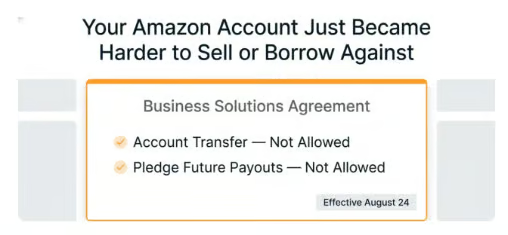
If you're selling your business, raising money or have a loan tied to your Amazon revenue, talk to your lawyer and lender this week. These rules are already in effect.
FREE!! Lumian Agents automates routine tasks like account health monitoring, sales tracking, reimbursement discrepancies, rating drop alerts, PPC monitoring, etc. You can also ask it anything about your Amazon business and get instant, context-aware answers and actions in seconds.
Meme Therapy
How did you like this week's newsletter?
Best,