How to Set Up Daily Amazon Account Health Alerts Before They Cost You Sales
Amazon flags account health issues in real time, but sellers see them days late. Set up SP-API webhook alerts for ODR, policy, and suppression events in 3 ways, from free to fully automated.

TL;DR
Amazon evaluates your account health continuously, but sellers only see problems when they log in — and native email alerts are inconsistent. Real-time protection means subscribing to Amazon's SP-API Notifications API (or a tool built on it) so ODR spikes, policy flags, and listing suppressions reach your team within minutes instead of days. Here are the thresholds that matter and three ways to set up alerts.
Key Takeaways
The Limits of Manual Checks: Checking Seller Central manually once a day introduces data lag, leaving listings vulnerable to policy flags and customer service defect spikes.
Critical Policy Thresholds: Amazon enforces strict contractual requirements, including an Order Defect Rate (ODR) below 1%, a Late Shipment Rate (LSR) below 4%, and a Pre-fulfillment Cancellation Rate below 2.5%.
SP-API Webhook Architecture: Real-time push notifications dispatch event payloads through Amazon's Notifications API, alerting teams to Account Health changes instantly.
Multi-Category Performance: Account Health spans four primary pillars: Customer Service Performance, Policy Compliance, Shipping Performance, and Business Customer Metrics.
Automated Governance: Combining real-time API monitoring with dedicated human brand management ensures policy warnings trigger instant ad throttling, catalog checks, and rapid appeal filing.
Why Waiting for Amazon's Account Health Warnings Is a Dangerous Strategy
Managing an enterprise catalog on Amazon requires maintaining high performance standards across logistics, customer service, and policy compliance. However, many brand leaders treat Account Health management as a reactive chore, logging into Seller Central periodically to review the Account Health dashboard.
Relying on manual log-ins creates significant operational vulnerability. Amazon's automated compliance systems evaluate account metrics and customer feedback continuously around the clock. A sudden surge in carrier shipping delays, a burst of negative feedback on a single order batch, or an automated intellectual property flag can degrade your account standing in hours.
When performance metrics drop below required thresholds or unaddressed policy violations accumulate, Amazon restricts account privileges. Listings lose Buy Box eligibility, active ad campaigns experience reduced placement priority, and severe breaches can result in account deactivation. Implementing an automated, daily alerting infrastructure is essential for protecting sales volume and preserving long-term brand equity.
The 4 Core Account Health Pillars That Require Daily Monitoring
Amazon organizes performance evaluation under four distinct operational pillars. To maintain a healthy Account Health Rating (AHR), brand teams must monitor specific metric limits across each category.
1. Customer Service Performance (Order Defect Rate)
The Order Defect Rate (ODR) measures a seller's ability to deliver a positive shopping experience over a rolling 60-day evaluation window. ODR covers three specific customer friction points:
Negative customer feedback percentage
Granted A-to-z Guarantee claims
Credit card chargeback claims
Amazon's seller performance policy requires an Order Defect Rate below 1%. Exceeding 1% ODR can trigger immediate restrictions on seller-fulfilled offers and Buy Box eligibility.
2. Shipping Performance (Seller-Fulfilled Operations)
For brands fulfilling orders directly via Merchant Fulfilled (FBM) channels, shipping metrics reflect delivery reliability:
Late Shipment Rate (LSR): Must remain below 4% over 10-day and 30-day evaluation windows.
Pre-fulfillment Cancellation Rate: Must remain below 2.5% over a rolling 7-day period.
Valid Tracking Rate (VTR): Must remain above 95% across all active product categories.
3. Policy Compliance and Account Health Rating (AHR)
Amazon summarizes policy adherence through the Account Health Rating (AHR), a numerical score ranging from 0 to 1,000. An AHR score of 200 to 1,000 indicates a healthy account standing. Scores between 100 and 199 represent an "At Risk" warning state, while scores below 99 make the account eligible for immediate deactivation.
Policy compliance flags cover several critical operational areas:
Intellectual Property (IP) infringement claims
Product authenticity and condition complaints
Restricted product policy violations
Listing text and main image compliance flags
4. Business Customer Performance
For accounts selling to B2B buyers on Amazon Business, maintaining an Invoice Defect Rate (IDR) below 5% is contractual. IDR tracks orders where tax invoices are not uploaded within one business day following shipment confirmation.
How to Set Up Account Health Alerts (3 Ways)
1. Native: In Seller Central, verify notification preferences under Settings > Notification Preferences, confirm the emails on file reach a monitored inbox, enable the Account Health mobile app notifications, and bookmark the Account Health dashboard for a daily check cadence. Honest limitation: coverage is inconsistent and some flags surface only on the dashboard.
2. Monitoring tool: connect via SP-API OAuth; tools subscribe to the Notifications API and push to Slack/email within minutes.
3. Integrated agent (Lumian Agents): same detection plus automated circuit breakers: ad throttling, offer pausing, appeal-draft prep.
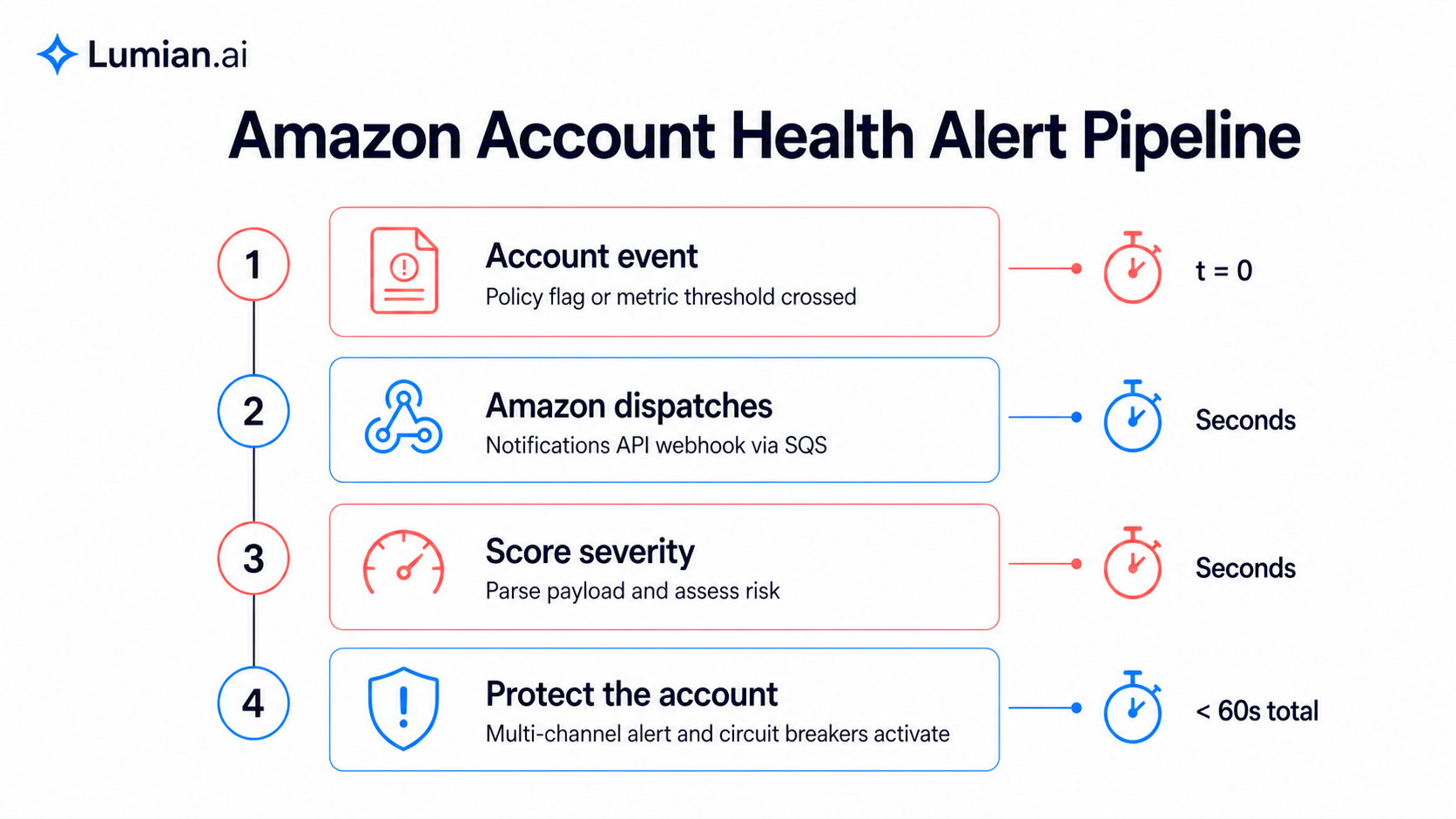
The Mechanism: SP-API Notifications and Webhooks
Rather than sending periodic GET requests to query account state (polling), modern e-commerce monitoring platforms subscribe to Amazon's Notifications API. When a policy warning is recorded or a metric threshold changes, Amazon dispatches an event payload through Webhooks or Amazon Simple Queue Service (SQS) in near real-time.
An automated ingestion engine parses the incoming payload to evaluate event severity:
Low Severity: Minor listing text flags that require simple flat-file updates.
Medium Severity: VTR or Late Shipment Rate increases approaching policy ceilings.
Critical Severity: AHR drops below 200, severe IP complaints, or immediate listing suppressions on top-selling SKUs.
By deploying the Lumian Agent platform, your brand connects account data feeds directly to automated monitoring networks, eliminating manual reporting data lag.
Comparing Account Health Monitoring Approaches
Selecting an account governance model depends on catalog size, fulfillment channels, and internal operational resources.
Monitoring Strategy | Detection Speed | Risk Protection | Actionability | Internal Overhead |
Manual Seller Central Checks | 24 - 48 Hours | Low (Delayed visibility) | Manual review required | High daily manual effort |
Standard Native Emails | 2 - 12 Hours | Moderate (Basic notifications) | Requires internal escalation | Moderate team effort |
Integrated AI Governance | Real-Time (< 60s) | High (Automated safeguards) | Automated circuit breakers & alerts | Minimal (review escalation queues) |
From Alerts to Remediation: Automating Account Protection
Receiving an instant alert is only half the solution. Preventing sales loss requires deploying automated safeguards the moment an Account Health event occurs.
When an Account Health warning is detected, an integrated platform like Lumian Features executes automated operational circuit breakers:
Automated PPC Ad Throttling: If a listing receives a compliance flag or loses Buy Box eligibility due to metric drops, active ad campaigns on that ASIN pause automatically, preserving ad budget.
Inventory Protection: If shipping metrics approach policy limits, seller-fulfilled offers pause temporarily to prevent further late shipments while pending orders clear.
Integrated Case Escalation: For catalog suppressions or false IP claims, automated tools gather transaction logs, product photos, and supplier invoices, queuing an appeal draft for human strategist review.
Combining automated execution speed with expert human governance across Lumian Amazon Services allows brands to maintain compliant account health without diverting internal focus from business expansion. Reviewing documented brand outcomes in Lumian Case Studies demonstrates how proactive governance protects marketplace revenue.
Best Practices for Long-Term Account Health Maintenance
To ensure your Amazon business remains resilient against policy shifts and performance fluctuations, adopt three foundational practices:
Conduct Weekly Audit Sweeps: Review policy compliance logs and customer feedback weekly to address minor warnings before they compound.
Maintain Strict Supplier Documentation: Store commercial invoices, authorization letters, and quality control certificates in accessible digital repositories for rapid appeal submission.
Establish Clear Escalation Queues: Assign specific team members or agency partners to handle Tier 3 account alerts within defined timeframes.
To learn how an automated hybrid management model can protect your account standing and streamline daily operations, explore resources on Lumian Amazon Growth Insights or schedule a strategy consultation.
Frequently Asked Questions
How quickly does Amazon notify sellers of an Account Health policy violation?
Amazon updates Account Health dashboard metrics in near real-time. When connected via SP-API notification webhooks, automated monitoring systems receive event payloads within minutes of a violation being recorded.
What is a safe Account Health Rating (AHR) score on Amazon?
An Account Health Rating (AHR) score of 200 or above is classified as Healthy by Amazon. Scores between 100 and 199 represent an At Risk state requiring immediate attention, while scores below 99 make the account eligible for deactivation.
Can an Account Health policy violation cause an immediate listing suppression?
Yes. High-severity policy violations - such as restricted product claims, safety concerns, or copyright infringement flags - can cause Amazon to suppress product listings immediately, regardless of your overall AHR score.
Will setting up real-time SP-API health alerts require sharing Seller Central passwords?
No. Secure monitoring platforms connect through Amazon's official Selling Partner API (SP-API) using OAuth 2.0 authorization, granting scoped read access without exposing primary account credentials or banking information.
How do human strategists assist when an Account Health alert fires?
In a hybrid agency model, automated systems handle instant alert detection and ad throttling, while dedicated human strategists draft formal Plans of Action (POAs), compile supplier invoices, and manage case escalations with Amazon support.
Does Amazon email me when my Account Health Rating drops?
Sometimes, but not reliably for every event. Amazon sends performance notifications for some violations, yet metric drift (a rising ODR trend, a falling VTR) and certain flags surface only on the Account Health dashboard. That gap between when Amazon records an issue and when you'd naturally see it is what real-time SP-API alerting closes.
Co-Founder & CEO, Lumian
Robin Lobo is Co-Founder and CEO of Lumian. He built and sold a seven-figure eyeglasses brand on Amazon and spent several years on the client side of traditional agencies before founding Lumian, an AI-native Amazon agency backed by $3M led by Bowery Capital.

AI Agent
Your Amazon business, fully managed.

Brand ManAger

Expert Team
How to Set Up Daily Amazon Account Health Alerts Before They Cost You Sales
Amazon flags account health issues in real time, but sellers see them days late. Set up SP-API webhook alerts for ODR, policy, and suppression events in 3 ways, from free to fully automated.
TL;DR
Amazon evaluates your account health continuously, but sellers only see problems when they log in — and native email alerts are inconsistent. Real-time protection means subscribing to Amazon's SP-API Notifications API (or a tool built on it) so ODR spikes, policy flags, and listing suppressions reach your team within minutes instead of days. Here are the thresholds that matter and three ways to set up alerts.
Key Takeaways
The Limits of Manual Checks: Checking Seller Central manually once a day introduces data lag, leaving listings vulnerable to policy flags and customer service defect spikes.
Critical Policy Thresholds: Amazon enforces strict contractual requirements, including an Order Defect Rate (ODR) below 1%, a Late Shipment Rate (LSR) below 4%, and a Pre-fulfillment Cancellation Rate below 2.5%.
SP-API Webhook Architecture: Real-time push notifications dispatch event payloads through Amazon's Notifications API, alerting teams to Account Health changes instantly.
Multi-Category Performance: Account Health spans four primary pillars: Customer Service Performance, Policy Compliance, Shipping Performance, and Business Customer Metrics.
Automated Governance: Combining real-time API monitoring with dedicated human brand management ensures policy warnings trigger instant ad throttling, catalog checks, and rapid appeal filing.
Why Waiting for Amazon's Account Health Warnings Is a Dangerous Strategy
Managing an enterprise catalog on Amazon requires maintaining high performance standards across logistics, customer service, and policy compliance. However, many brand leaders treat Account Health management as a reactive chore, logging into Seller Central periodically to review the Account Health dashboard.
Relying on manual log-ins creates significant operational vulnerability. Amazon's automated compliance systems evaluate account metrics and customer feedback continuously around the clock. A sudden surge in carrier shipping delays, a burst of negative feedback on a single order batch, or an automated intellectual property flag can degrade your account standing in hours.
When performance metrics drop below required thresholds or unaddressed policy violations accumulate, Amazon restricts account privileges. Listings lose Buy Box eligibility, active ad campaigns experience reduced placement priority, and severe breaches can result in account deactivation. Implementing an automated, daily alerting infrastructure is essential for protecting sales volume and preserving long-term brand equity.
The 4 Core Account Health Pillars That Require Daily Monitoring
Amazon organizes performance evaluation under four distinct operational pillars. To maintain a healthy Account Health Rating (AHR), brand teams must monitor specific metric limits across each category.
1. Customer Service Performance (Order Defect Rate)
The Order Defect Rate (ODR) measures a seller's ability to deliver a positive shopping experience over a rolling 60-day evaluation window. ODR covers three specific customer friction points:
Negative customer feedback percentage
Granted A-to-z Guarantee claims
Credit card chargeback claims
Amazon's seller performance policy requires an Order Defect Rate below 1%. Exceeding 1% ODR can trigger immediate restrictions on seller-fulfilled offers and Buy Box eligibility.
2. Shipping Performance (Seller-Fulfilled Operations)
For brands fulfilling orders directly via Merchant Fulfilled (FBM) channels, shipping metrics reflect delivery reliability:
Late Shipment Rate (LSR): Must remain below 4% over 10-day and 30-day evaluation windows.
Pre-fulfillment Cancellation Rate: Must remain below 2.5% over a rolling 7-day period.
Valid Tracking Rate (VTR): Must remain above 95% across all active product categories.
3. Policy Compliance and Account Health Rating (AHR)
Amazon summarizes policy adherence through the Account Health Rating (AHR), a numerical score ranging from 0 to 1,000. An AHR score of 200 to 1,000 indicates a healthy account standing. Scores between 100 and 199 represent an "At Risk" warning state, while scores below 99 make the account eligible for immediate deactivation.
Policy compliance flags cover several critical operational areas:
Intellectual Property (IP) infringement claims
Product authenticity and condition complaints
Restricted product policy violations
Listing text and main image compliance flags
4. Business Customer Performance
For accounts selling to B2B buyers on Amazon Business, maintaining an Invoice Defect Rate (IDR) below 5% is contractual. IDR tracks orders where tax invoices are not uploaded within one business day following shipment confirmation.
How to Set Up Account Health Alerts (3 Ways)
1. Native: In Seller Central, verify notification preferences under Settings > Notification Preferences, confirm the emails on file reach a monitored inbox, enable the Account Health mobile app notifications, and bookmark the Account Health dashboard for a daily check cadence. Honest limitation: coverage is inconsistent and some flags surface only on the dashboard.
2. Monitoring tool: connect via SP-API OAuth; tools subscribe to the Notifications API and push to Slack/email within minutes.
3. Integrated agent (Lumian Agents): same detection plus automated circuit breakers: ad throttling, offer pausing, appeal-draft prep.
The Mechanism: SP-API Notifications and Webhooks
Rather than sending periodic GET requests to query account state (polling), modern e-commerce monitoring platforms subscribe to Amazon's Notifications API. When a policy warning is recorded or a metric threshold changes, Amazon dispatches an event payload through Webhooks or Amazon Simple Queue Service (SQS) in near real-time.
An automated ingestion engine parses the incoming payload to evaluate event severity:
Low Severity: Minor listing text flags that require simple flat-file updates.
Medium Severity: VTR or Late Shipment Rate increases approaching policy ceilings.
Critical Severity: AHR drops below 200, severe IP complaints, or immediate listing suppressions on top-selling SKUs.
By deploying the Lumian Agent platform, your brand connects account data feeds directly to automated monitoring networks, eliminating manual reporting data lag.
Comparing Account Health Monitoring Approaches
Selecting an account governance model depends on catalog size, fulfillment channels, and internal operational resources.
Monitoring Strategy | Detection Speed | Risk Protection | Actionability | Internal Overhead |
Manual Seller Central Checks | 24 - 48 Hours | Low (Delayed visibility) | Manual review required | High daily manual effort |
Standard Native Emails | 2 - 12 Hours | Moderate (Basic notifications) | Requires internal escalation | Moderate team effort |
Integrated AI Governance | Real-Time (< 60s) | High (Automated safeguards) | Automated circuit breakers & alerts | Minimal (review escalation queues) |
From Alerts to Remediation: Automating Account Protection
Receiving an instant alert is only half the solution. Preventing sales loss requires deploying automated safeguards the moment an Account Health event occurs.
When an Account Health warning is detected, an integrated platform like Lumian Features executes automated operational circuit breakers:
Automated PPC Ad Throttling: If a listing receives a compliance flag or loses Buy Box eligibility due to metric drops, active ad campaigns on that ASIN pause automatically, preserving ad budget.
Inventory Protection: If shipping metrics approach policy limits, seller-fulfilled offers pause temporarily to prevent further late shipments while pending orders clear.
Integrated Case Escalation: For catalog suppressions or false IP claims, automated tools gather transaction logs, product photos, and supplier invoices, queuing an appeal draft for human strategist review.
Combining automated execution speed with expert human governance across Lumian Amazon Services allows brands to maintain compliant account health without diverting internal focus from business expansion. Reviewing documented brand outcomes in Lumian Case Studies demonstrates how proactive governance protects marketplace revenue.
Best Practices for Long-Term Account Health Maintenance
To ensure your Amazon business remains resilient against policy shifts and performance fluctuations, adopt three foundational practices:
Conduct Weekly Audit Sweeps: Review policy compliance logs and customer feedback weekly to address minor warnings before they compound.
Maintain Strict Supplier Documentation: Store commercial invoices, authorization letters, and quality control certificates in accessible digital repositories for rapid appeal submission.
Establish Clear Escalation Queues: Assign specific team members or agency partners to handle Tier 3 account alerts within defined timeframes.
To learn how an automated hybrid management model can protect your account standing and streamline daily operations, explore resources on Lumian Amazon Growth Insights or schedule a strategy consultation.
Frequently Asked Questions
How quickly does Amazon notify sellers of an Account Health policy violation?
Amazon updates Account Health dashboard metrics in near real-time. When connected via SP-API notification webhooks, automated monitoring systems receive event payloads within minutes of a violation being recorded.
What is a safe Account Health Rating (AHR) score on Amazon?
An Account Health Rating (AHR) score of 200 or above is classified as Healthy by Amazon. Scores between 100 and 199 represent an At Risk state requiring immediate attention, while scores below 99 make the account eligible for deactivation.
Can an Account Health policy violation cause an immediate listing suppression?
Yes. High-severity policy violations - such as restricted product claims, safety concerns, or copyright infringement flags - can cause Amazon to suppress product listings immediately, regardless of your overall AHR score.
Will setting up real-time SP-API health alerts require sharing Seller Central passwords?
No. Secure monitoring platforms connect through Amazon's official Selling Partner API (SP-API) using OAuth 2.0 authorization, granting scoped read access without exposing primary account credentials or banking information.
How do human strategists assist when an Account Health alert fires?
In a hybrid agency model, automated systems handle instant alert detection and ad throttling, while dedicated human strategists draft formal Plans of Action (POAs), compile supplier invoices, and manage case escalations with Amazon support.
Does Amazon email me when my Account Health Rating drops?
Sometimes, but not reliably for every event. Amazon sends performance notifications for some violations, yet metric drift (a rising ODR trend, a falling VTR) and certain flags surface only on the Account Health dashboard. That gap between when Amazon records an issue and when you'd naturally see it is what real-time SP-API alerting closes.
Co-Founder & CEO, Lumian
Robin Lobo is Co-Founder and CEO of Lumian. He built and sold a seven-figure eyeglasses brand on Amazon and spent several years on the client side of traditional agencies before founding Lumian, an AI-native Amazon agency backed by $3M led by Bowery Capital.
AI Agent
Your Amazon business, fully managed.
Brand ManAger
Expert Team
How to Set Up Daily Amazon Account Health Alerts Before They Cost You Sales
Amazon flags account health issues in real time, but sellers see them days late. Set up SP-API webhook alerts for ODR, policy, and suppression events in 3 ways, from free to fully automated.
TL;DR
Amazon evaluates your account health continuously, but sellers only see problems when they log in — and native email alerts are inconsistent. Real-time protection means subscribing to Amazon's SP-API Notifications API (or a tool built on it) so ODR spikes, policy flags, and listing suppressions reach your team within minutes instead of days. Here are the thresholds that matter and three ways to set up alerts.
Key Takeaways
The Limits of Manual Checks: Checking Seller Central manually once a day introduces data lag, leaving listings vulnerable to policy flags and customer service defect spikes.
Critical Policy Thresholds: Amazon enforces strict contractual requirements, including an Order Defect Rate (ODR) below 1%, a Late Shipment Rate (LSR) below 4%, and a Pre-fulfillment Cancellation Rate below 2.5%.
SP-API Webhook Architecture: Real-time push notifications dispatch event payloads through Amazon's Notifications API, alerting teams to Account Health changes instantly.
Multi-Category Performance: Account Health spans four primary pillars: Customer Service Performance, Policy Compliance, Shipping Performance, and Business Customer Metrics.
Automated Governance: Combining real-time API monitoring with dedicated human brand management ensures policy warnings trigger instant ad throttling, catalog checks, and rapid appeal filing.
Why Waiting for Amazon's Account Health Warnings Is a Dangerous Strategy
Managing an enterprise catalog on Amazon requires maintaining high performance standards across logistics, customer service, and policy compliance. However, many brand leaders treat Account Health management as a reactive chore, logging into Seller Central periodically to review the Account Health dashboard.
Relying on manual log-ins creates significant operational vulnerability. Amazon's automated compliance systems evaluate account metrics and customer feedback continuously around the clock. A sudden surge in carrier shipping delays, a burst of negative feedback on a single order batch, or an automated intellectual property flag can degrade your account standing in hours.
When performance metrics drop below required thresholds or unaddressed policy violations accumulate, Amazon restricts account privileges. Listings lose Buy Box eligibility, active ad campaigns experience reduced placement priority, and severe breaches can result in account deactivation. Implementing an automated, daily alerting infrastructure is essential for protecting sales volume and preserving long-term brand equity.
The 4 Core Account Health Pillars That Require Daily Monitoring
Amazon organizes performance evaluation under four distinct operational pillars. To maintain a healthy Account Health Rating (AHR), brand teams must monitor specific metric limits across each category.
1. Customer Service Performance (Order Defect Rate)
The Order Defect Rate (ODR) measures a seller's ability to deliver a positive shopping experience over a rolling 60-day evaluation window. ODR covers three specific customer friction points:
Negative customer feedback percentage
Granted A-to-z Guarantee claims
Credit card chargeback claims
Amazon's seller performance policy requires an Order Defect Rate below 1%. Exceeding 1% ODR can trigger immediate restrictions on seller-fulfilled offers and Buy Box eligibility.
2. Shipping Performance (Seller-Fulfilled Operations)
For brands fulfilling orders directly via Merchant Fulfilled (FBM) channels, shipping metrics reflect delivery reliability:
Late Shipment Rate (LSR): Must remain below 4% over 10-day and 30-day evaluation windows.
Pre-fulfillment Cancellation Rate: Must remain below 2.5% over a rolling 7-day period.
Valid Tracking Rate (VTR): Must remain above 95% across all active product categories.
3. Policy Compliance and Account Health Rating (AHR)
Amazon summarizes policy adherence through the Account Health Rating (AHR), a numerical score ranging from 0 to 1,000. An AHR score of 200 to 1,000 indicates a healthy account standing. Scores between 100 and 199 represent an "At Risk" warning state, while scores below 99 make the account eligible for immediate deactivation.
Policy compliance flags cover several critical operational areas:
Intellectual Property (IP) infringement claims
Product authenticity and condition complaints
Restricted product policy violations
Listing text and main image compliance flags
4. Business Customer Performance
For accounts selling to B2B buyers on Amazon Business, maintaining an Invoice Defect Rate (IDR) below 5% is contractual. IDR tracks orders where tax invoices are not uploaded within one business day following shipment confirmation.
How to Set Up Account Health Alerts (3 Ways)
1. Native: In Seller Central, verify notification preferences under Settings > Notification Preferences, confirm the emails on file reach a monitored inbox, enable the Account Health mobile app notifications, and bookmark the Account Health dashboard for a daily check cadence. Honest limitation: coverage is inconsistent and some flags surface only on the dashboard.
2. Monitoring tool: connect via SP-API OAuth; tools subscribe to the Notifications API and push to Slack/email within minutes.
3. Integrated agent (Lumian Agents): same detection plus automated circuit breakers: ad throttling, offer pausing, appeal-draft prep.
The Mechanism: SP-API Notifications and Webhooks
Rather than sending periodic GET requests to query account state (polling), modern e-commerce monitoring platforms subscribe to Amazon's Notifications API. When a policy warning is recorded or a metric threshold changes, Amazon dispatches an event payload through Webhooks or Amazon Simple Queue Service (SQS) in near real-time.
An automated ingestion engine parses the incoming payload to evaluate event severity:
Low Severity: Minor listing text flags that require simple flat-file updates.
Medium Severity: VTR or Late Shipment Rate increases approaching policy ceilings.
Critical Severity: AHR drops below 200, severe IP complaints, or immediate listing suppressions on top-selling SKUs.
By deploying the Lumian Agent platform, your brand connects account data feeds directly to automated monitoring networks, eliminating manual reporting data lag.
Comparing Account Health Monitoring Approaches
Selecting an account governance model depends on catalog size, fulfillment channels, and internal operational resources.
Monitoring Strategy | Detection Speed | Risk Protection | Actionability | Internal Overhead |
Manual Seller Central Checks | 24 - 48 Hours | Low (Delayed visibility) | Manual review required | High daily manual effort |
Standard Native Emails | 2 - 12 Hours | Moderate (Basic notifications) | Requires internal escalation | Moderate team effort |
Integrated AI Governance | Real-Time (< 60s) | High (Automated safeguards) | Automated circuit breakers & alerts | Minimal (review escalation queues) |
From Alerts to Remediation: Automating Account Protection
Receiving an instant alert is only half the solution. Preventing sales loss requires deploying automated safeguards the moment an Account Health event occurs.
When an Account Health warning is detected, an integrated platform like Lumian Features executes automated operational circuit breakers:
Automated PPC Ad Throttling: If a listing receives a compliance flag or loses Buy Box eligibility due to metric drops, active ad campaigns on that ASIN pause automatically, preserving ad budget.
Inventory Protection: If shipping metrics approach policy limits, seller-fulfilled offers pause temporarily to prevent further late shipments while pending orders clear.
Integrated Case Escalation: For catalog suppressions or false IP claims, automated tools gather transaction logs, product photos, and supplier invoices, queuing an appeal draft for human strategist review.
Combining automated execution speed with expert human governance across Lumian Amazon Services allows brands to maintain compliant account health without diverting internal focus from business expansion. Reviewing documented brand outcomes in Lumian Case Studies demonstrates how proactive governance protects marketplace revenue.
Best Practices for Long-Term Account Health Maintenance
To ensure your Amazon business remains resilient against policy shifts and performance fluctuations, adopt three foundational practices:
Conduct Weekly Audit Sweeps: Review policy compliance logs and customer feedback weekly to address minor warnings before they compound.
Maintain Strict Supplier Documentation: Store commercial invoices, authorization letters, and quality control certificates in accessible digital repositories for rapid appeal submission.
Establish Clear Escalation Queues: Assign specific team members or agency partners to handle Tier 3 account alerts within defined timeframes.
To learn how an automated hybrid management model can protect your account standing and streamline daily operations, explore resources on Lumian Amazon Growth Insights or schedule a strategy consultation.
Frequently Asked Questions
How quickly does Amazon notify sellers of an Account Health policy violation?
Amazon updates Account Health dashboard metrics in near real-time. When connected via SP-API notification webhooks, automated monitoring systems receive event payloads within minutes of a violation being recorded.
What is a safe Account Health Rating (AHR) score on Amazon?
An Account Health Rating (AHR) score of 200 or above is classified as Healthy by Amazon. Scores between 100 and 199 represent an At Risk state requiring immediate attention, while scores below 99 make the account eligible for deactivation.
Can an Account Health policy violation cause an immediate listing suppression?
Yes. High-severity policy violations - such as restricted product claims, safety concerns, or copyright infringement flags - can cause Amazon to suppress product listings immediately, regardless of your overall AHR score.
Will setting up real-time SP-API health alerts require sharing Seller Central passwords?
No. Secure monitoring platforms connect through Amazon's official Selling Partner API (SP-API) using OAuth 2.0 authorization, granting scoped read access without exposing primary account credentials or banking information.
How do human strategists assist when an Account Health alert fires?
In a hybrid agency model, automated systems handle instant alert detection and ad throttling, while dedicated human strategists draft formal Plans of Action (POAs), compile supplier invoices, and manage case escalations with Amazon support.
Does Amazon email me when my Account Health Rating drops?
Sometimes, but not reliably for every event. Amazon sends performance notifications for some violations, yet metric drift (a rising ODR trend, a falling VTR) and certain flags surface only on the Account Health dashboard. That gap between when Amazon records an issue and when you'd naturally see it is what real-time SP-API alerting closes.
Co-Founder & CEO, Lumian
Robin Lobo is Co-Founder and CEO of Lumian. He built and sold a seven-figure eyeglasses brand on Amazon and spent several years on the client side of traditional agencies before founding Lumian, an AI-native Amazon agency backed by $3M led by Bowery Capital.

AI Agent
Your Amazon business, fully managed.
Brand ManAger
Expert Team