What Is an Amazon AI Agent? How It Works vs. Dashboards
An Amazon AI agent connects to Seller Central via SP-API to monitor and act on your account autonomously. Learn how it works, plus 4 ways to spot a real one vs. a dashboard.

TL;DR
An Amazon AI agent is autonomous software that connects to Seller Central via Amazon's Selling Partner API (SP-API), monitors live account data, and executes tasks like bid changes, listing fixes, and reimbursement claims without waiting for a human to pull a report. Below: how the architecture works, and four tests that separate real agents from rebranded dashboards.
Key Takeaways
Action Over Analytics: Dashboards require humans to spot trends and make changes. AI agents perceive live account events and execute corrective or growth-oriented actions directly.
Context-Aware Reasoning: Unlike rigid rule-based PPC software, an AI agent evaluates cross-functional data (such as syncing PPC bid acceleration with warehouse days-of-cover to prevent stockouts).
Agentic Skills Framework: True agents utilize discrete, task-oriented skills - like listing suppression fixes, FBA fee audit disputes, and search term mining - that run autonomously or via conversational prompts.
Human-in-the-Loop Safety: Real enterprise agents operate within bounded parameter guardrails, providing transparent audit logs and approval-gated escalation tiers.
Why Are Amazon Sellers Moving From Dashboards to AI Agents?
For over a decade, Amazon sellers and brand managers have relied on software tools built around a passive paradigm: data visualization. You log into a software portal, review graphs representing sales volume, click-through rates, or Advertising Cost of Sales (ACoS), and manually interpret what went wrong. Once a decision is made, you log into Amazon Seller Central or open a third-party campaign manager to make the adjustments yourself.
As catalog complexity expands and marketplace competition intensifies, manual execution creates significant operational friction. Across the accounts Lumian manages, agents flag stockout risk an average of 45 days before inventory hits zero and reimbursement audits recover 3% of GMV per account per year. This operational shift has introduced the term "Amazon AI Agent" into the e-commerce vocabulary. However, because "AI" has become a ubiquitous marketing term, many software vendors have simply rebranded traditional reporting dashboards or basic rule-based repricers as "AI agents." Understanding what true agentic architecture achieves is essential for brand leaders evaluating their operational technology stack.
What Is an Amazon AI Agent?
An Amazon AI agent is software that perceives account state, reasons about it and takes goal-directed action via API integrations with minimal human intervention. Rather than waiting for a user to pull a report, an AI agent acts as a digital team member. It continuously monitors live data streams from Amazon Seller Central (including advertising performance, inventory days-of-cover, catalog compliance flags, and buyer communications) and executes multi-step operational workflows to achieve specific business goals.
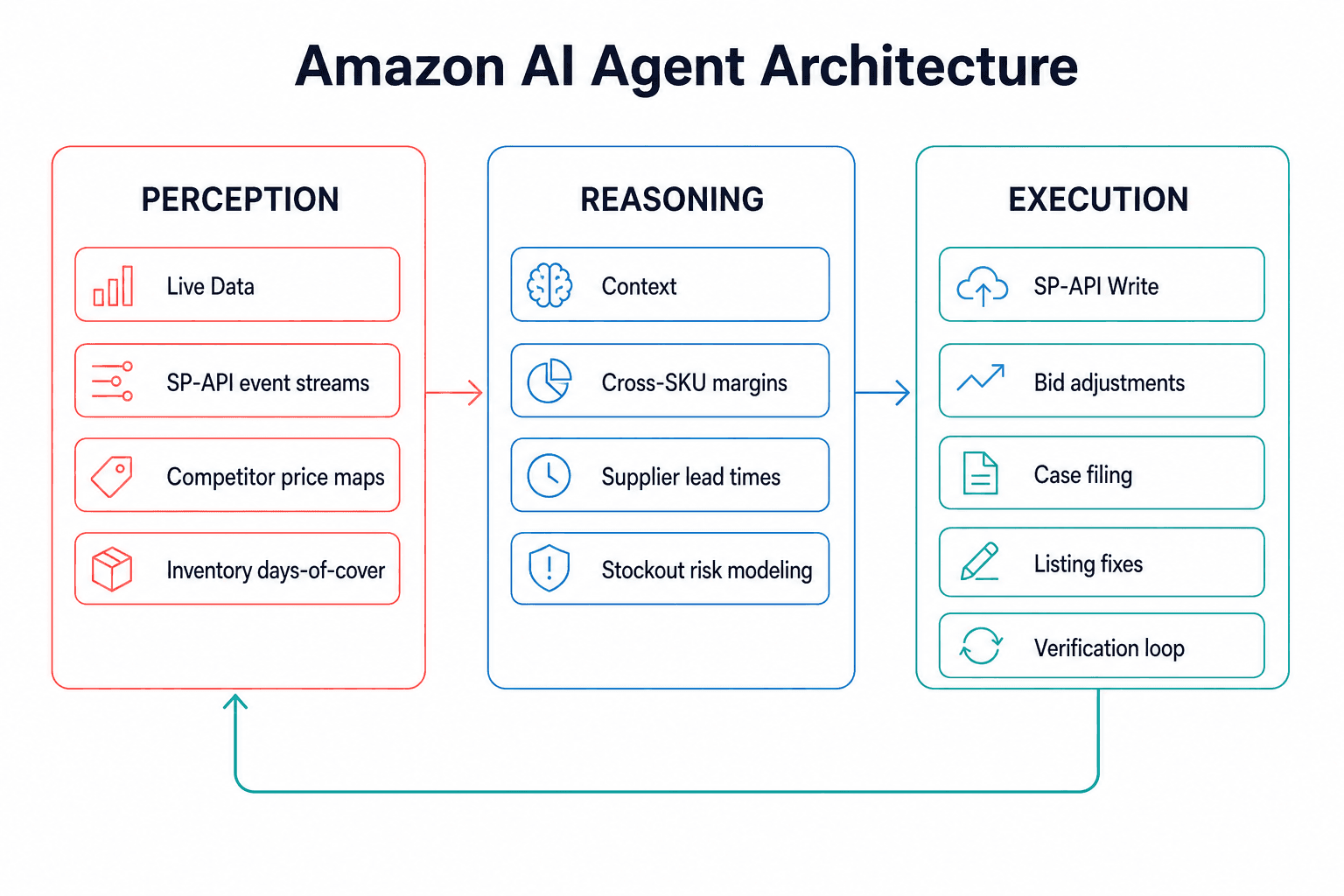
Create a horizontal 3-panel diagram (SVG or PNG, min 1200px wide, brand colors):
Panel 1 PERCEPTION (Live Data)
SP-API event streams
Competitor price maps
Inventory days-of-cover
Panel 2 REASONING (Context)
Cross-SKU margins
Supplier lead times
Stockout risk modeling
Panel 3 EXECUTION (SP-API Write)
Bid adjustments
Case filing
Listing fixes
Arrows: Perception → Reasoning → Execution, with a return arrow
from Execution back to Perception labeled "Verification loop"
File name: amazon-ai-agent-architecture-diagram.png
Alt text: "Diagram of Amazon AI agent architecture showing the perception, reasoning, and execution loop connected to Seller Central via SP-API"
Caption (below image): "An Amazon AI agent runs a continuous perception-reasoning-execution loop through Amazon's Selling Partner API."
Lumian Agents connects directly via Amazon's Selling Partner API (SP-API). It handles routine daily monitoring, flags critical anomalies, builds purchase orders, and optimizes advertising campaigns in real time.
How an Amazon AI Agent Works: The Perception-Reasoning-Action Loop
Unlike traditional software that follows rigid "if-this-then-that" rules, a real AI agent operates through a continuous cognitive loop composed of three fundamental stages:
1. Continuous Perception
The agent continuously ingests raw account data streams via official API connections. It monitors changes in organic keyword rank, Buy Box percentage, competitor pricing shifts, FBA receiving discrepancies, and detail page attributes.
2. Context-Aware Reasoning
When an event is detected, the agent evaluates the situation against broader account context rather than isolated metrics. For instance, if a top-selling SKU experiences a rapid surge in sales velocity, a traditional PPC tool might automatically raise advertising bids to maximize sales. An AI agent, however, evaluates current warehouse inventory and supplier lead times. If the system identifies a stockout risk within 10 days, it reasons that accelerating PPC spend will destroy organic rank once inventory hits zero.
3. Direct Execution and Verification
After determining the optimal path, the agent executes the required action. It can adjust bid caps, harvest negative search terms, file reimbursement disputes for damaged inventory, or draft compliant responses to buyer messages. Following execution, the agent verifies the outcome, logging every action in a time-stamped audit ledger.
For a side-by-side look at how agentic platforms compare, see how Lumian Agents stacks up against Jarvio, Epinium, and traditional tools.
4 Ways to Tell a Real AI Agent from a Rebranded Dashboard
Four criteria separate a real agent from a re-skinned dashboard.
1. Action Capability vs. Passive Visualization
The Rebranded Dashboard: Displays colorful charts showing that your ACoS spiked yesterday or that a listing was suppressed. The burden of fixing the problem remains entirely on you.
The Real AI Agent: Identifies the suppressed listing, parses the exact policy or main-image issue via the SP-API, fixes the attribute, re-submits the file, and verifies re-indexing.
2. Cross-Functional Integration vs. Isolated Silos
The Rebranded Dashboard: Focuses on a single isolated variable, such as PPC bids or keyword tracking, oblivious to supply chain realities or margin thresholds.
The Real AI Agent: Synthesizes data across multiple domains. It balances PPC ad spend against inventory velocity, gross margin floors, and FBA fee changes simultaneously.
3. Conversational Execution vs. Complex Menu Traversal
The Rebranded Dashboard: Forces users to navigate nested menus, configure custom rules, or build complex rule engines manually.
The Real AI Agent: Features conversational processing. You can simply prompt the system - such as "Show me search terms where we are losing sales to competitors and add non-converting targets to negative exact" - and the agent executes the task directly.
4. Human-in-the-Loop Governance vs. Unconstrained Automation
The Rebranded Dashboard: Either executes no actions at all or runs unmonitored scripts that risk runaway bidding and margin erosion.
The Real AI Agent: Operates within a clear governance structure. Low-risk micro-adjustments execute automatically, while high-stakes decisions (like core pricing or brand registry edits) trigger approval gates for human brand managers.
The Strategic Advantage of a Hybrid Management Model
AI agents run 24/7. Humans set strategy. The best-performing accounts use both. In a hybrid management framework, specialized AI agents handle routine 24/7 account monitoring, bid execution, and inventory tracking. Meanwhile, senior human brand managers review high-level recommendations, oversee brand positioning, and align marketplace strategy with corporate growth goals.
To discover how autonomous agents and expert operators can streamline your Amazon operations, see how Lumian Agents work or request a comprehensive account review.
Frequently Asked Questions
What is the main difference between an Amazon PPC tool and an Amazon AI agent?
Traditional Amazon PPC tools use basic rules to adjust keyword bids in isolation. An Amazon AI agent evaluates PPC data alongside inventory levels, listing conversion rates, and profit margin floors, executing multi-step optimizations across your entire account.
How does an Amazon AI agent connect to my Seller Central account?
An Amazon AI agent connects via Amazon's official Selling Partner API (SP-API) using secure OAuth 2.0 protocols. This enables read and write capabilities for advertising, inventory, and catalog management without sharing primary login credentials.
Can an AI agent accidentally ruin my ad campaigns or pricing?
Real enterprise AI agents operate within defined parameter guardrails, such as maximum bid caps, daily budget limits, and gross margin price floors. High-stakes modifications require human approval before execution.
Do I still need human account managers if I use an AI agent?
Yes. AI agents handle monitoring and execution around the clock, but human brand managers are essential for high-level goal setting, creative vision, product launches, and overall business strategy.
How quickly can an AI agent identify account issues like listing suppressions or stockout risks?
Because AI agents continuously monitor account streams via SP-API webhooks and daily sweeps, they detect catalog suppressions, Buy Box loss, or inventory burn anomalies within minutes or hours rather than days.
What is the difference between an AI agent and an Amazon agency?
A traditional agency assigns humans to monitor and execute everything manually, which caps how fast they respond. An AI agent monitors and executes 24/7 through SP-API but lacks strategic judgment. AI-native agencies like Lumian combine both: agents handle continuous execution, human brand managers own strategy and approvals.
Co-Founder & CEO, Lumian
Robin Lobo is Co-Founder and CEO of Lumian. He built and sold a seven-figure eyeglasses brand on Amazon and spent several years on the client side of traditional agencies before founding Lumian, an AI-native Amazon agency backed by $3M led by Bowery Capital.

AI Agent
Your Amazon business, fully managed.

Brand ManAger

Expert Team
What Is an Amazon AI Agent? How It Works vs. Dashboards
An Amazon AI agent connects to Seller Central via SP-API to monitor and act on your account autonomously. Learn how it works, plus 4 ways to spot a real one vs. a dashboard.
TL;DR
An Amazon AI agent is autonomous software that connects to Seller Central via Amazon's Selling Partner API (SP-API), monitors live account data, and executes tasks like bid changes, listing fixes, and reimbursement claims without waiting for a human to pull a report. Below: how the architecture works, and four tests that separate real agents from rebranded dashboards.
Key Takeaways
Action Over Analytics: Dashboards require humans to spot trends and make changes. AI agents perceive live account events and execute corrective or growth-oriented actions directly.
Context-Aware Reasoning: Unlike rigid rule-based PPC software, an AI agent evaluates cross-functional data (such as syncing PPC bid acceleration with warehouse days-of-cover to prevent stockouts).
Agentic Skills Framework: True agents utilize discrete, task-oriented skills - like listing suppression fixes, FBA fee audit disputes, and search term mining - that run autonomously or via conversational prompts.
Human-in-the-Loop Safety: Real enterprise agents operate within bounded parameter guardrails, providing transparent audit logs and approval-gated escalation tiers.
Why Are Amazon Sellers Moving From Dashboards to AI Agents?
For over a decade, Amazon sellers and brand managers have relied on software tools built around a passive paradigm: data visualization. You log into a software portal, review graphs representing sales volume, click-through rates, or Advertising Cost of Sales (ACoS), and manually interpret what went wrong. Once a decision is made, you log into Amazon Seller Central or open a third-party campaign manager to make the adjustments yourself.
As catalog complexity expands and marketplace competition intensifies, manual execution creates significant operational friction. Across the accounts Lumian manages, agents flag stockout risk an average of 45 days before inventory hits zero and reimbursement audits recover 3% of GMV per account per year. This operational shift has introduced the term "Amazon AI Agent" into the e-commerce vocabulary. However, because "AI" has become a ubiquitous marketing term, many software vendors have simply rebranded traditional reporting dashboards or basic rule-based repricers as "AI agents." Understanding what true agentic architecture achieves is essential for brand leaders evaluating their operational technology stack.
What Is an Amazon AI Agent?
An Amazon AI agent is software that perceives account state, reasons about it and takes goal-directed action via API integrations with minimal human intervention. Rather than waiting for a user to pull a report, an AI agent acts as a digital team member. It continuously monitors live data streams from Amazon Seller Central (including advertising performance, inventory days-of-cover, catalog compliance flags, and buyer communications) and executes multi-step operational workflows to achieve specific business goals.
Create a horizontal 3-panel diagram (SVG or PNG, min 1200px wide, brand colors):
Panel 1 PERCEPTION (Live Data)
SP-API event streams
Competitor price maps
Inventory days-of-cover
Panel 2 REASONING (Context)
Cross-SKU margins
Supplier lead times
Stockout risk modeling
Panel 3 EXECUTION (SP-API Write)
Bid adjustments
Case filing
Listing fixes
Arrows: Perception → Reasoning → Execution, with a return arrow
from Execution back to Perception labeled "Verification loop"
File name: amazon-ai-agent-architecture-diagram.png
Alt text: "Diagram of Amazon AI agent architecture showing the perception, reasoning, and execution loop connected to Seller Central via SP-API"
Caption (below image): "An Amazon AI agent runs a continuous perception-reasoning-execution loop through Amazon's Selling Partner API."
Lumian Agents connects directly via Amazon's Selling Partner API (SP-API). It handles routine daily monitoring, flags critical anomalies, builds purchase orders, and optimizes advertising campaigns in real time.
How an Amazon AI Agent Works: The Perception-Reasoning-Action Loop
Unlike traditional software that follows rigid "if-this-then-that" rules, a real AI agent operates through a continuous cognitive loop composed of three fundamental stages:
1. Continuous Perception
The agent continuously ingests raw account data streams via official API connections. It monitors changes in organic keyword rank, Buy Box percentage, competitor pricing shifts, FBA receiving discrepancies, and detail page attributes.
2. Context-Aware Reasoning
When an event is detected, the agent evaluates the situation against broader account context rather than isolated metrics. For instance, if a top-selling SKU experiences a rapid surge in sales velocity, a traditional PPC tool might automatically raise advertising bids to maximize sales. An AI agent, however, evaluates current warehouse inventory and supplier lead times. If the system identifies a stockout risk within 10 days, it reasons that accelerating PPC spend will destroy organic rank once inventory hits zero.
3. Direct Execution and Verification
After determining the optimal path, the agent executes the required action. It can adjust bid caps, harvest negative search terms, file reimbursement disputes for damaged inventory, or draft compliant responses to buyer messages. Following execution, the agent verifies the outcome, logging every action in a time-stamped audit ledger.
For a side-by-side look at how agentic platforms compare, see how Lumian Agents stacks up against Jarvio, Epinium, and traditional tools.
4 Ways to Tell a Real AI Agent from a Rebranded Dashboard
Four criteria separate a real agent from a re-skinned dashboard.
1. Action Capability vs. Passive Visualization
The Rebranded Dashboard: Displays colorful charts showing that your ACoS spiked yesterday or that a listing was suppressed. The burden of fixing the problem remains entirely on you.
The Real AI Agent: Identifies the suppressed listing, parses the exact policy or main-image issue via the SP-API, fixes the attribute, re-submits the file, and verifies re-indexing.
2. Cross-Functional Integration vs. Isolated Silos
The Rebranded Dashboard: Focuses on a single isolated variable, such as PPC bids or keyword tracking, oblivious to supply chain realities or margin thresholds.
The Real AI Agent: Synthesizes data across multiple domains. It balances PPC ad spend against inventory velocity, gross margin floors, and FBA fee changes simultaneously.
3. Conversational Execution vs. Complex Menu Traversal
The Rebranded Dashboard: Forces users to navigate nested menus, configure custom rules, or build complex rule engines manually.
The Real AI Agent: Features conversational processing. You can simply prompt the system - such as "Show me search terms where we are losing sales to competitors and add non-converting targets to negative exact" - and the agent executes the task directly.
4. Human-in-the-Loop Governance vs. Unconstrained Automation
The Rebranded Dashboard: Either executes no actions at all or runs unmonitored scripts that risk runaway bidding and margin erosion.
The Real AI Agent: Operates within a clear governance structure. Low-risk micro-adjustments execute automatically, while high-stakes decisions (like core pricing or brand registry edits) trigger approval gates for human brand managers.
The Strategic Advantage of a Hybrid Management Model
AI agents run 24/7. Humans set strategy. The best-performing accounts use both. In a hybrid management framework, specialized AI agents handle routine 24/7 account monitoring, bid execution, and inventory tracking. Meanwhile, senior human brand managers review high-level recommendations, oversee brand positioning, and align marketplace strategy with corporate growth goals.
To discover how autonomous agents and expert operators can streamline your Amazon operations, see how Lumian Agents work or request a comprehensive account review.
Frequently Asked Questions
What is the main difference between an Amazon PPC tool and an Amazon AI agent?
Traditional Amazon PPC tools use basic rules to adjust keyword bids in isolation. An Amazon AI agent evaluates PPC data alongside inventory levels, listing conversion rates, and profit margin floors, executing multi-step optimizations across your entire account.
How does an Amazon AI agent connect to my Seller Central account?
An Amazon AI agent connects via Amazon's official Selling Partner API (SP-API) using secure OAuth 2.0 protocols. This enables read and write capabilities for advertising, inventory, and catalog management without sharing primary login credentials.
Can an AI agent accidentally ruin my ad campaigns or pricing?
Real enterprise AI agents operate within defined parameter guardrails, such as maximum bid caps, daily budget limits, and gross margin price floors. High-stakes modifications require human approval before execution.
Do I still need human account managers if I use an AI agent?
Yes. AI agents handle monitoring and execution around the clock, but human brand managers are essential for high-level goal setting, creative vision, product launches, and overall business strategy.
How quickly can an AI agent identify account issues like listing suppressions or stockout risks?
Because AI agents continuously monitor account streams via SP-API webhooks and daily sweeps, they detect catalog suppressions, Buy Box loss, or inventory burn anomalies within minutes or hours rather than days.
What is the difference between an AI agent and an Amazon agency?
A traditional agency assigns humans to monitor and execute everything manually, which caps how fast they respond. An AI agent monitors and executes 24/7 through SP-API but lacks strategic judgment. AI-native agencies like Lumian combine both: agents handle continuous execution, human brand managers own strategy and approvals.
Co-Founder & CEO, Lumian
Robin Lobo is Co-Founder and CEO of Lumian. He built and sold a seven-figure eyeglasses brand on Amazon and spent several years on the client side of traditional agencies before founding Lumian, an AI-native Amazon agency backed by $3M led by Bowery Capital.
AI Agent
Your Amazon business, fully managed.
Brand ManAger
Expert Team
What Is an Amazon AI Agent? How It Works vs. Dashboards
An Amazon AI agent connects to Seller Central via SP-API to monitor and act on your account autonomously. Learn how it works, plus 4 ways to spot a real one vs. a dashboard.
TL;DR
An Amazon AI agent is autonomous software that connects to Seller Central via Amazon's Selling Partner API (SP-API), monitors live account data, and executes tasks like bid changes, listing fixes, and reimbursement claims without waiting for a human to pull a report. Below: how the architecture works, and four tests that separate real agents from rebranded dashboards.
Key Takeaways
Action Over Analytics: Dashboards require humans to spot trends and make changes. AI agents perceive live account events and execute corrective or growth-oriented actions directly.
Context-Aware Reasoning: Unlike rigid rule-based PPC software, an AI agent evaluates cross-functional data (such as syncing PPC bid acceleration with warehouse days-of-cover to prevent stockouts).
Agentic Skills Framework: True agents utilize discrete, task-oriented skills - like listing suppression fixes, FBA fee audit disputes, and search term mining - that run autonomously or via conversational prompts.
Human-in-the-Loop Safety: Real enterprise agents operate within bounded parameter guardrails, providing transparent audit logs and approval-gated escalation tiers.
Why Are Amazon Sellers Moving From Dashboards to AI Agents?
For over a decade, Amazon sellers and brand managers have relied on software tools built around a passive paradigm: data visualization. You log into a software portal, review graphs representing sales volume, click-through rates, or Advertising Cost of Sales (ACoS), and manually interpret what went wrong. Once a decision is made, you log into Amazon Seller Central or open a third-party campaign manager to make the adjustments yourself.
As catalog complexity expands and marketplace competition intensifies, manual execution creates significant operational friction. Across the accounts Lumian manages, agents flag stockout risk an average of 45 days before inventory hits zero and reimbursement audits recover 3% of GMV per account per year. This operational shift has introduced the term "Amazon AI Agent" into the e-commerce vocabulary. However, because "AI" has become a ubiquitous marketing term, many software vendors have simply rebranded traditional reporting dashboards or basic rule-based repricers as "AI agents." Understanding what true agentic architecture achieves is essential for brand leaders evaluating their operational technology stack.
What Is an Amazon AI Agent?
An Amazon AI agent is software that perceives account state, reasons about it and takes goal-directed action via API integrations with minimal human intervention. Rather than waiting for a user to pull a report, an AI agent acts as a digital team member. It continuously monitors live data streams from Amazon Seller Central (including advertising performance, inventory days-of-cover, catalog compliance flags, and buyer communications) and executes multi-step operational workflows to achieve specific business goals.
Create a horizontal 3-panel diagram (SVG or PNG, min 1200px wide, brand colors):
Panel 1 PERCEPTION (Live Data)
SP-API event streams
Competitor price maps
Inventory days-of-cover
Panel 2 REASONING (Context)
Cross-SKU margins
Supplier lead times
Stockout risk modeling
Panel 3 EXECUTION (SP-API Write)
Bid adjustments
Case filing
Listing fixes
Arrows: Perception → Reasoning → Execution, with a return arrow
from Execution back to Perception labeled "Verification loop"
File name: amazon-ai-agent-architecture-diagram.png
Alt text: "Diagram of Amazon AI agent architecture showing the perception, reasoning, and execution loop connected to Seller Central via SP-API"
Caption (below image): "An Amazon AI agent runs a continuous perception-reasoning-execution loop through Amazon's Selling Partner API."
Lumian Agents connects directly via Amazon's Selling Partner API (SP-API). It handles routine daily monitoring, flags critical anomalies, builds purchase orders, and optimizes advertising campaigns in real time.
How an Amazon AI Agent Works: The Perception-Reasoning-Action Loop
Unlike traditional software that follows rigid "if-this-then-that" rules, a real AI agent operates through a continuous cognitive loop composed of three fundamental stages:
1. Continuous Perception
The agent continuously ingests raw account data streams via official API connections. It monitors changes in organic keyword rank, Buy Box percentage, competitor pricing shifts, FBA receiving discrepancies, and detail page attributes.
2. Context-Aware Reasoning
When an event is detected, the agent evaluates the situation against broader account context rather than isolated metrics. For instance, if a top-selling SKU experiences a rapid surge in sales velocity, a traditional PPC tool might automatically raise advertising bids to maximize sales. An AI agent, however, evaluates current warehouse inventory and supplier lead times. If the system identifies a stockout risk within 10 days, it reasons that accelerating PPC spend will destroy organic rank once inventory hits zero.
3. Direct Execution and Verification
After determining the optimal path, the agent executes the required action. It can adjust bid caps, harvest negative search terms, file reimbursement disputes for damaged inventory, or draft compliant responses to buyer messages. Following execution, the agent verifies the outcome, logging every action in a time-stamped audit ledger.
For a side-by-side look at how agentic platforms compare, see how Lumian Agents stacks up against Jarvio, Epinium, and traditional tools.
4 Ways to Tell a Real AI Agent from a Rebranded Dashboard
Four criteria separate a real agent from a re-skinned dashboard.
1. Action Capability vs. Passive Visualization
The Rebranded Dashboard: Displays colorful charts showing that your ACoS spiked yesterday or that a listing was suppressed. The burden of fixing the problem remains entirely on you.
The Real AI Agent: Identifies the suppressed listing, parses the exact policy or main-image issue via the SP-API, fixes the attribute, re-submits the file, and verifies re-indexing.
2. Cross-Functional Integration vs. Isolated Silos
The Rebranded Dashboard: Focuses on a single isolated variable, such as PPC bids or keyword tracking, oblivious to supply chain realities or margin thresholds.
The Real AI Agent: Synthesizes data across multiple domains. It balances PPC ad spend against inventory velocity, gross margin floors, and FBA fee changes simultaneously.
3. Conversational Execution vs. Complex Menu Traversal
The Rebranded Dashboard: Forces users to navigate nested menus, configure custom rules, or build complex rule engines manually.
The Real AI Agent: Features conversational processing. You can simply prompt the system - such as "Show me search terms where we are losing sales to competitors and add non-converting targets to negative exact" - and the agent executes the task directly.
4. Human-in-the-Loop Governance vs. Unconstrained Automation
The Rebranded Dashboard: Either executes no actions at all or runs unmonitored scripts that risk runaway bidding and margin erosion.
The Real AI Agent: Operates within a clear governance structure. Low-risk micro-adjustments execute automatically, while high-stakes decisions (like core pricing or brand registry edits) trigger approval gates for human brand managers.
The Strategic Advantage of a Hybrid Management Model
AI agents run 24/7. Humans set strategy. The best-performing accounts use both. In a hybrid management framework, specialized AI agents handle routine 24/7 account monitoring, bid execution, and inventory tracking. Meanwhile, senior human brand managers review high-level recommendations, oversee brand positioning, and align marketplace strategy with corporate growth goals.
To discover how autonomous agents and expert operators can streamline your Amazon operations, see how Lumian Agents work or request a comprehensive account review.
Frequently Asked Questions
What is the main difference between an Amazon PPC tool and an Amazon AI agent?
Traditional Amazon PPC tools use basic rules to adjust keyword bids in isolation. An Amazon AI agent evaluates PPC data alongside inventory levels, listing conversion rates, and profit margin floors, executing multi-step optimizations across your entire account.
How does an Amazon AI agent connect to my Seller Central account?
An Amazon AI agent connects via Amazon's official Selling Partner API (SP-API) using secure OAuth 2.0 protocols. This enables read and write capabilities for advertising, inventory, and catalog management without sharing primary login credentials.
Can an AI agent accidentally ruin my ad campaigns or pricing?
Real enterprise AI agents operate within defined parameter guardrails, such as maximum bid caps, daily budget limits, and gross margin price floors. High-stakes modifications require human approval before execution.
Do I still need human account managers if I use an AI agent?
Yes. AI agents handle monitoring and execution around the clock, but human brand managers are essential for high-level goal setting, creative vision, product launches, and overall business strategy.
How quickly can an AI agent identify account issues like listing suppressions or stockout risks?
Because AI agents continuously monitor account streams via SP-API webhooks and daily sweeps, they detect catalog suppressions, Buy Box loss, or inventory burn anomalies within minutes or hours rather than days.
What is the difference between an AI agent and an Amazon agency?
A traditional agency assigns humans to monitor and execute everything manually, which caps how fast they respond. An AI agent monitors and executes 24/7 through SP-API but lacks strategic judgment. AI-native agencies like Lumian combine both: agents handle continuous execution, human brand managers own strategy and approvals.
Co-Founder & CEO, Lumian
Robin Lobo is Co-Founder and CEO of Lumian. He built and sold a seven-figure eyeglasses brand on Amazon and spent several years on the client side of traditional agencies before founding Lumian, an AI-native Amazon agency backed by $3M led by Bowery Capital.

AI Agent
Your Amazon business, fully managed.
Brand ManAger
Expert Team