AI Agency vs. In-House Account Manager: The True Cost of Scaling an Amazon Full Service Business
Evaluate the true cost of scaling an Amazon full-service business. Compare AI-native agencies with in-house account managers across operational latency, overhead, and margin protection.
TL;DR
What to Expect:
A comprehensive financial and operational comparison between hiring an in-house Amazon account manager and partnering with an AI-native full-service agency. This guide analyzes payroll overhead, hidden latency costs, and software stack expenses to reveal the most scalable path for enterprise brands.
Key Takeaways:
The hidden cost of an in-house hire is operational latency - human account managers cannot monitor and adjust catalogs 24/7, leading to delayed reactions to Buy Box losses or competitive threats.
Relying on manual human management introduces a modern software stack tax, where siloed subscriptions for keyword tracking, advertising, and inventory forecasting quickly drain capital.
AI-native operations combine predictive algorithms with human strategic oversight, cutting down diagnostic lag and keeping total business margins stable.
Intro
Sustaining a leading enterprise brand within the Amazon ecosystem requires a continuous commitment to operational efficiency. As the marketplace grows more concentrated and competitive pressures rise, corporate leadership faces a critical structural choice: how to effectively staff and scale their Amazon full-service operations.
The debate historically centered on a straightforward choice between recruiting an internal, dedicated in-house account manager or outsourcing the catalog to a traditional third-party agency.
However, technology has introduced a more efficient model to the market. The rise of integrated, AI-native platforms has fundamentally shifted the financial and operational calculus of e-commerce staffing. Evaluating these models solely based on direct salary compared to monthly agency retainers provides an incomplete view of the real costs. To protect profit margins and support long-term growth, enterprise executives must analyze the hidden variables of operational latency, software subscription creep, and capital utilization.
The Financial Reality of the In-House Infrastructure Tax
When executives evaluate the cost of an in-house Amazon account manager, they frequently default to baseline payroll figures. While a specialized e-commerce strategist requires a competitive base salary, the actual corporate expense is significantly higher.
According to data compiled by the US Bureau of Labor Statistics, benefits accounted for roughly 30% of total employer compensation costs as of the BLS's March 2026 figures. When you add in the costs of recruitment, office space, hardware procurement, and training cycles, the capital required to maintain a single internal hire scales rapidly.
Furthermore, a human manager cannot operate in a vacuum. To execute baseline responsibilities across advertising optimization, search visibility, and supply chain tracking, an internal manager requires a suite of specialized software tools. This necessity creates a hidden infrastructure tax. Subscriptions for standalone keyword research packages, programmatic bidding tools, visual split-testing platforms, and inventory forecasting engines quickly accumulate. This disconnected software environment leaves enterprise brands paying a high monthly premium for data that remains trapped in isolated organizational silos.
Operational Latency: The Invisible Drain on Ad Spend
The most significant financial risk of relying entirely on an in-house human manager is not payroll overhead - it is operational latency. The Amazon marketplace operates continuously, with competitor repricing algorithms, catalog compliance shifts, and listing buy box changes occurring at all hours.
A human employee typically works a standard 40-hour week. This structural boundary means that your product catalog goes unmonitored for roughly 76% of the week, leaving your listings exposed during critical holiday sales periods, evenings, and weekends.
Consider an asset tracking anomaly: if an aggressive competitor launches a targeted discount or a significant coupon on a high-volume search term on a Friday evening, your real-time conversion rates will often drop immediately. A human manager will likely not notice the shift until Monday morning. For over 48 hours, your Sponsored Brands campaigns and any off-Amazon media keep bidding aggressively, driving expensive traffic to a listing that has temporarily lost its competitive edge. In high-velocity categories, that diagnostic delay results in significant ad waste and a spiking Total Advertising Cost of Sales (TACoS).
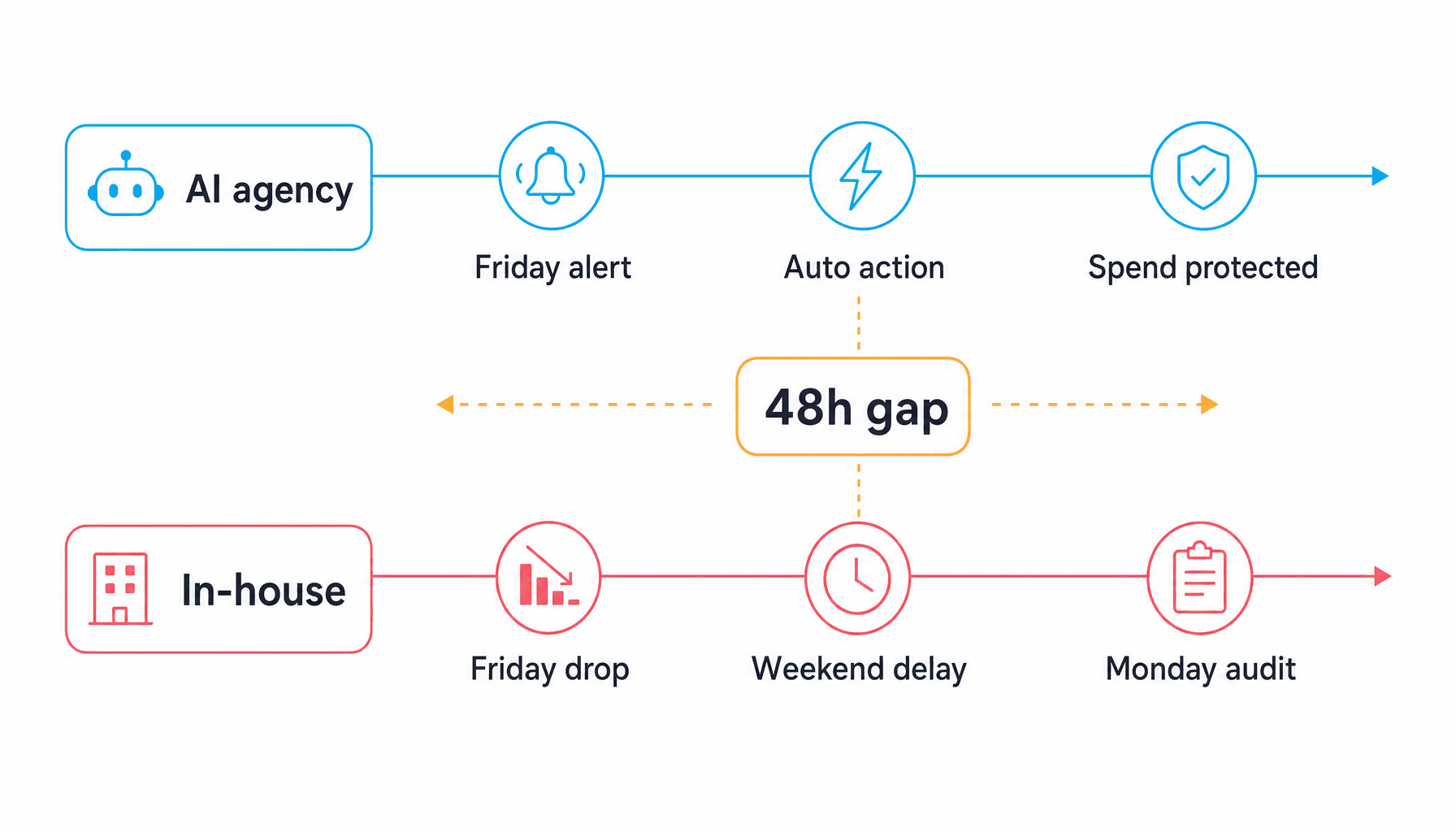
The AI-Native Agency Alternative: Continuous Optimization
Partnering with an AI-native operational suite changes your workflow from reactive troubleshooting to immediate, automated catalog defense. This model replaces the slow speed of manual updates with continuous, closed-loop automation that connects your entire business footprint.
An advanced operational architecture integrates your data loop by linking front-end advertising velocity directly to back-end supply chain infrastructure. This continuous sync removes the need for manual cross-referencing between separate teams.
Instead of waiting for human intervention, automated workflows track your listings around the clock. The platform monitors your digital shelf every 15 to 30 minutes, adjusting keyword bids dynamically based on real-time inventory runway and conversion metrics. By automating repetitive tactical tasks, the system keeps your ad budgets optimized and your listings visible without requiring constant manual oversight so your brand managers spend their hours on strategy instead of monitoring.
Evaluation Parameter | In-House Account Manager | AI-Native Platform Model |
Operational Coverage | Restricted to standard human working hours (~40 hours/week). | Continuous, 24/7/365 automated digital shelf monitoring. |
Software Stack Expense | Requires external, siloed tool subscriptions. | Consolidated into a single workspace. |
Optimization Tempo | Manual, periodic adjustments introducing human delay. | Real-time, algorithmic bid updates every 15 minutes. |
Inventory Awareness | Requires manual data sharing between logistics and media. | Automated bid mitigation linked to live warehouse levels. |
Keeping Humans in the Strategic Loop
Choosing an AI-native approach does not mean eliminating human logic from your business strategy. Machine learning models excel at processing massive datasets, identifying anomalies, and executing real-time bid updates, but they lack the capacity for high-level creative vision and long-term brand development.
The most effective modern operational models combine advanced automation with expert human oversight. The platform's algorithms handle the repetitive tactical grind of data aggregation and real-time adjustments, while an experienced brand strategist reviews macro-level trends, guides new product expansions, and shapes your overarching market positioning.
This combination of machine speed and human judgment allows enterprise brands to scale their operations efficiently without getting slowed down by administrative friction. By handing the daily maintenance tasks over to automated platforms, you free your internal leadership to focus on long-term expansion, product line innovation, and sustainable channel growth.
Frequently Asked Questions
How does operational latency directly impact my brand's Amazon conversion rates?
Human operational latency creates diagnostic delays when responding to fast-moving market changes. When competitive pricing moves, listing suppressions, or buy box losses happen outside of standard working hours, your ad campaigns continue to buy expensive traffic on unoptimized pages, resulting in ad waste and lower natural rankings.
Why is an in-house manager's software stack considered an operational tax?
To manage a full-service catalog, an internal hire requires a suite of standalone tools for keyword tracking, PPC automation, and inventory planning. This independent software approach forces brands to pay multiple high subscription fees for separate tools that fail to communicate with each other naturally.
What is inventory-aware bidding, and why does it protect my margins?
Inventory-aware bidding links your advertising spend directly to live warehouse stock data. If a product faces an unexpected supply chain delay, an automated platform identifies the stock risk immediately and lowers bids on high-cost keywords, extending your remaining inventory and helping you avoid a complete stockout.
Does transitioning to an AI-native operational model mean firing my current e-commerce team?
No. An AI-native platform functions as an operational partner that frees your current team from tedious manual data entries and constant spreadsheet analysis. This automation allows your strategists to step away from administrative tasks and focus entirely on creative marketing, product innovation, and high-level strategy.

Co-Founder & CEO, Lumian
Robin Lobo is Co-Founder and CEO of Lumian. He built and sold a seven-figure eyeglasses brand on Amazon and spent several years on the client side of traditional agencies before founding Lumian, an AI-native Amazon agency backed by $3M led by Bowery Capital.