Capitalizing on Competitor Blindspots: Using Amazon Competitive Analysis to Own Your Product Category
This article outlines how to pivot from basic tracking to predictive market intelligence that systematically converts rival listing gaps into your own market share.
TL;DR
What to Expect:
A tactical operational playbook detailing how high-volume e-commerce brands reverse-engineer competitor vulnerabilities. This article outlines how to pivot from basic tracking to predictive market intelligence that systematically converts rival listing gaps into your own market share.
Key Takeaways:
Standard, manual tracking methods fail to capture dynamic competitive shifts, leading to delayed marketing reactions.
Competitor vulnerabilities - such as stock fluctuations, unoptimized listings, and ad placement overlap - offer immediate opportunities to scale organic visibility.
Deploying real-time, inventory-aware AI systems allows brands to capture shifting market share automatically before competitors can adjust.
Intro
Sustaining category dominance within the modern Amazon ecosystem requires continuous tactical execution. Within this highly concentrated retail environment, traditional brand tracking is no longer sufficient. Many e-commerce executives review monthly or quarterly competitive reports, assuming that historical sales data provides an accurate roadmap for growth.
The primary limitation of this conventional approach is data latency.
A standard competitive report displays historical outcomes rather than real-time opportunities. It tracks what a competitor achieved weeks ago, but fails to highlight the current, operational blindspots that leave their catalog vulnerable today. When a top-tier competitor experiences a quiet inventory shortage, an unannounced category change, or a sudden dip in conversion efficiency, traditional data models lag too far behind to capture the opportunity. Winning a market sector requires replacing slow human tracking with continuous competitive analysis that automatically identifies and acts on competitor blindspots.
The Cost of Operational Latency in Competitive Tracking
Treating competitive intelligence as a periodic research project rather than a real-time data stream leaves a significant amount of revenue on the table. In high-velocity categories, market conditions shift rapidly as rival automated platforms alter pricing parameters, run out of stock, or change target terms throughout the day.
When an internal team relies on manual cross-referencing to track the market, they introduce a significant gap in execution. For example, if a primary competitor faces an unannounced stockout risk on a top-performing product on a Tuesday morning, a manual workflow rarely catches the shift immediately. Instead, the gap goes unnoticed until weekly or monthly performance reviews:
Missed Impressions Share: While a rival's listing loses its buy box status, their organic real estate becomes vulnerable. If your advertising spend doesn't scale up instantly to capture that traffic, other agile brands will step in.
Inefficient Paid Traffic Bidding: Failing to track where competitors run out of stock can cause your campaigns to over-bid on hyper-competitive search terms, driving up your average Cost-Per-Click (CPC) without capitalizing on clear market openings.
Slower Ranking Momentum: Amazon's search engine prioritizes steady sales velocity. When you miss a temporary market opening caused by a competitor's listing issues, you miss an opportunity to permanently elevate your natural search keyword rankings.
By the time a brand manager manually extracts data sheets, verifies the competitor's inventory issues, and adjusts campaign targets, the market opening has often closed. Reclaiming that potential market share later requires aggressive, low-margin ad spend, directly impacting your profitability.
Structural Vulnerabilities: Mapping Your Competitor's Weaknesses
Transforming competitive analysis into a reliable growth driver requires looking past top-line sales numbers and focusing on specific operational vulnerabilities. Competitors consistently leave digital shelf openings across three main structural areas:
1. Supply Chain and Inventory Fluctuations
Even sophisticated sellers frequently face logistical disruptions. When a top-performing competitor experiences an unexpected shipping bottleneck or a rapid depletion of FBA safety stock, their search visibility is left exposed. Tracing these patterns allows your business to optimize manufacturing workflows and align promotional budgets to capture the traffic the moment their listings falter.
2. Listing Quality and Search Positioning Gaps
Amazon's continuous rollout of conversational search features - driven by advanced models like Alexa for Shopping - has reshaped how consumers find products. Shoppers increasingly use long, detail-heavy queries rather than short keywords. Competitors who rely on legacy keyword stuffing often fail to optimize their listings for intent-based search structures, creating a major opening for brands that build scannable, mobile-optimized descriptions.
3. Inefficient Advertising and Keyword Cannibalization
Many brands scale their paid media campaigns quickly without establishing clear negative match guardrails. This lack of coordination often leads to internal keyword cannibalization, where their separate Sponsored Products and Sponsored Brands initiatives actively compete against one another. Identifying these overlapping ad campaigns allows you to adjust your keyword bidding strategy, securing premium placements at a lower average CPC.
Reversing the Matrix: Automated Market Intelligence in Action
Capturing competitor blindspots before rival brands can respond requires a data architecture that removes human latency entirely. Modern enterprise e-commerce operations use continuous, algorithmic monitoring to turn competitive observations into immediate, automated marketing adjustments.
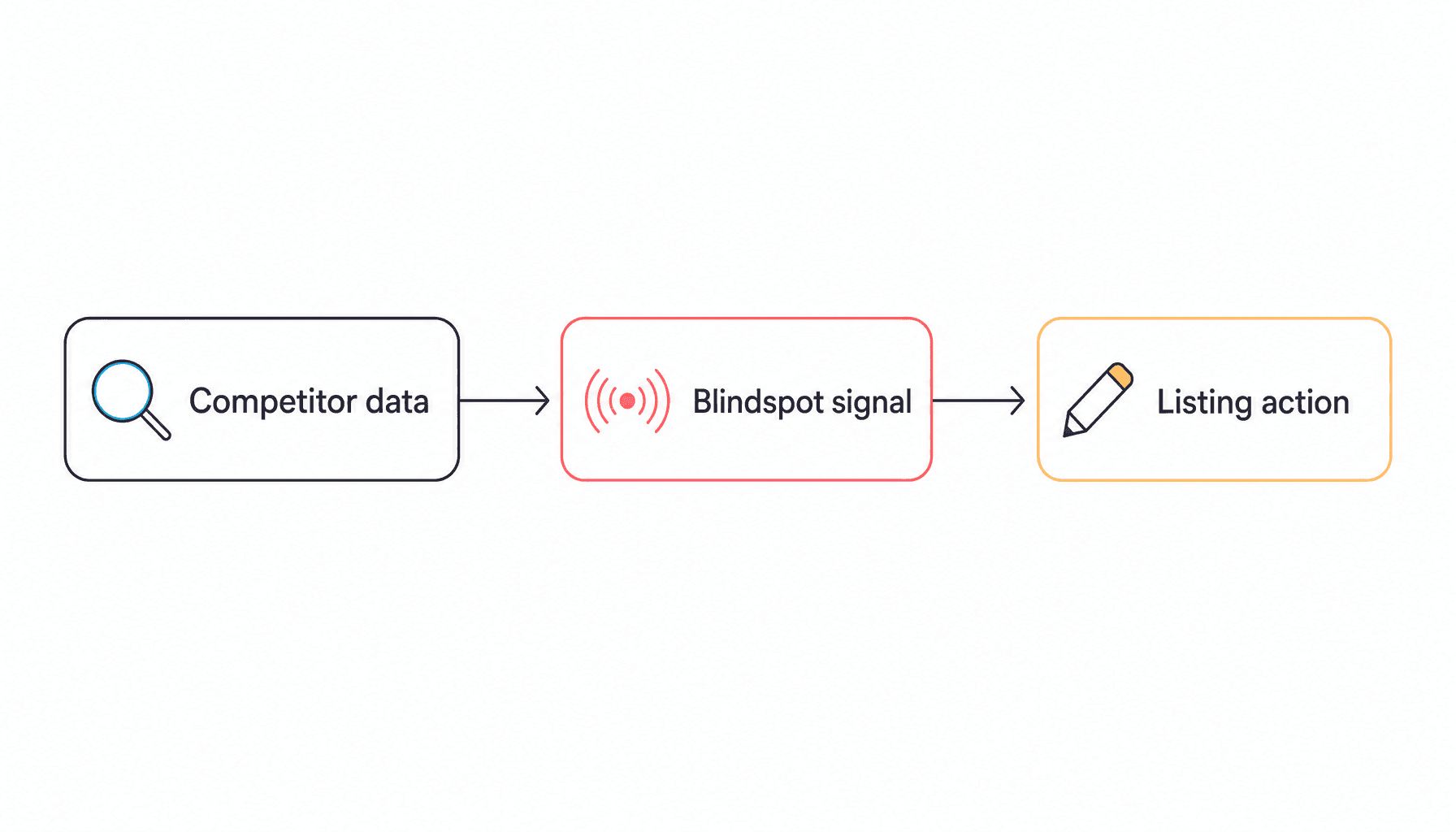
An integrated, protective data framework relies on three core operational pillars:
Real-Time Data Integration
An advanced operations platform bypasses slow manual reporting by connecting directly with Amazon's Selling Partner API (SP-API) and licensed third-party market data. By evaluating your competitive circle every 15 to 30 minutes, the platform tracks real-time shifts in competitor pricing, coupon updates, buy-box ownership, and search position trends across your entire category.
Automated Anomaly Detection
Instead of forcing teams to manually sort through spreadsheets to spot market changes, an intelligent system monitors the digital shelf continuously. By establishing clear baselines for your category's organic search visibility, the platform instantly flags unexpected changes in competitor conversion efficiency or listing availability the moment they occur.
Integrated Bidding Guardrails
Your advertising spend must adapt automatically to shifting market dynamics. When real-time tracking catches a competitor stockout or a pricing mismatch on a shared high-volume term, your platform should coordinate with your ad accounts instantly. By automatically raising bids on top-of-funnel keywords when a competitor is vulnerable, the system helps you secure premium visibility and maximize your impression share when your conversion potential is highest.
Maximizing Total Business Returns
Moving beyond isolated advertising metrics allows enterprise brands to approach market expansion with greater confidence. When your internal teams are freed from the daily grind of manual data tracking, they can shift their attention toward high-level strategy, product line innovation, and long-term channel health.
If a top-tier competitor lowers their price or launches an aggressive discount on a primary keyword, an automated data platform will catch the shift within minutes. Instead of leaving your campaigns exposed to expensive, low-converting traffic for days, the system flags the shift and adjusts your bidding thresholds against limits your brand manager set, protecting your Total Advertising Cost of Sales (TACoS) and defending your margins.
Similarly, if your data infrastructure identifies that a rival product is facing an extended stockout due to supply chain bottlenecks, your platform can quickly scale up your ad campaigns to capture the open demand. This proactive adjustment funnels your marketing capital directly into high-yield, organic growth targets, helping you win new customers and solidify your category leadership. By using intelligent automation to turn competitor vulnerabilities into immediate growth opportunities, you transform your backend data loops from an administrative task into a scalable, high-yielding engine built for sustainable marketplace success.
Frequently Asked Questions
How does real-time competitive analysis differ from traditional market reporting?
Traditional reporting relies on historical sales files and monthly data exports, which often display performance changes weeks after they occur. Real-time competitive analysis integrates live data streams to track competitor pricing, stock updates, and search positions every few minutes, allowing your brand to respond to market openings immediately.
Why does a competitor's FBA stockout offer a critical ranking opportunity for my brand?
When a product goes out of stock, its organic sales velocity drops to zero, and Amazon's search algorithms begin lowering its keyword rankings. If your system automatically scales up promotional ad spend on those shared search terms during their stockout, your product can capture the open demand and secure a stronger natural search position.
How do conversational search assistants like Alexa for Shopping alter competitive listing requirements?
Conversational search assistants move product discovery away from simple phrase matching toward complex, intent-driven customer queries. Competitors who continue to rely on legacy keyword stuffing fail to index for these longer questions, creating an opening for brands that build clear, context-rich product copy.
What is the risk of keyword cannibalization in competitive advertising campaigns?
Keyword cannibalization occurs when a brand runs multiple campaign types that target identical keywords without clear coordination. This internal overlap causes your campaigns to bid against one another in Amazon's auctions, driving up your average CPCs without expanding your actual visibility across the search results page.

Co-Founder & CEO, Lumian
Robin Lobo is Co-Founder and CEO of Lumian. He built and sold a seven-figure eyeglasses brand on Amazon and spent several years on the client side of traditional agencies before founding Lumian, an AI-native Amazon agency backed by $3M led by Bowery Capital.