The 2026 Blueprint for Amazon Listing Optimization: Driving Conversion Rates with Predictive AI
Discover how predictive AI, COSMO, and conversational search engine algorithms like Rufus are reshaping Amazon listing optimization and conversion rates in 2026.
TL;DR
What to Expect: A comprehensive breakdown of how Amazon's structural shift to semantic commerce (COSMO) and AI-driven shopping (Rufus) alters listing mechanics. Learn to pivot from legacy keyword stuffing to intent-modeled, conversion-optimized positioning.
Key Takeaways:
Amazon's customer exploration relies heavily on contextual problem-solving rather than exact-match indexing.
Predictive AI agents enable constant testing and rapid execution across imagery, title adjustments, and A+ content.
Success in 2026 demands data-backed listing audits, adaptive ad placement alignment, and dynamic catalog defense.
The landscape of third-party retail on Amazon has undergone a fundamental structural consolidation. Marketplace Pulse data shows that in 2023, it took roughly 15,000 sellers to generate half of Amazon's U.S. third-party GMV. By 2026, that concentration has sharpened dramatically - it now takes fewer than 8,000 sellers to capture that exact same market share.
This environment leaves very little margin for error. Brands that continue to manage their product detail pages through legacy, manually scheduled cadences find themselves slipping down the organic search rankings.
The primary catalyst for this shift is the wholesale rewriting of Amazon's underlying search and discovery architecture. Optimization is no longer just about adjusting text for a traditional search index. It requires building a product presence that appeals directly to predictive AI models and algorithmic assistants that work around the clock to match user intent with high-conversion product listings.
Understanding the New Search Architecture: Rufus and COSMO
For years, Amazon SEO was an exercise in index manipulation. Sellers packed backend search terms, bullet points, and titles with every conceivable long-tail keyword variation. But Amazon's rollout of its generative shopping assistant, Rufus, which more than 300 million customers used in 2025, driving nearly $12 billion in incremental annualized sales by Amazon's own Q4 2025 reporting - completely disrupted that playbook. In May 2026, Amazon began folding Rufus into a broader system called Alexa for Shopping. The brand name is shifting; the underlying engine - conversational Q&A and the COSMO knowledge graph beneath it - carries over intact, so the principles below still apply.
Rufus does not just scan a page for exact phrase matches. It relies heavily on COSMO, Amazon's deep intent-modeling knowledge graph. COSMO analyzes whether a product listing realistically solves the specific, nuanced problem a shopper describes. If a customer inputs a conversational query like "What should I look for in a trail running shoe for muddy conditions?", the algorithm evaluates structural attributes, consumer sentiments hidden within reviews, and behavioral signals to construct an explicit answer.
When your listing is evaluated by an intent-based knowledge graph, keyword stuffing becomes counterproductive. Instead, optimization requires precision data architecture. Listings must clearly state the product's design intentions, material specifications, and contextual use cases in highly legible prose. This structural clarity allows predictive models to easily categorize your inventory as the definitive answer to specific customer inquiries.
The Pitfalls of Traditional Listing Management Cadences
Traditional agency models and internal teams are often restricted by execution lag. A standard content refresh or A+ update might take up to ten business days to move through design, copywriting, and administrative approvals. In the interim, shifts in market pricing, competitor promotions, or sudden alterations in search volume go unanswered.
Worse yet, suppressed listings or quiet classification changes can go completely unnoticed for 48 hours or longer. On a high-velocity ASIN, two days of lost visibility can severely damage your sales history and organic velocity, allowing agile competitors to capture the market share.
Managing an e-commerce catalog effectively in 2026 requires continuous vigilance. Price changes, stock-out risks, and competitive visual changes happen in real time. Safeguarding your conversion rates requires an integrated infrastructure where diagnostic data directly drives swift, strategic updates.
The Predictive AI Blueprint: Dynamic Catalog Optimization
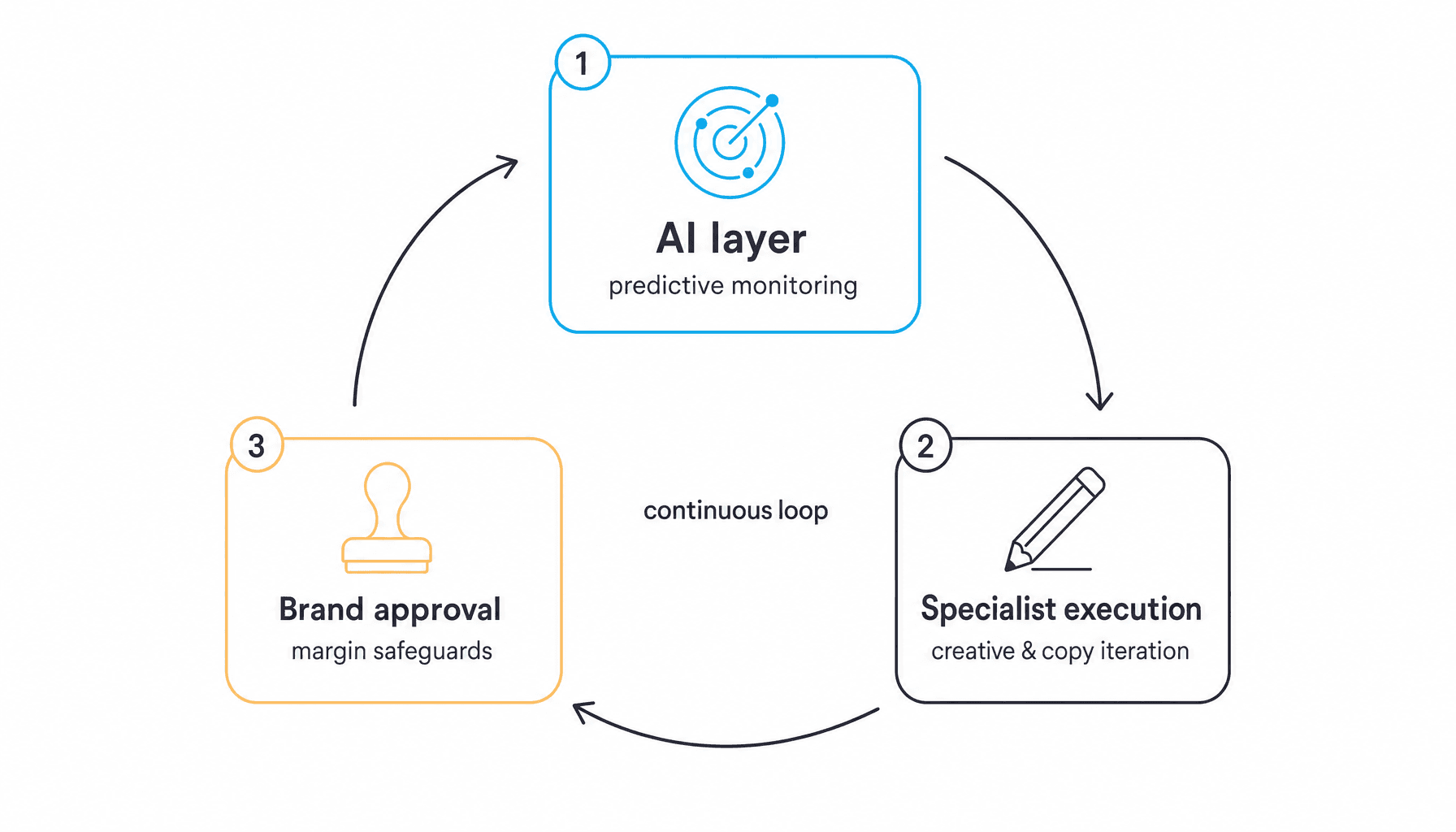
Deploying predictive AI models allows brands to move away from static, reactive management and shift toward proactive, continuous optimization. Instead of reviewing performance metrics at the end of the month, operational workflows utilize algorithmic agents that actively monitor listings and execute optimizations immediately.
Labeled Visual and Text Integration
Every structural component of your product detail page must work together systematically to confirm the purchase intent identified by Amazon's search models.
Intent-Aligned Product Titles: Move beyond strings of disparate search terms. Titles should lead with the core brand identity, followed immediately by the single most definitive attribute that solves the user's core purchasing dilemma.
Context-Rich Structural Bullets: Use bullet points to establish clean, functional parameters. Address the exact physical qualities, compatibility rules, and technical performance boundaries that predictive search engines scan for when parsing complex customer problems.
Optimized A+ Content Frameworks: Visual structures should be organized logically to lead a scanning eye from high-level visual validation down to granular, feature-by-feature comparisons.
Aligning Ads Infrastructure with Listing Realities
A common point of friction in e-commerce operations is the disconnect between paid media execution and listing status. PPC campaigns often run independently of inventory forecasts or real-time conversion changes, resulting in wasted ad spend on underperforming or low-stock products.
Predictive systems bridge this gap by establishing real-time feedback loops between advertising platforms and catalog health.
Managing Conversion Volatility
When a competitor implements a sudden price drop or a temporary coupon on a primary tracking keyword, your listing's conversion rate may experience a temporary dip. An automated, predictive advertising system registers this shift immediately, dynamically adjusting Sponsored Products, Sponsored Brands, and Sponsored Display bids to defend historical TACoS targets without depleting marketing budgets during periods of low conversion.
Mitigating Stockout Risks
If a top-selling SKU faces an unexpected stockout risk within a two-week window due to shipping bottlenecks, the system automatically scales back aggressive keyword bids. This strategic slowing preserves organic keyword rank and historical conversion metrics, buying time for supply chain operators to approve and route replacement inventory safely to FBA fulfillment centers.
Establishing a Proactive Defensive Staging Protocol
To maintain steady growth across major e-commerce categories - including personal care, supplements, apparel, beverages, and industrial tools - brands must treat their listings as active, digital storefronts that require continuous defense. The Buy Box is constantly targeted by automated pricing engines, matching strategies, and sudden changes in catalog compliance policies.
A modern optimization blueprint relies on automated diagnostic monitoring. Continuous scanning allows systems to detect unauthorized listing changes, counterfeit offerings, or abrupt category reclassifications instantly. When an anomaly is discovered, the system surfaces it with a recommended correction in minutes, and your brand manager approves the pricing or backend change the same day – fast enough to protect account health, with a human still owning the call.
Frequently Asked Questions
How does Amazon's COSMO algorithm affect my legacy product keywords?
COSMO shifts search evaluation from simple word matching to deep intent modeling. Rather than checking if a listing contains exact keyword phrases, it analyzes if your text, structure, and review trends prove that the item solves the specific problem described by the user.
Why is residual execution lag dangerous for high-volume Amazon ASINs?
When manual optimization workflows take days to implement, listings are left exposed to real-time market changes. Suppressed listings, stock out flags, and competitor promotions can rapidly erode your sales velocity and lower your organic search rankings if left unaddressed.
How should predictive AI systems handle advertising bids during a stockout risk?
When a predictive system detects that inventory levels are insufficient to support current sales volume before the next shipment arrives, it automatically reduces promotional bids. This action cools demand, preserves your listing's conversion history, and extends your product availability to protect overall keyword rankings.
Can conversational AI tools like Rufus surface information from product images?
Yes. Amazon's models analyze text, structured catalog tables, and image metadata (such as alt text and visual assets) to build a complete profile of a product's utility. Ensuring that your visual media is clean, descriptive, and accurately indexed is critical for maintaining visibility.

Co-Founder & CEO, Lumian
Robin Lobo is Co-Founder and CEO of Lumian. He built and sold a seven-figure eyeglasses brand on Amazon and spent several years on the client side of traditional agencies before founding Lumian, an AI-native Amazon agency backed by $3M led by Bowery Capital.