The Automation Playbook: Scale Your E-commerce Business Without Becoming the Operational Bottleneck
Stop acting as your brand's operational bottleneck. Discover how an integrated, inventory-aware automation engine connects your data streams to protect margins.
TL;DR
What to Expect: A strategic operational guide outlining how high-volume e-commerce brands break through scaling plateaus. It details the precise shift from manual, siloed management to an integrated, AI-driven automation framework that links marketing, catalog monitoring, and logistics.
Key Takeaways:
Human operational latency creates hidden bottlenecks that directly erode conversion rates and organic rankings.
Autonomous workflows remove data delays by instantly syncing live advertising metrics with warehouse inventory realities.
Transitioning to predictive, closed-loop systems prevents capital drain, eliminates manual errors, and protects brand margins at scale.
Scaling a multi-million dollar e-commerce business presents a unique paradox. In the early stages of growth, success is driven by direct founder involvement - a hands-on approach to managing listing copy, adjusting ad bids, and resolving fulfillment bottlenecks. However, as order volumes cross critical growth thresholds, this granular involvement transforms into a major operational liability.
When a brand scales its SKU count and broadens its distribution across channels, the volume of daily operational decisions grows exponentially. Relying on manual oversight to manage this complexity creates an artificial ceiling on your growth.
The true barrier to scaling is rarely a lack of market demand or capital constraint. Instead, it is almost always the operational latency built into manual workflows. When data remains trapped in isolated organizational silos, teams are forced to spend their time reacting to yesterday’s problems rather than driving future growth. The fix isn't to take people out of the loop, it's to take the manual data-shuffling out, so your best people stop burning hours on low-value work. Automation handles the plumbing; your brand managers own the judgment calls.
The Human Latency Trap: Breaking the Scaling Ceiling
E-commerce operations are fundamentally a battle against time. Every minute that a listing anomaly, a stock mismatch, or an inefficient ad bid goes unnoticed results in direct margin erosion. Yet traditional operational structures still rely on manual hand-offs to move data between separate business divisions.
Consider a typical e-commerce team's workflow. The logistics team monitors warehouse inventory through an ERP system, the marketing team tracks campaigns via specialized advertising dashboards, and the digital shelf manager updates product detail pages within Amazon Seller Central.
When these systems do not communicate automatically, critical information moves slowly. If an unexpected supply chain delay shortens the inventory runway for a top-performing ASIN, that information must be manually extracted, analyzed, and emailed to the marketing team. By the time an advertising manager opens that report and manually drops keyword bids to preserve stock, days have passed. In high-velocity categories, that delay results in wasted ad spend on products facing a stockout, driving up your Total Advertising Cost of Sales (TACoS) and compromising your long-term organic rankings.
Syncing PPC Campaigns with Warehouse Realities
True operational automation begins by building a real-time connection between your front-end advertising platforms and your back-end supply chain infrastructure. Treating advertising performance and inventory management as separate concerns is a significant structural vulnerability.
When your paid media spend operates independently of your actual fulfillment pipeline, you run the constant risk of over-funding low-stock inventory. Driven by backward-looking historical performance data, traditional PPC campaigns will continue to bid aggressively on high-volume keywords even when a product is on the verge of selling out.
An automated, inventory-aware operational loop completely redefines this workflow:
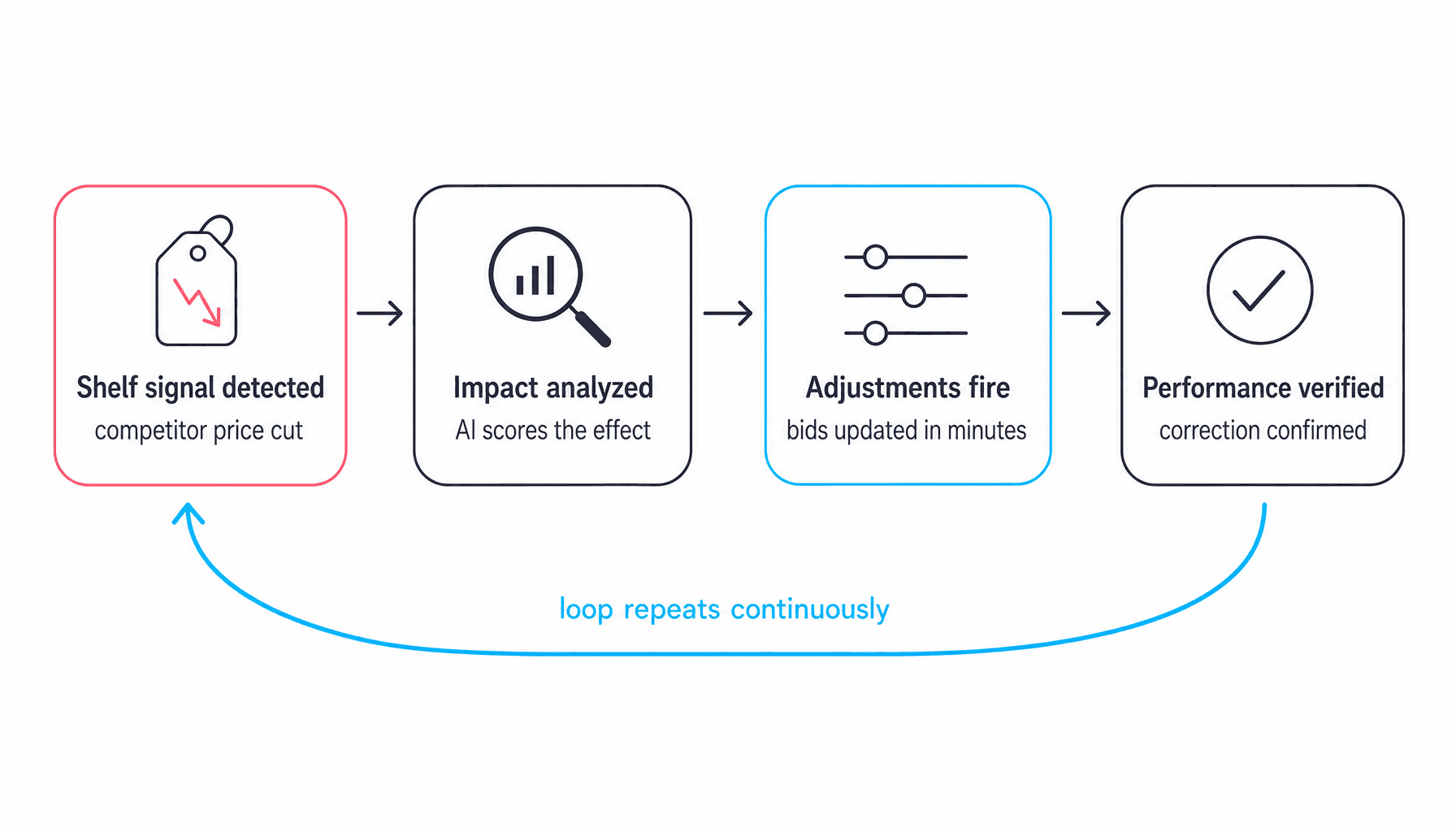
When your systems are fully integrated, an impending inventory risk automatically triggers a protective campaign response. The system reduces bids on high-cost, top-of-funnel promotional terms, slowing down sales velocity just enough to extend your remaining stock until the next shipment arrives. This proactive reduction protects your margins, prevents early stockouts, and safeguards your historical organic search positions.
Guarding the Digital Shelf via Autonomous Monitoring
Managing a scaling e-commerce catalog manually is like trying to monitor a shifting landscape with a static map. Competitors constantly adjust pricing, launch aggressive promotions, or alter their visual positioning to capture your market share.
If your internal team relies on daily or weekly manual audits to catch these competitive threats, your listings remain highly vulnerable. If a competitor introduces a targeted discount or a compelling coupon on a shared high-volume search term on a Tuesday, your real-time conversion rates will often drop immediately. If your team doesn't identify this shift until a Friday review, you waste three full days driving expensive traffic to a page that has lost its competitive edge.
Deploying an autonomous, 24/7 digital shelf monitoring system removes this diagnostic lag entirely. Algorithmic tracking agents monitor your product listings around the clock, evaluating conversion metrics, buy-box ownership, and competitive movements every 15 to 30 minutes.
When the system catches a drop in your conversion rate caused by a competitor's pricing adjustment, it doesn't just flag the issue in a report. It instantly coordinates with your ad bidding systems to adjust keyword targets, protecting your ad budget and defending your brand equity within the hour.
Transitioning from Reactive Fixes to Prescriptive Action
The ultimate goal of an automated e-commerce playbook is to shift your entire organization away from reactive troubleshooting and toward proactive execution. Brand growth accelerates when your team stops hunting for operational errors and starts acting on clear, pre-validated solutions.
Instead of staring at fragmented data dashboards and trying to guess why sales dropped last week, operations should rely on automated root-cause analysis. An integrated intelligence platform evaluates your entire digital footprint simultaneously, instantly tracing performance drops back to their exact operational root causes - whether that is an unauthorized listing change, an unannounced category shift, or an unexpected fulfillment delay.
By automating the daily tactical grind of data aggregation, analysis, and basic bid adjustments, you take the grind off your team's plate. Your internal team is freed from the burden of repetitive administrative tasks, allowing them to focus entirely on high-level strategy, product line expansion, and long-term channel health. Automation transforms your backend operations from a messy bottleneck into an efficient, scalable engine built for sustainable growth.
Frequently Asked Questions
How does human operational latency actively harm an e-commerce brand's conversion rates?
Human latency creates dangerous diagnostic delays when responding to fast-moving market changes. When listing updates, competitor pricing drops, or inventory risks require manual identification and communication across separate teams, your listings remain unoptimized for days, resulting in wasted ad spend and lower organic visibility.
Why is it critical to connect active Amazon PPC bids with real-time inventory levels?
Traditional advertising campaigns often run completely separated from warehouse inventory data, which leads to aggressive spending on products facing stockout risks. Linking your PPC infrastructure directly to live fulfillment data allows systems to automatically lower bids on high-cost keywords when stock is low, preserving inventory and protecting your keyword rankings.
Can autonomous listing monitoring help protect a brand against aggressive competitor pricing changes?
Autonomous monitoring tracks the digital shelf continuously, evaluating conversion rates and competitive pricing adjustments every few minutes. When a competitor drops their price on a shared high-volume term, an automated system identifies the shift immediately and adjusts your ad spend to prevent driving traffic to a non-competitive listing.
What is the difference between standard analytics dashboards and automated root-cause analysis?
Standard dashboards display historical performance data in isolation, forcing teams to manually export and cross-reference multiple files to guess why a metric shifted. Automated root-cause analysis evaluates your entire catalog data loop simultaneously, instantly connecting performance outcomes to their specific operational triggers.

Co-Founder & CEO, Lumian
Robin Lobo is Co-Founder and CEO of Lumian. He built and sold a seven-figure eyeglasses brand on Amazon and spent several years on the client side of traditional agencies before founding Lumian, an AI-native Amazon agency backed by $3M led by Bowery Capital.