Stop Bleeding Cash: 7 Amazon PPC Optimization Mistakes Destroying Your Ad Spend This Quarter
Stop bleeding cash on Amazon PPC. Discover the 7 critical advertising mistakes destroying your margins this quarter and learn how predictive, inventory-aware AI fixes them.
TL;DR
What to Expect:
A comprehensive operational audit identifying the hidden structural flaws in your current Amazon advertising strategy. This guide moves beyond basic troubleshooting to reveal how outdated bid management, isolated inventory data, and keyword cannibalization silently drain your margins.
Key Takeaways:
Standard keyword bid adjustments fail to account for real-time conversion volatility, leading to over-bidding on underperforming traffic.
Failing to connect inventory levels to active PPC campaigns leads to expensive, wasted ad spend on low-stock or out-of-stock ASINs.
Deploying autonomous, inventory-aware AI agents cuts out diagnostic delays, automatically structure campaigns, and actively defends your Total Advertising Cost of Sales (TACoS).
Sustaining a profitable brand on Amazon has become a challenge of thin margins and precise execution. Compounded by rising Cost-Per-Click (CPC) rates — up 8–12% year over year in 2026 after a sharp jump in 2025, and spiking as much as 30% during peak events like Prime Day, sellers face a marketplace where every click directly impacts the bottom line. The State of PPC 2026 report found that 53% of marketers say managing PPC campaigns is harder than it was two years ago - a complexity squeeze that hits Amazon sellers especially hard, given how fast the marketplace moves.
When ad costs rise, many brands try to compensate by launching more campaigns or pushing raw keyword volumes higher. However, adding complexity to an already inefficient setup often accelerates your losses.
The real drain on your budget rarely stems from a poor product or bad luck. Instead, it is usually caused by quiet, systemic errors in how your campaigns are run, analyzed, and integrated with the rest of your business. If your team still relies on manual adjustments or rigid, rule-based automation, you are likely falling victim to the 7 critical PPC optimization mistakes destroying your ad spend this quarter.
1. Operating with Fragmented, Non-Predictive Bidding Systems
Many e-commerce teams manage bids by reacting to historical performance data. A brand manager downloads a search term report from the previous 30 days, calculates the average Advertising Cost of Sales (ACoS), and manually shifts keyword bids up or down based on those backward-looking metrics.
This reactive method presents a major operational liability: it assumes that past performance perfectly predicts future customer behavior. If a specific keyword converted well during a brief promotional window or a temporary seasonal spike, a manual system will often keep bids high long after that shopping trend has faded.
Conversely, rigid, rule-based automation software simply executes basic "if/then" triggers - such as reducing a bid by 15% whenever ACoS crosses a 30% threshold. These systems fail to analyze the contextual signals surrounding a click. They cannot differentiate between an isolated performance dip and a lasting market shift, leaving your campaigns exposed to sudden conversion drops.
2. Running Blind to Real-Time Inventory Volatility
One of the costliest errors an Amazon brand can make is keeping advertising budgets completely separated from warehouse operations. When your PPC strategies run independently of your actual stock levels, you end up wasting ad spend on products that cannot fulfill customer demand.
Consider a top-selling SKU that suddenly faces an unexpected stockout risk, with only 11 days of available inventory left on hand due to unexpected shipping delays. If your PPC software remains unaware of this logistical bottleneck, it will keep driving aggressive Sponsored Products and Sponsored Brands traffic to that listing.
This disconnect triggers a painful chain reaction:
The high ad volume burns through your remaining inventory faster than planned, forcing an early stockout.
Wasted ad dollars are spent on items that disappear from shelves before organic interest can build momentum.
The subsequent out-of-stock status breaks your sales velocity, severely damaging your organic search positions.
When an ASIN goes out of stock, reclaiming your original keyword ranking often requires weeks of aggressive, low-margin ad spend, erasing the profitability of previous sales.
3. Allowing Internal Keyword Cannibalization to Drive Up CPCs
When brands scale their advertising catalogs quickly, they often accidentally pit their own campaigns against one another. Keyword cannibalization occurs when multiple campaign types - such as separate Sponsored Products, Sponsored Brands, and Sponsored Display initiatives - target the exact same high-volume search phrases without distinct targeting rules.
Instead of winning multiple placements across the search results page, your campaigns end up bidding against each other in Amazon's real-time auction. This internal competition drives up your average CPCs without expanding your actual impression share.
Without a central workspace to organize and coordinate bids across your entire catalog, you end up paying an artificial premium for customer traffic you already controlled.
4. Relying on Slow, Manual Optimization Cadences
The speed of the Amazon marketplace moves much faster than traditional agency or internal management workflows can handle. A standard management model often relies on weekly optimization cycles, where an account strategist reviews campaign performance and adjusts targets every few days.
But consumer demand, competitor pricing, and buy-box ownership change by the hour. If a competitor drops their price by 12% on a shared high-volume term on a Tuesday morning, your listing's conversion rate will likely drop immediately.
If your team doesn't look at the data until Friday, your campaigns will spend three full days driving expensive traffic to a listing that has lost its competitive edge. In high-velocity categories, that 72-hour diagnostic delay can result in thousands of dollars in wasted ad spend and a rising TACoS.
5. Overlooking Intent-Based Conversational Search Patterns
The introduction of Rufus (now Alexa for Shopping), Amazon's generative AI shopping assistant, used by more than 300 million customers in 2025, has altered how shoppers discover products. Shoppers are shifting away from traditional, fragmented keyword queries and moving toward longer, intent-driven conversational searches.
Sellers who focus exclusively on exact-match short-tail terms miss out on this evolving traffic. Rufus relies heavily on Amazon's COSMO knowledge graph to surface products that solve specific problems described by the customer.
If your advertising strategy fails to identify and fund these longer, intent-modeled phrases through flexible broad match and automatic discovery campaigns, your brand will miss out on highly targeted, high-converting customer traffic.
6. Ignoring Total Advertising Cost of Sales (TACoS) Fluidity
Evaluating an advertising budget solely through an isolated ACoS metric provides an incomplete picture of your brand's financial health. ACoS only measures ad spend against direct ad revenue, completely ignoring how your paid campaigns impact your broader organic sales velocity.
Fixating entirely on lowering your ACoS can lead to short-sighted budget cuts on top-of-funnel keywords that were actually driving your organic visibility. Amazon's search algorithms heavily prioritize sales velocity from relevant search terms.
When you cut off those foundational traffic sources, your organic rankings often drop, causing a net loss in total revenue. True efficiency requires tracking TACoS fluidity, ensuring your ad spend actively supports organic growth rather than running in an expensive silo.
7. Falling Into the Broad Negative Keyword Trap
To cut down on ad waste, many brands frequently add negative keywords to their campaigns. However, applying broad negative match rules without careful data validation can accidentally block profitable, high-converting search traffic.
For example, if an operator adds a broad negative for a term like "organic" to stop impressions on a low-margin variation, that single rule can accidentally block a whole range of related long-tail search terms that were actually converting well. This over-filtering reduces your total impression share and chokes off healthy sales pipelines, leaving your brand dependent on a shrinking pool of expensive, hyper-competitive keywords.
Shifting to Autonomous, Multi-Channel Campaign Infrastructure
Eliminating these 7 costly mistakes requires moving away from manual maintenance and embracing automated, integrated management. Modern e-commerce operations require a data infrastructure where advertising, inventory forecasting, and catalog tracking work together seamlessly in real time.
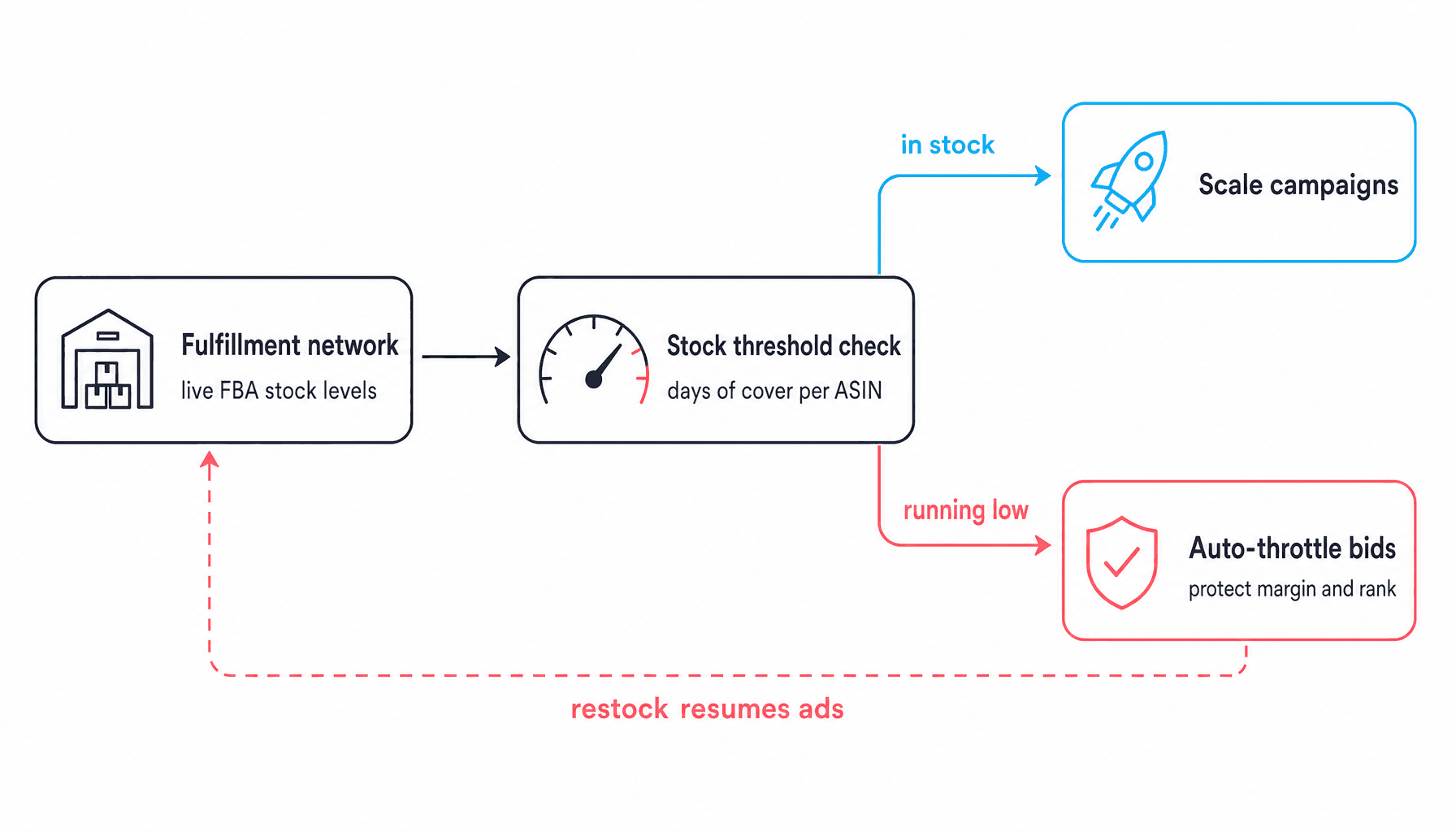
Transitioning your catalog to predictive, inventory-aware AI agents resolves the underlying speed issue that complicates traditional management. Instead of waiting for weekly manual review cycles, automated workflows monitor your listings 24/7, adjusting bids every 15 to 30 minutes based on real-time market changes.
When your advertising software is connected directly to your warehouse data, your strategies adjust automatically. If stock levels drop, the system scales back high-cost bids to protect your organic ranking momentum. If a competitor drops their price, your system launches a targeted defensive campaign within the hour. By handing the daily tactical grind over to intelligent automation, you free your brand to focus on high-level growth, product development, and long-term profitability.
Frequently Asked Questions
How do rising average Cost-Per-Click (CPC) rates impact my overall campaign strategy?
When average CPC rates climb, relying on manual optimizations or backward-looking historical reviews becomes highly inefficient. Scaling brands must adopt real-time, automated bidding systems that adjust targets dynamically based on immediate conversion data, preventing wasted ad spend on underperforming keywords.
What is the relationship between my inventory levels and active Amazon PPC bids?
Traditional PPC campaigns often run completely isolated from actual product stock levels, which leads to wasted ad spend on low-stock products. An integrated, inventory-aware management system automatically scales down promotional bids when stock risks are flagged, preserving your inventory and protecting your organic keyword rankings.
Why does keyword cannibalization happen across separate Amazon campaign types?
Keyword cannibalization occurs when different ad formats - like Sponsored Products and Sponsored Brands campaigns - target identical search terms without coordinated bidding guardrails. This internal overlap causes your own campaigns to compete against one another, raising your CPCs without increasing your overall visibility.
How does Amazon's AI assistant Rufus change consumer search behavior?
Rufus shifts product discovery away from basic phrase matching toward detailed, conversational search queries. Brands must optimize their product listings and update their advertising structures to align with intent-based customer questions, ensuring their items are recognized as solutions by Amazon's search models.

Co-Founder & CEO, Lumian
Robin Lobo is Co-Founder and CEO of Lumian. He built and sold a seven-figure eyeglasses brand on Amazon and spent several years on the client side of traditional agencies before founding Lumian, an AI-native Amazon agency backed by $3M led by Bowery Capital.