Real-Time Threat Mapping: How to Prevent Amazon Listing Suppression Before It Kills Your Organic Rank
This article breaks down the algorithmic drivers behind search suppression and provides data-driven strategies to shield your organic traffic.
TL;DR
What to Expect:
A technical blueprint detailing how automated retail systems detect and prevent unexpected catalog suppressions. This article breaks down the algorithmic drivers behind search suppression and provides data-driven strategies to shield your organic traffic.
Key Takeaways:
Modern listing suppression is handled instantly by automated crawlers, meaning manual checking introduces fatal delay.
Even brief visibility gaps cause compounding damage to your sales history, erasing keyword momentum.
Shifting to predictive, continuous threat mapping connects catalog data loops to prevent losses before they hurt your conversion rate.
Intro
Sustaining a leading enterprise brand within the modern Amazon ecosystem requires managing constant data updates. While e-commerce directors dedicate considerable focus to bidding efficiency and visual testing, a quiet operational risk often threatens catalog health: algorithmic listing suppression.
This issue does not stem from a formal, manual policy review by an Amazon performance team. Instead, suppression happens instantly via Amazon's own automated catalog and quality checks that flag irregularities in catalog data, title structures, image dimensions, or pricing integrity.
When a core ASIN falls victim to a search suppression or a browse block, the immediate impact is a total loss of digital shelf visibility. Because Amazon's search algorithm (what sellers commonly call A10) rewards steady sales velocity and consistent conversion history, a sudden drop in page impressions can severely disrupt your ranking position. Relying on manual workflows to catch these programmatic errors leaves your business exposed to high diagnostic lag. To insulate margins, scaling brands must deploy real-time threat mapping systems that catch catalog compliance risks before they disrupt customer pipelines.
The Financial Reality of Brand Classification Inefficiencies
Treating a search-suppressed product page as a simple administrative ticket to be fixed by an operations manager during the week ignores how modern e-commerce systems work. Data compiled by industry benchmarks shows that high-volume Amazon merchants lose substantial sales velocity when core listings experience unexpected downtime.
When a product page is suppressed from search results, your Sponsored Products ads stop serving and Sponsored Display typically goes ineligible too. Sponsored Brands ads, however, keep running, so you keep paying for clicks that now land on a suppressed page. Either way, the halt in real traffic creates a problematic chain reaction:
Sales History Drop: Amazon's search models assess your listing's performance hourly. When your conversion rate drops to zero due to a technical suppression, the algorithm quickly lowers your organic authority.
Competitor Real Estate Gains: As your listing drops out of top keyword spots, competing products capture that natural shelf space, building their own sales momentum.
Wasted External Media Budgets: Unlike internal PPC campaigns, your off-platform marketing funnels - including TikTok ads, Google Search initiatives, and email newsletters - keep driving traffic to a non-functional page, resulting in wasted ad spend.
By the time a brand manager manually exports multiple report files, isolates the compliance error, and submits a correction via Seller Central, days have passed. Reclaiming your original search position often demands weeks of low-margin promotional spend, erasing your previous profitability.
Mapping the Triggers: Why Automated Scrapers Freeze ASINs
To defend your digital catalog effectively, you must identify the explicit triggers that prompt Amazon's systems to suppress a listing. These automated checks evaluate your catalog continuously, enforcing rigid structural standards across three main risk zones:
Risk Zone | Algorithmic Trigger | Operational Impact |
Pricing Integrity | Off-platform price tracking shows your product listed lower on an external site. | Immediate loss of the Buy Box or total search suppression due to price parity rules. |
Image Compliance | Main product photo fails to utilize a pure white background or violates pixel dimensions. | The ASIN is dropped from search result pages and shifted into a browse-only status. |
Data Structure | Title exceeds character limits, contains promotional text, or backend attributes mismatch. | The listing is automatically flagged for optimization non-compliance and hidden. |
Relying on manual visual checks to track these variables across a large catalog is highly inefficient. If an automated scraper identifies a price parity issue or a missing backend attribute on a Tuesday, your conversion rate will suffer immediately. If your internal team only checks catalog status files during weekly reviews, you face extended periods of unoptimized visibility.
Building a Predictive Threat Mapping Architecture
Eliminating diagnostic delays requires moving away from reactive troubleshooting and embracing automated catalog protection. Modern e-commerce brands use real-time threat mapping to connect their entire data ecosystem, allowing them to fix structural vulnerabilities before they impact sales rankings.
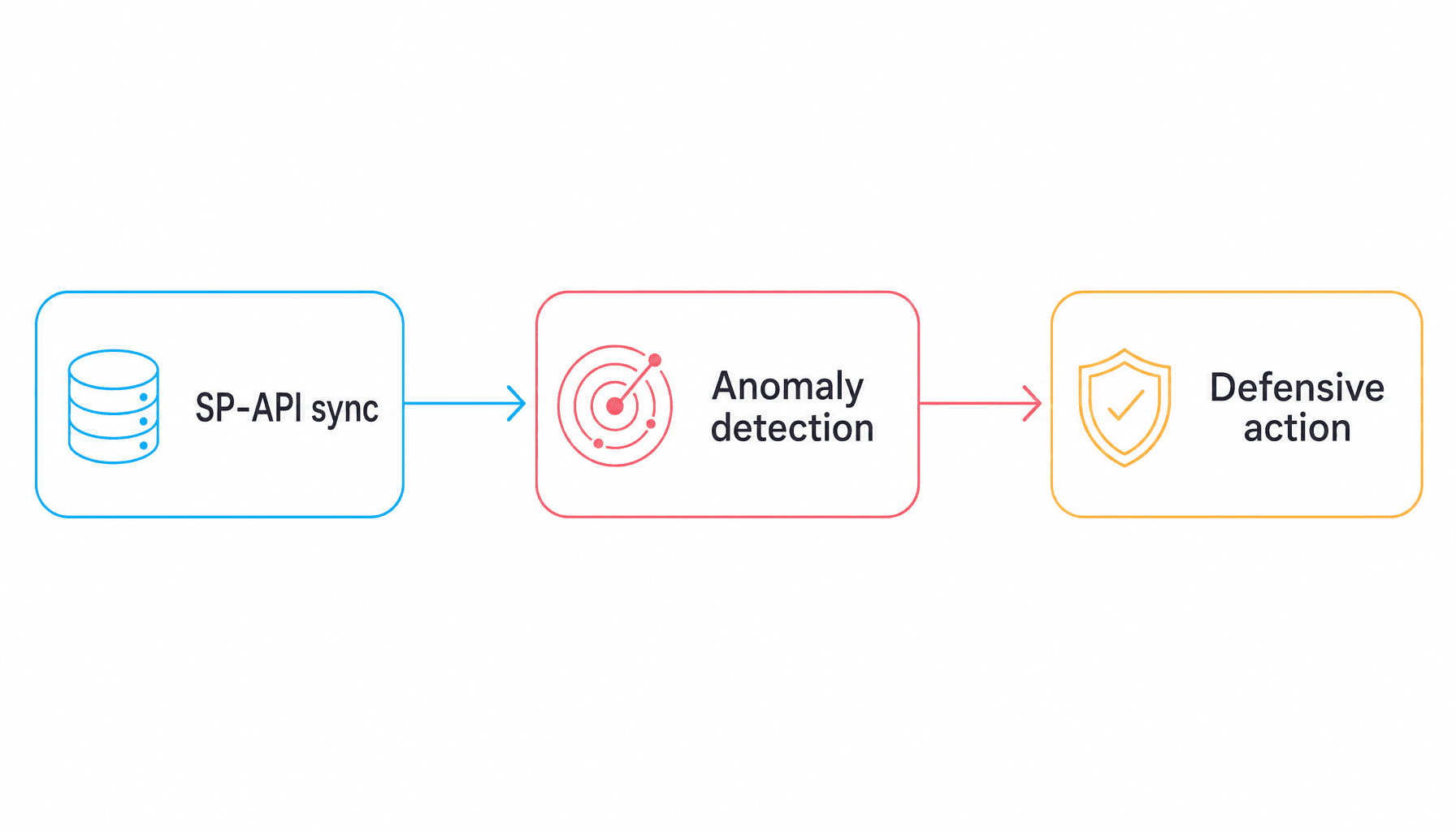
An integrated, protective data framework relies on three core operational pillars:
1. Continuous SP-API Integration
An advanced operational platform bypasses slow user dashboards by pulling data directly from Amazon's Selling Partner API (SP-API). By monitoring your catalog's structured data loop every 15 to 30 minutes, the platform tracks changes in buy-box status, search placement, and backend compliance flags in real time.
2. Automated Root-Cause Identification
When a performance drop occurs, an intelligent system does not force your team to guess the cause. It utilizes automated root-cause analysis to trace the anomaly back to its precise origin. If a listing drops in organic rank, the system immediately checks if the change was caused by a price tracking issue, a missing attribute field, or an unexpected catalog shift.
3. Integrated Bidding Guardrails
Your advertising spend must adapt automatically to changes in your catalog health. When real-time tracking flags a search suppression or a buy-box loss on an ASIN, your system should coordinate with your ad accounts instantly. By pulling back spend on related off-platform media and Sponsored Brands ads, you prevent your brand from paying for premium clicks on a broken listing.
Protecting Market Share Through Proactive Execution
Shifting from manual spreadsheets to automated catalog mapping helps enterprise brands stay ahead of fast-moving marketplace shifts. When your software handles daily monitoring, your team can pivot from tedious data sorting to strategic growth execution.
If a competitor attempts to alter your shared listing details through a flat-file submission, an automated tracking system will catch the change immediately. The platform flags the change within minutes with the exact diff and a recommended correction, and your brand manager pushes the fix the same hour. This rapid defense keeps your product page compliant and stable.
Similarly, if an automated scraper flags a price parity issue because of a temporary discount on an external retail platform, a predictive data hub will identify the mismatch quickly. Instead of leaving your Amazon listing suppressed for days, the engine alerts your team immediately and your operator adjusts the price to resolve the conflict. By using intelligent automation to eliminate human latency, you protect your hard-won keyword rankings, preserve your ad budgets, and build an unshakeable foundation for scalable e-commerce growth.

Co-Founder & CEO, Lumian
Robin Lobo is Co-Founder and CEO of Lumian. He built and sold a seven-figure eyeglasses brand on Amazon and spent several years on the client side of traditional agencies before founding Lumian, an AI-native Amazon agency backed by $3M led by Bowery Capital.