Amazon Ad Tools for Seamless PPC Management in 2026
Compare the best Amazon ad tools for 2026. Discover how multi-platform PPC automation, AI analytics, and SP-API integrations maximize retail media ROI.
TL;DR
What to expect from this article: An analytical breakdown of modern Amazon advertising tools, cross-channel PPC automation, and AI-driven media management in 2026. This guide explores how integrating Amazon Ads with off-platform traffic channels optimizes customer acquisition and protects contribution margins.
Key Takeaways:
Modern PPC management requires moving beyond isolated campaign bidding to orchestrate full-funnel advertising across Amazon, Meta, and Google Ads.
Automated ad tools utilize direct API connections to update keyword bids, reallocate budgets based on TACoS targets, and eliminate wasted ad spend.
Off-Amazon traffic from Meta and Google can lift Best Sellers Rank when properly attributed, most brands under-track this.
On July 27, 2026, Amazon cut the maximum product title length from 200 to 75 characters, a change that broke thousands of existing listings overnight and forced sellers to rebuild titles under the new limit.
Intro
Managing retail media campaigns on Amazon has become a complex data orchestration exercise. Rising CPCs and fragmented ad portals mean manual bid management leaves real budget on the table.
In 2026, the growth of retail media networks has made manual campaign management inefficient. E-commerce managers face rising Cost-Per-Click (CPC) rates, complex ad formats, and the challenge of driving off-Amazon external traffic to maintain organic search rank. To scale sustainably, brands are adopting advanced ad management solutions that leverage artificial intelligence and cross-platform automation to streamline operations and maximize advertising return on investment (ROAS).
What Are Amazon Ad Tools and How Has PPC Automation Evolved?
An Amazon ad tool is a specialized software application engineered to programmatically create, manage, and optimize pay-per-click (PPC) advertising campaigns on the Amazon marketplace.
In today's e-commerce landscape, PPC automation functions by connecting directly to the Amazon Ads API to monitor performance metrics in real time. Rather than relying on human operators to manually adjust bids or export weekly search term reports, automated systems analyze impression trends, click-through rates (CTR), and conversion percentages continuously. They automatically reallocate campaign budgets, harvest converting keywords, and isolate negative search terms to protect net operating margins.
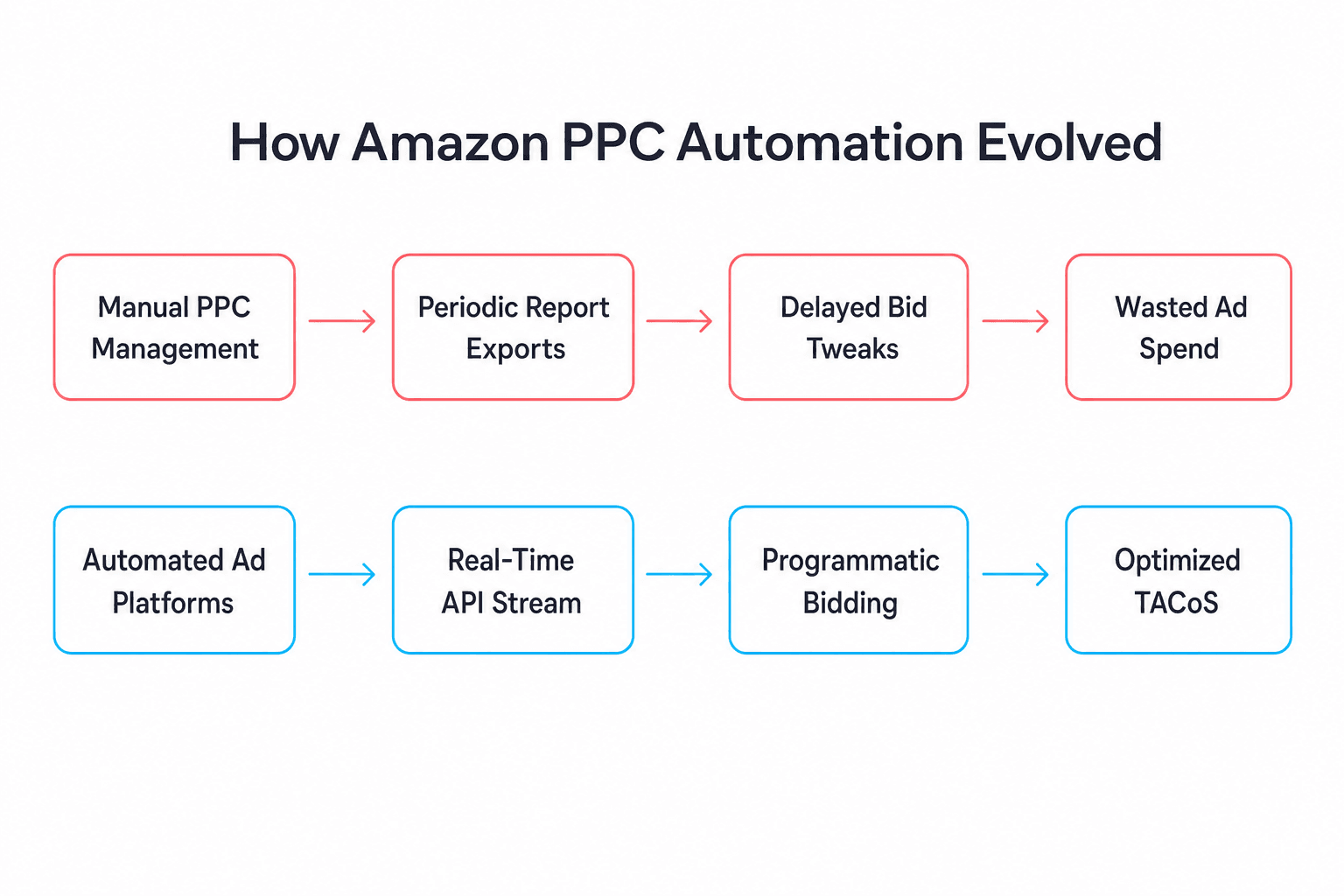
According to SellerMetrics, Amazon sellers typically spend 10% to 20% of their monthly revenue on ads, with budgets ranging from a few hundred dollars a month to tens of thousands for established brands. Modern ad platforms transition media management from reactive weekly maintenance into a continuous, real-time optimization loop.
Why Is Multi-Platform Integration Essential for E-Commerce Retail Media?
Multi-platform integration is essential because modern customer buying journeys rarely start and end on a single website. Consumers frequently discover products via social media channels like Meta (Instagram and Facebook) or search engines like Google before finalizing their purchase on Amazon.
Deploying AI-powered marketing across both on-Amazon and off-Amazon channels provides several strategic benefits for expanding brands:
1. Unified Attribution and Incremental Growth
Driving off-platform traffic via Google Ads and Meta Ads can significantly boost a product's Best Sellers Rank (BSR) on Amazon. However, managing these campaigns in isolated silos makes it difficult to measure true return on ad spend. Multi-platform ad tools integrate with Amazon Attribution to link external ad clicks directly to Amazon sales, providing clear visibility into incremental brand growth.
2. Cross-Channel Budget Optimization
When an advertising platform tracks performance across Meta, Google, and Amazon simultaneously, its optimization algorithms can dynamically allocate budget to the highest-performing channel. If a Meta video ad yields a lower customer acquisition cost (CAC) than a Sponsored Products keyword on a given day, the system can shift media spend automatically to maximize total sales.
3. Comprehensive AI-Generated Insights
Disparate data sheets obscure overarching consumer trends. Advanced ad management software synthesizes advertising metrics across channels into unified, plain-English executive summaries. These automated insights highlight cross-channel keyword performance, flag seasonal demand shifts, and evaluate customer lifetime value (LTV) across your entire retail footprint.
How Do the Top Amazon Ad Tools Compare in 2026?
Selecting the right PPC software requires evaluating tools based on their automation depth, multi-platform capabilities, and target budget tiers. Below is a comparative breakdown of the leading ad management solutions available in 2026. Tools below are ordered by depth of native operations integration rather than price or popularity, Lumian Technologies, which publishes this guide, also builds Lumian Agent.
1. Lumian Agent (Integrated Operations & Media Intelligence)
Lumian Agent connects store administration and media tracking through direct Selling Partner API and Ads API integrations, coordinating ad spend alongside inventory levels, account health, and contribution margins rather than optimizing ad bids in isolation.
Core Strengths: Features pre-built operational dashboards, natural-language chat querying for ad analytics, and scheduled tasks that monitor TACoS shifts daily. Reduces ad spend on low-stock SKUs and delivers cross-channel reporting summaries to Slack or email.
Target Budget Tier: Ideal for growing mid-market and enterprise brands that require unified store operations alongside automated media management.
2. Perpetua (Programmatic Bid Optimization)
Perpetua offers an established programmatic media engine focused on goal-based campaign creation. Operators set target ACoS guidelines, and the software's algorithms adjust keyword bids dynamically across Sponsored Products, Sponsored Brands, and Sponsored Display.
Core Strengths: Provides structured "Always-On" campaign architecture, advanced Amazon DSP access, and integrated video ad generation tools.
Target Budget Tier: Best suited for brands with medium to large monthly ad budgets seeking dedicated programmatic bid management.
3. Intentwise (Advanced Analytics & AMC Integration)
Intentwise specializes in advanced retail media analytics, providing a powerful data pipeline that connects Amazon Ads, Amazon Marketing Cloud (AMC), and external ad channels into a centralized data warehouse.
Core Strengths: Offers customizable SQL-based reporting modules, detailed attribution modeling across Amazon and Walmart, and deep AMC spatial analytics.
Target Budget Tier: Enterprise brands and agency media teams requiring custom data infrastructure and multi-retailer analytics.
4. Helium 10 Adtomic (PPC Management for Sellers)
Adtomic is the built-in advertising management module within the broader Helium 10 software suite, designed to simplify campaign creation and keyword harvesting for private-label sellers.
Core Strengths: Seamless integration with Helium 10's keyword research tools, automated search term rule creation, and clean bid suggestion interfaces.
Target Budget Tier: Early-stage and mid-sized Amazon sellers looking for an all-in-one software package to handle keyword research and basic ad management.
Tool | Core Function | Budget Tier | Best For |
Lumian Agent | Ad spend + inventory + account health, unified | Mid-market to enterprise | Brands wanting operations and media managed together |
Perpetua | Programmatic bid optimization, DSP access | Medium to large ad budgets | Dedicated programmatic bid management |
Intentwise | AMC + multi-retailer data pipeline | Enterprise / agency | Custom analytics infrastructure |
Helium 10 Adtomic | Keyword research + basic PPC | Early-stage to mid-size sellers | All-in-one, lower-complexity setups |
What Should You Look for in an Amazon Ad Tool?
When evaluating Amazon ad tools for your marketing stack, ensure the platform includes these seven core operational capabilities:
Direct Amazon Ads API and SP-API Integration: Secure, official API access to guarantee real-time data syncs without relying on manual report downloads.
Automated Keyword Harvesting and Negative Match Rules: Software rules that automatically promote converting customer search queries into active targets while masking non-converting phrases.
Inventory-Aware Bidding Guards: Automated safeguards that pause or lower ad spend when SKU inventory drops below defined safety thresholds to prevent rapid stockouts.
TACoS and Contribution Margin Tracking: Metrics tracking that prioritizes total brand profitability over isolated, campaign-level ACoS targets.
Off-Amazon Attribution Support: Native compatibility with Amazon Attribution to measure and optimize traffic driven from Google, Meta, and TikTok.
Customizable Human-in-the-Loop Controls: Flexible rules that allow operators to review major budget reallocations or bid changes before execution.
Cross-Channel Executive Analytics: Unified reporting engines that synthesize complex ad data into actionable summaries delivered via Slack, email, or interactive chat interfaces.
Conclusion
The evolution of retail media in 2026 has made advanced ad management solutions essential for brands seeking to protect their market share on Amazon. By moving past manual bidding and adopting multi-platform PPC automation, e-commerce companies can optimize full-funnel customer acquisition, capture incremental traffic from external channels, and protect their net contribution margins. The tools compared above vary widely in how they balance automation against manual control. Lumian Agent is built around unifying ad spend with account health and inventory – see how it works.
Frequently Asked Questions
What are the primary benefits of using AI-powered marketing tools for Amazon PPC?
AI-powered tools make real-time bid adjustments, harvest converting search terms, and cut wasted ad spend automatically. This lowers Total Advertising Cost of Sale (TACoS) and frees up time for strategic planning.
How does off-Amazon traffic impact my product's organic search rank?
Amazon's A10 algorithm rewards listings that drive high-converting external traffic. Qualified visitors from Google and Meta boost conversion rates and Best Sellers Rank, which improves organic keyword positioning.
What is the difference between ACoS and TACoS in ad management?
ACoS (Advertising Cost of Sales) measures direct ad efficiency by dividing ad spend by direct ad revenue. TACoS (Total Advertising Cost of Sales) divides total ad spend by total revenue (including organic sales), offering a clearer picture of how advertising drives overall business growth and organic rank.
Can an automated ad tool protect my campaigns when product inventory is low?
Yes, provided the software includes inventory-aware bidding guards. Advanced tools like Lumian Agent monitor SKU stock levels via the SP-API and automatically reduce ad spend on low-stock items, preventing stockouts and saving ad budget for fully stocked products.
Is it safe to authorize third-party ad software on my Amazon Ads account?
Third-party ad software is safe to authorize when it uses official Amazon Ads API and Selling Partner API protocols. These integrations let you grant specific data permissions and revoke access anytime through Seller Central or the Amazon Ads console.

Co-Founder & CEO, Lumian
Robin Lobo is Co-Founder and CEO of Lumian. He built and sold a seven-figure eyeglasses brand on Amazon and spent several years on the client side of traditional agencies before founding Lumian, an AI-native Amazon agency backed by $3M led by Bowery Capital.