Building Your Own Amazon AI Agent with ChatGPT or Claude vs. Using a Purpose-Built Agent
ChatGPT and Claude handle ad-hoc Amazon tasks well, but live account management needs SP-API guardrails they lack. See when DIY works and what building your own really costs.

TL;DR
General-purpose LLMs like ChatGPT and Claude are excellent for ad-hoc Amazon tasks: copywriting, review analysis, one-off research. Managing a live account daily requires continuous SP-API monitoring, deterministic guardrails, and cross-functional reasoning that purpose-built agents provide out of the box. This guide covers where each approach wins and the real cost of building your own.
Key Takeaways
Data Connectivity: General LLMs require manual CSV exports or custom-coded API bridges, whereas purpose-built agents connect natively to Amazon SP-API via secure OAuth 2.0.
Context & Memory: General LLM models lose memory context across long conversations, whereas purpose-built architecture maintains persistent relational databases across advertising, inventory, and catalog health.
Execution & Safety: DIY prompts cannot safely execute live API changes without strict parameter guardrails, price floors, and automated circuit breakers.
Total Cost of Ownership: Building and maintaining custom API integrations, prompt pipelines, and error-handling code quickly exceeds the cost of deploying an established e-commerce AI infrastructure.
Can You Manage an Amazon Account with ChatGPT or Claude?
The rapid evolution of frontier Large Language Models (LLMs) like OpenAI's ChatGPT and Anthropic's Claude has made advanced artificial intelligence accessible to every e-commerce business. With Custom GPTs, Claude Projects, and API connectors, brand managers can upload CSV reports, write custom instructions, and analyze campaign performance in seconds.
For ad-hoc tasks - such as rewriting a single product description, brainstorming A+ Content concepts, or summarizing a customer review file - general-purpose LLMs perform exceptionally well. These models provide rapid text generation and basic pattern recognition without requiring upfront software development.
However, as catalog complexity grows and sales volume expands, relying on custom prompts for daily account operations reveals structural limitations. Managing a live Amazon business requires more than generating text; it demands real-time data ingestion, cross-functional decision-making, and safe automated execution.
How DIY AI Agents Work (and Where They Struggle)
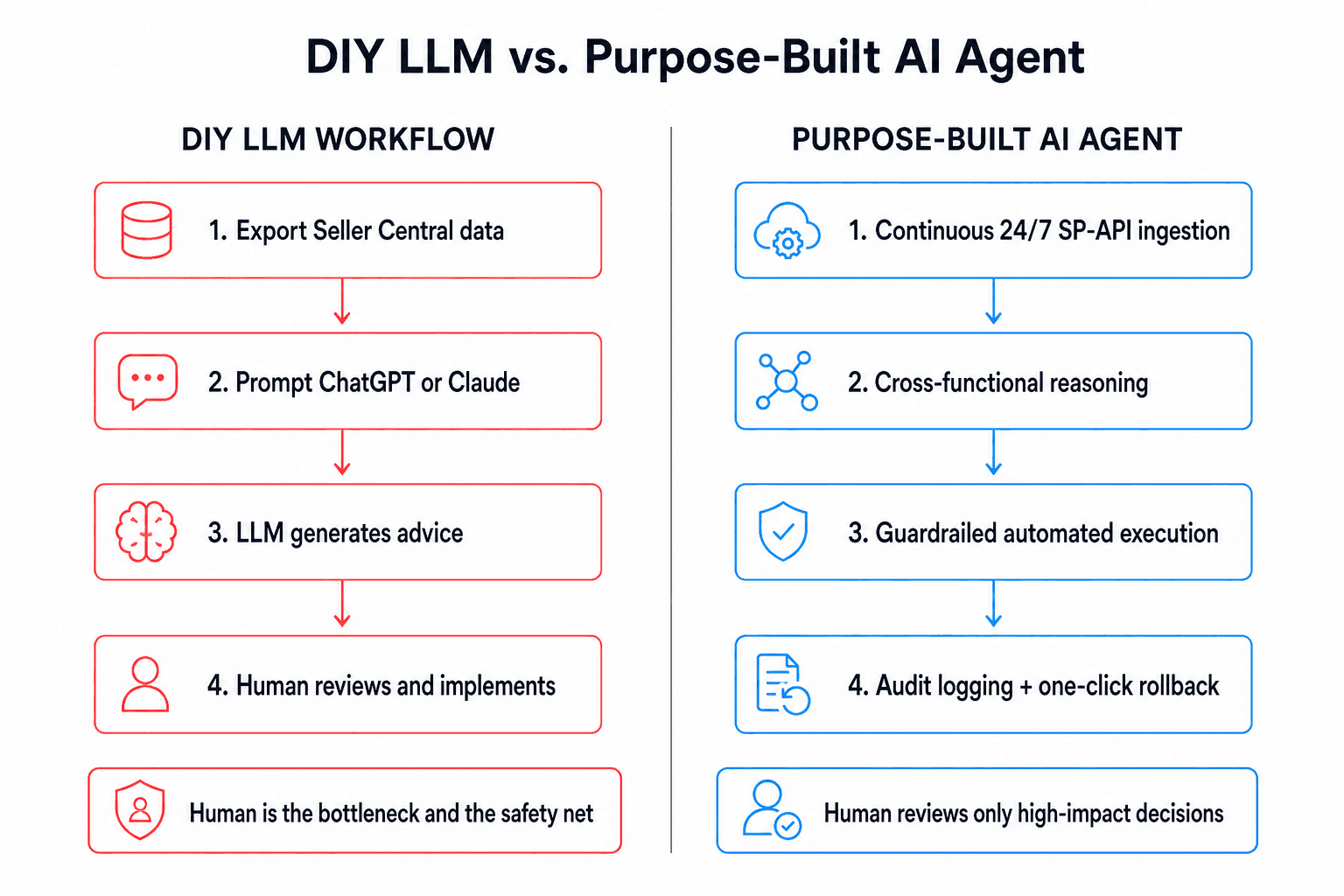
Creating a DIY agent using ChatGPT, Claude, or a custom wrapper typically involves three components:
Prompt Engineering: Writing system instructions that tell the LLM how to act as an Amazon PPC specialist, copywriter, or inventory planner.
Data Connection: Uploading Seller Central exports, or wiring live data through connectors and MCP integrations, which both ChatGPT and Claude now support.
Output Interpretation: Reading the model's textual advice and manually implementing those recommendations back inside Seller Central.
The Limitations of DIY Workflows
Context Window and Memory Decay: Large Language Models process data in limited context windows. When analyzing thousands of search terms or daily inventory logs, models truncate older data, leading to incomplete insights or hallucinated statistics.
Static vs. Real-Time Data: Seller Central CSV exports represent a single snapshot in time. By the time a report is exported, uploaded, and analyzed, Buy Box statuses may have shifted, ad budgets may have depleted, or inventory burn rates may have accelerated.
Lack of Multi-Domain Synthesis: A prompt written for PPC ad optimization does not automatically check warehouse days-of-cover or gross margin floors. An LLM might recommend aggressively increasing bids on a high-converting keyword without realizing the SKU will run out of stock in five days.
Execution Accountability: Even with connectors, a general LLM executes without marketplace-specific guardrails. Nothing stops it from dropping a price below margin floor or blowing a daily budget, and there is no audit trail or rollback when it does. The burden of catching errors stays with the human.
What Purpose-Built Amazon AI Agents Do Differently
Purpose-built Amazon AI platforms are engineered specifically around marketplace architecture, combining specialized machine learning models with native API integrations and deterministic guardrails.
Instead of acting as an isolated chatbot, a purpose-built system like Lumian Agents operates as an automated control layer over your Seller Central account.
1. Native Selling Partner API (SP-API) Ingestion
Purpose-built agents connect directly to Amazon via OAuth 2.0 protocols. They stream performance logs, inventory movements, buy box status shifts, and campaign spend around the clock without requiring manual spreadsheet exports.
2. Relational Cross-Functional Reasoning
E-commerce decisions rarely happen in isolation. Purpose-built agents evaluate data across multiple domains simultaneously:
Inventory-Aware Bidding: Automatically throttling pay-per-click (PPC) ad spend when warehouse stock drops below critical thresholds to prevent stockouts and preserve organic rank.
Margin-Aware Pricing: Calculating real-time net profitability after accounting for FBA storage fees, ad spend, and COGS before recommending price adjustments.
Automated Catalog Health: Scanning for listing suppressions, title truncation policy flags, and Buy Box losses continuously.
3. Bounded Execution Guardrails
Safety is paramount when automating live marketplace accounts. Purpose-built agents operate within hard programmatic boundaries - such as maximum bid caps, daily budget limits, and gross margin price floors. High-consequence decisions trigger approval queues for human review, ensuring that automated speed never compromises account health.
Architectural Comparison: DIY Setup vs. Purpose-Built Platform
To understand the operational differences, review how custom DIY builds compare against purpose-built agent infrastructure across core technical requirements:
Operational Feature | DIY ChatGPT / Claude Build | Purpose-Built Amazon AI Agent |
Data Connection | Manual CSV upload or custom middleware | Native 24/7 SP-API integration |
Execution Method | Manual implementation by human user | Automated API dispatch with approval gates |
Multi-Domain Intelligence | Fragmented across separate prompts | Integrated across PPC, inventory, and catalog health |
Risk Containment | High risk of hallucinated calculations | Deterministic parameter guardrails & price floors |
Maintenance Burden | High - constant prompt and API debugging | Low, platform-maintained infrastructure |
Auditability | Chat history threads | Immutable, timestamped audit log with 1-click rollback |
The Hidden Costs of Building and Maintaining DIY Agents
While starting with a ChatGPT or Claude subscription appears cost-effective, scaling a custom-built solution introduces significant hidden operational overhead.
1. Developer and Maintenance Labor
Building a custom API connector between an LLM and Amazon SP-API requires dedicated software engineering time. Amazon frequently updates API documentation, endpoints, and rate limits. Maintaining custom code, handling authentication token refreshes, and managing API error codes requires ongoing developer maintenance.
2. The Cost of Hallucination in Financial Workflows
General-purpose LLMs are probabilistic text generators, not deterministic math engines. When calculating complex metrics like Total Advertising Cost of Sales (TACoS) or inventory reorder points across large datasets, general LLMs can miscalculate numbers while presenting them with high confidence.3. Industry Adoption Trends
Marketplace competition is accelerating rapidly. According to data published by Triple Whale on AI e-commerce statistics, over 80% of retail organizations are actively deploying or piloting AI workflows. In a high-velocity environment, spending internal bandwidth troubleshooting custom prompt workflows puts brands at a disadvantage compared to competitors utilizing optimized, purpose-built tools.
When to Use DIY AI vs. When to Deploy a Purpose-Built Platform
Selecting the right approach depends on your brand's operational maturity, catalog size, and technical resources.
Choose a DIY LLM Workflow If:
You need ad-hoc assistance writing listing bullet points, drafting customer service responses, or brainstorming brand messaging.
You manage a simple catalog with 1 to 3 SKUs where manual data exports take only a few minutes per week.
You are testing early-stage product concepts and do not require automated API execution or real-time inventory monitoring.
Choose a Purpose-Built Platform If:
You manage a growing catalog across multiple parent-child variations or international marketplaces.
You want 24/7 automated campaign execution, negative keyword harvesting, and inventory-aware bid throttling without manual report exporting.
You require enterprise data security, transparent audit logging, and human-in-the-loop governance to protect brand margins.
For brands seeking complete operational management, pairing purpose-built technology with expert human execution delivers the fastest path to scale. Combining automated AI speed with dedicated brand management strategies through Lumian Amazon Management Services allows brand leaders to eliminate manual operational bottlenecks entirely.
Frequently Asked Questions
Can I connect ChatGPT or Claude directly to my Amazon Seller Central account?
While custom API bridges can be built using middleware tools, standard interfaces for ChatGPT and Claude do not natively support direct, secure read-and-write connections to Amazon's Selling Partner API (SP-API) without custom engineering and OAuth security configurations.
What is the biggest risk of using a DIY ChatGPT prompt for Amazon PPC?
General LLMs lack real-time visibility into warehouse inventory levels and gross margin floors. A prompt optimized purely for ad performance may aggressively raise bids on a product nearing a stockout, accelerating inventory depletion and eroding organic search rank once stock hits zero.
How do purpose-built Amazon AI agents prevent mathematical hallucinations?
Purpose-built platforms separate deterministic data processing from generative natural language interfaces. Calculations for metrics like ACoS, TACoS, and reorder points are handled by precise mathematical algorithms, while generative models are used strictly for text and analysis tasks.
How does a purpose-built agent protect account security?
Purpose-built platforms use Amazon's official SP-API OAuth 2.0 framework, granting scoped read and write access without requiring primary Seller Central passwords. Data is encrypted using enterprise TLS 1.3 and AES-256 standards.
Is a purpose-built AI agent more cost-effective than building custom software in-house?
For most brands, yes. Building and maintaining custom SP-API integrations typically requires an ongoing engineering commitment measured in tens of thousands of dollars per year. The exception is large sellers with in-house engineering teams and genuinely unique workflow needs. For everyone else, purpose-built infrastructure is cheaper and faster.
How much does it cost to build a custom Amazon AI agent?
A minimal custom build (SP-API auth, data pipeline, LLM integration, basic guardrails) typically requires 2-4 months of engineering time to launch, plus ongoing maintenance as Amazon updates its APIs. Most brands spend $50K-$150K in the first year before reaching feature parity with off-the-shelf platforms.
Co-Founder & CEO, Lumian
Robin Lobo is Co-Founder and CEO of Lumian. He built and sold a seven-figure eyeglasses brand on Amazon and spent several years on the client side of traditional agencies before founding Lumian, an AI-native Amazon agency backed by $3M led by Bowery Capital.

AI Agent
Your Amazon business, fully managed.

Brand ManAger

Expert Team
Building Your Own Amazon AI Agent with ChatGPT or Claude vs. Using a Purpose-Built Agent
ChatGPT and Claude handle ad-hoc Amazon tasks well, but live account management needs SP-API guardrails they lack. See when DIY works and what building your own really costs.
TL;DR
General-purpose LLMs like ChatGPT and Claude are excellent for ad-hoc Amazon tasks: copywriting, review analysis, one-off research. Managing a live account daily requires continuous SP-API monitoring, deterministic guardrails, and cross-functional reasoning that purpose-built agents provide out of the box. This guide covers where each approach wins and the real cost of building your own.
Key Takeaways
Data Connectivity: General LLMs require manual CSV exports or custom-coded API bridges, whereas purpose-built agents connect natively to Amazon SP-API via secure OAuth 2.0.
Context & Memory: General LLM models lose memory context across long conversations, whereas purpose-built architecture maintains persistent relational databases across advertising, inventory, and catalog health.
Execution & Safety: DIY prompts cannot safely execute live API changes without strict parameter guardrails, price floors, and automated circuit breakers.
Total Cost of Ownership: Building and maintaining custom API integrations, prompt pipelines, and error-handling code quickly exceeds the cost of deploying an established e-commerce AI infrastructure.
Can You Manage an Amazon Account with ChatGPT or Claude?
The rapid evolution of frontier Large Language Models (LLMs) like OpenAI's ChatGPT and Anthropic's Claude has made advanced artificial intelligence accessible to every e-commerce business. With Custom GPTs, Claude Projects, and API connectors, brand managers can upload CSV reports, write custom instructions, and analyze campaign performance in seconds.
For ad-hoc tasks - such as rewriting a single product description, brainstorming A+ Content concepts, or summarizing a customer review file - general-purpose LLMs perform exceptionally well. These models provide rapid text generation and basic pattern recognition without requiring upfront software development.
However, as catalog complexity grows and sales volume expands, relying on custom prompts for daily account operations reveals structural limitations. Managing a live Amazon business requires more than generating text; it demands real-time data ingestion, cross-functional decision-making, and safe automated execution.
How DIY AI Agents Work (and Where They Struggle)
Creating a DIY agent using ChatGPT, Claude, or a custom wrapper typically involves three components:
Prompt Engineering: Writing system instructions that tell the LLM how to act as an Amazon PPC specialist, copywriter, or inventory planner.
Data Connection: Uploading Seller Central exports, or wiring live data through connectors and MCP integrations, which both ChatGPT and Claude now support.
Output Interpretation: Reading the model's textual advice and manually implementing those recommendations back inside Seller Central.
The Limitations of DIY Workflows
Context Window and Memory Decay: Large Language Models process data in limited context windows. When analyzing thousands of search terms or daily inventory logs, models truncate older data, leading to incomplete insights or hallucinated statistics.
Static vs. Real-Time Data: Seller Central CSV exports represent a single snapshot in time. By the time a report is exported, uploaded, and analyzed, Buy Box statuses may have shifted, ad budgets may have depleted, or inventory burn rates may have accelerated.
Lack of Multi-Domain Synthesis: A prompt written for PPC ad optimization does not automatically check warehouse days-of-cover or gross margin floors. An LLM might recommend aggressively increasing bids on a high-converting keyword without realizing the SKU will run out of stock in five days.
Execution Accountability: Even with connectors, a general LLM executes without marketplace-specific guardrails. Nothing stops it from dropping a price below margin floor or blowing a daily budget, and there is no audit trail or rollback when it does. The burden of catching errors stays with the human.
What Purpose-Built Amazon AI Agents Do Differently
Purpose-built Amazon AI platforms are engineered specifically around marketplace architecture, combining specialized machine learning models with native API integrations and deterministic guardrails.
Instead of acting as an isolated chatbot, a purpose-built system like Lumian Agents operates as an automated control layer over your Seller Central account.
1. Native Selling Partner API (SP-API) Ingestion
Purpose-built agents connect directly to Amazon via OAuth 2.0 protocols. They stream performance logs, inventory movements, buy box status shifts, and campaign spend around the clock without requiring manual spreadsheet exports.
2. Relational Cross-Functional Reasoning
E-commerce decisions rarely happen in isolation. Purpose-built agents evaluate data across multiple domains simultaneously:
Inventory-Aware Bidding: Automatically throttling pay-per-click (PPC) ad spend when warehouse stock drops below critical thresholds to prevent stockouts and preserve organic rank.
Margin-Aware Pricing: Calculating real-time net profitability after accounting for FBA storage fees, ad spend, and COGS before recommending price adjustments.
Automated Catalog Health: Scanning for listing suppressions, title truncation policy flags, and Buy Box losses continuously.
3. Bounded Execution Guardrails
Safety is paramount when automating live marketplace accounts. Purpose-built agents operate within hard programmatic boundaries - such as maximum bid caps, daily budget limits, and gross margin price floors. High-consequence decisions trigger approval queues for human review, ensuring that automated speed never compromises account health.
Architectural Comparison: DIY Setup vs. Purpose-Built Platform
To understand the operational differences, review how custom DIY builds compare against purpose-built agent infrastructure across core technical requirements:
Operational Feature | DIY ChatGPT / Claude Build | Purpose-Built Amazon AI Agent |
Data Connection | Manual CSV upload or custom middleware | Native 24/7 SP-API integration |
Execution Method | Manual implementation by human user | Automated API dispatch with approval gates |
Multi-Domain Intelligence | Fragmented across separate prompts | Integrated across PPC, inventory, and catalog health |
Risk Containment | High risk of hallucinated calculations | Deterministic parameter guardrails & price floors |
Maintenance Burden | High - constant prompt and API debugging | Low, platform-maintained infrastructure |
Auditability | Chat history threads | Immutable, timestamped audit log with 1-click rollback |
The Hidden Costs of Building and Maintaining DIY Agents
While starting with a ChatGPT or Claude subscription appears cost-effective, scaling a custom-built solution introduces significant hidden operational overhead.
1. Developer and Maintenance Labor
Building a custom API connector between an LLM and Amazon SP-API requires dedicated software engineering time. Amazon frequently updates API documentation, endpoints, and rate limits. Maintaining custom code, handling authentication token refreshes, and managing API error codes requires ongoing developer maintenance.
2. The Cost of Hallucination in Financial Workflows
General-purpose LLMs are probabilistic text generators, not deterministic math engines. When calculating complex metrics like Total Advertising Cost of Sales (TACoS) or inventory reorder points across large datasets, general LLMs can miscalculate numbers while presenting them with high confidence.3. Industry Adoption Trends
Marketplace competition is accelerating rapidly. According to data published by Triple Whale on AI e-commerce statistics, over 80% of retail organizations are actively deploying or piloting AI workflows. In a high-velocity environment, spending internal bandwidth troubleshooting custom prompt workflows puts brands at a disadvantage compared to competitors utilizing optimized, purpose-built tools.
When to Use DIY AI vs. When to Deploy a Purpose-Built Platform
Selecting the right approach depends on your brand's operational maturity, catalog size, and technical resources.
Choose a DIY LLM Workflow If:
You need ad-hoc assistance writing listing bullet points, drafting customer service responses, or brainstorming brand messaging.
You manage a simple catalog with 1 to 3 SKUs where manual data exports take only a few minutes per week.
You are testing early-stage product concepts and do not require automated API execution or real-time inventory monitoring.
Choose a Purpose-Built Platform If:
You manage a growing catalog across multiple parent-child variations or international marketplaces.
You want 24/7 automated campaign execution, negative keyword harvesting, and inventory-aware bid throttling without manual report exporting.
You require enterprise data security, transparent audit logging, and human-in-the-loop governance to protect brand margins.
For brands seeking complete operational management, pairing purpose-built technology with expert human execution delivers the fastest path to scale. Combining automated AI speed with dedicated brand management strategies through Lumian Amazon Management Services allows brand leaders to eliminate manual operational bottlenecks entirely.
Frequently Asked Questions
Can I connect ChatGPT or Claude directly to my Amazon Seller Central account?
While custom API bridges can be built using middleware tools, standard interfaces for ChatGPT and Claude do not natively support direct, secure read-and-write connections to Amazon's Selling Partner API (SP-API) without custom engineering and OAuth security configurations.
What is the biggest risk of using a DIY ChatGPT prompt for Amazon PPC?
General LLMs lack real-time visibility into warehouse inventory levels and gross margin floors. A prompt optimized purely for ad performance may aggressively raise bids on a product nearing a stockout, accelerating inventory depletion and eroding organic search rank once stock hits zero.
How do purpose-built Amazon AI agents prevent mathematical hallucinations?
Purpose-built platforms separate deterministic data processing from generative natural language interfaces. Calculations for metrics like ACoS, TACoS, and reorder points are handled by precise mathematical algorithms, while generative models are used strictly for text and analysis tasks.
How does a purpose-built agent protect account security?
Purpose-built platforms use Amazon's official SP-API OAuth 2.0 framework, granting scoped read and write access without requiring primary Seller Central passwords. Data is encrypted using enterprise TLS 1.3 and AES-256 standards.
Is a purpose-built AI agent more cost-effective than building custom software in-house?
For most brands, yes. Building and maintaining custom SP-API integrations typically requires an ongoing engineering commitment measured in tens of thousands of dollars per year. The exception is large sellers with in-house engineering teams and genuinely unique workflow needs. For everyone else, purpose-built infrastructure is cheaper and faster.
How much does it cost to build a custom Amazon AI agent?
A minimal custom build (SP-API auth, data pipeline, LLM integration, basic guardrails) typically requires 2-4 months of engineering time to launch, plus ongoing maintenance as Amazon updates its APIs. Most brands spend $50K-$150K in the first year before reaching feature parity with off-the-shelf platforms.
Co-Founder & CEO, Lumian
Robin Lobo is Co-Founder and CEO of Lumian. He built and sold a seven-figure eyeglasses brand on Amazon and spent several years on the client side of traditional agencies before founding Lumian, an AI-native Amazon agency backed by $3M led by Bowery Capital.
AI Agent
Your Amazon business, fully managed.
Brand ManAger
Expert Team
Building Your Own Amazon AI Agent with ChatGPT or Claude vs. Using a Purpose-Built Agent
ChatGPT and Claude handle ad-hoc Amazon tasks well, but live account management needs SP-API guardrails they lack. See when DIY works and what building your own really costs.
TL;DR
General-purpose LLMs like ChatGPT and Claude are excellent for ad-hoc Amazon tasks: copywriting, review analysis, one-off research. Managing a live account daily requires continuous SP-API monitoring, deterministic guardrails, and cross-functional reasoning that purpose-built agents provide out of the box. This guide covers where each approach wins and the real cost of building your own.
Key Takeaways
Data Connectivity: General LLMs require manual CSV exports or custom-coded API bridges, whereas purpose-built agents connect natively to Amazon SP-API via secure OAuth 2.0.
Context & Memory: General LLM models lose memory context across long conversations, whereas purpose-built architecture maintains persistent relational databases across advertising, inventory, and catalog health.
Execution & Safety: DIY prompts cannot safely execute live API changes without strict parameter guardrails, price floors, and automated circuit breakers.
Total Cost of Ownership: Building and maintaining custom API integrations, prompt pipelines, and error-handling code quickly exceeds the cost of deploying an established e-commerce AI infrastructure.
Can You Manage an Amazon Account with ChatGPT or Claude?
The rapid evolution of frontier Large Language Models (LLMs) like OpenAI's ChatGPT and Anthropic's Claude has made advanced artificial intelligence accessible to every e-commerce business. With Custom GPTs, Claude Projects, and API connectors, brand managers can upload CSV reports, write custom instructions, and analyze campaign performance in seconds.
For ad-hoc tasks - such as rewriting a single product description, brainstorming A+ Content concepts, or summarizing a customer review file - general-purpose LLMs perform exceptionally well. These models provide rapid text generation and basic pattern recognition without requiring upfront software development.
However, as catalog complexity grows and sales volume expands, relying on custom prompts for daily account operations reveals structural limitations. Managing a live Amazon business requires more than generating text; it demands real-time data ingestion, cross-functional decision-making, and safe automated execution.
How DIY AI Agents Work (and Where They Struggle)
Creating a DIY agent using ChatGPT, Claude, or a custom wrapper typically involves three components:
Prompt Engineering: Writing system instructions that tell the LLM how to act as an Amazon PPC specialist, copywriter, or inventory planner.
Data Connection: Uploading Seller Central exports, or wiring live data through connectors and MCP integrations, which both ChatGPT and Claude now support.
Output Interpretation: Reading the model's textual advice and manually implementing those recommendations back inside Seller Central.
The Limitations of DIY Workflows
Context Window and Memory Decay: Large Language Models process data in limited context windows. When analyzing thousands of search terms or daily inventory logs, models truncate older data, leading to incomplete insights or hallucinated statistics.
Static vs. Real-Time Data: Seller Central CSV exports represent a single snapshot in time. By the time a report is exported, uploaded, and analyzed, Buy Box statuses may have shifted, ad budgets may have depleted, or inventory burn rates may have accelerated.
Lack of Multi-Domain Synthesis: A prompt written for PPC ad optimization does not automatically check warehouse days-of-cover or gross margin floors. An LLM might recommend aggressively increasing bids on a high-converting keyword without realizing the SKU will run out of stock in five days.
Execution Accountability: Even with connectors, a general LLM executes without marketplace-specific guardrails. Nothing stops it from dropping a price below margin floor or blowing a daily budget, and there is no audit trail or rollback when it does. The burden of catching errors stays with the human.
What Purpose-Built Amazon AI Agents Do Differently
Purpose-built Amazon AI platforms are engineered specifically around marketplace architecture, combining specialized machine learning models with native API integrations and deterministic guardrails.
Instead of acting as an isolated chatbot, a purpose-built system like Lumian Agents operates as an automated control layer over your Seller Central account.
1. Native Selling Partner API (SP-API) Ingestion
Purpose-built agents connect directly to Amazon via OAuth 2.0 protocols. They stream performance logs, inventory movements, buy box status shifts, and campaign spend around the clock without requiring manual spreadsheet exports.
2. Relational Cross-Functional Reasoning
E-commerce decisions rarely happen in isolation. Purpose-built agents evaluate data across multiple domains simultaneously:
Inventory-Aware Bidding: Automatically throttling pay-per-click (PPC) ad spend when warehouse stock drops below critical thresholds to prevent stockouts and preserve organic rank.
Margin-Aware Pricing: Calculating real-time net profitability after accounting for FBA storage fees, ad spend, and COGS before recommending price adjustments.
Automated Catalog Health: Scanning for listing suppressions, title truncation policy flags, and Buy Box losses continuously.
3. Bounded Execution Guardrails
Safety is paramount when automating live marketplace accounts. Purpose-built agents operate within hard programmatic boundaries - such as maximum bid caps, daily budget limits, and gross margin price floors. High-consequence decisions trigger approval queues for human review, ensuring that automated speed never compromises account health.
Architectural Comparison: DIY Setup vs. Purpose-Built Platform
To understand the operational differences, review how custom DIY builds compare against purpose-built agent infrastructure across core technical requirements:
Operational Feature | DIY ChatGPT / Claude Build | Purpose-Built Amazon AI Agent |
Data Connection | Manual CSV upload or custom middleware | Native 24/7 SP-API integration |
Execution Method | Manual implementation by human user | Automated API dispatch with approval gates |
Multi-Domain Intelligence | Fragmented across separate prompts | Integrated across PPC, inventory, and catalog health |
Risk Containment | High risk of hallucinated calculations | Deterministic parameter guardrails & price floors |
Maintenance Burden | High - constant prompt and API debugging | Low, platform-maintained infrastructure |
Auditability | Chat history threads | Immutable, timestamped audit log with 1-click rollback |
The Hidden Costs of Building and Maintaining DIY Agents
While starting with a ChatGPT or Claude subscription appears cost-effective, scaling a custom-built solution introduces significant hidden operational overhead.
1. Developer and Maintenance Labor
Building a custom API connector between an LLM and Amazon SP-API requires dedicated software engineering time. Amazon frequently updates API documentation, endpoints, and rate limits. Maintaining custom code, handling authentication token refreshes, and managing API error codes requires ongoing developer maintenance.
2. The Cost of Hallucination in Financial Workflows
General-purpose LLMs are probabilistic text generators, not deterministic math engines. When calculating complex metrics like Total Advertising Cost of Sales (TACoS) or inventory reorder points across large datasets, general LLMs can miscalculate numbers while presenting them with high confidence.3. Industry Adoption Trends
Marketplace competition is accelerating rapidly. According to data published by Triple Whale on AI e-commerce statistics, over 80% of retail organizations are actively deploying or piloting AI workflows. In a high-velocity environment, spending internal bandwidth troubleshooting custom prompt workflows puts brands at a disadvantage compared to competitors utilizing optimized, purpose-built tools.
When to Use DIY AI vs. When to Deploy a Purpose-Built Platform
Selecting the right approach depends on your brand's operational maturity, catalog size, and technical resources.
Choose a DIY LLM Workflow If:
You need ad-hoc assistance writing listing bullet points, drafting customer service responses, or brainstorming brand messaging.
You manage a simple catalog with 1 to 3 SKUs where manual data exports take only a few minutes per week.
You are testing early-stage product concepts and do not require automated API execution or real-time inventory monitoring.
Choose a Purpose-Built Platform If:
You manage a growing catalog across multiple parent-child variations or international marketplaces.
You want 24/7 automated campaign execution, negative keyword harvesting, and inventory-aware bid throttling without manual report exporting.
You require enterprise data security, transparent audit logging, and human-in-the-loop governance to protect brand margins.
For brands seeking complete operational management, pairing purpose-built technology with expert human execution delivers the fastest path to scale. Combining automated AI speed with dedicated brand management strategies through Lumian Amazon Management Services allows brand leaders to eliminate manual operational bottlenecks entirely.
Frequently Asked Questions
Can I connect ChatGPT or Claude directly to my Amazon Seller Central account?
While custom API bridges can be built using middleware tools, standard interfaces for ChatGPT and Claude do not natively support direct, secure read-and-write connections to Amazon's Selling Partner API (SP-API) without custom engineering and OAuth security configurations.
What is the biggest risk of using a DIY ChatGPT prompt for Amazon PPC?
General LLMs lack real-time visibility into warehouse inventory levels and gross margin floors. A prompt optimized purely for ad performance may aggressively raise bids on a product nearing a stockout, accelerating inventory depletion and eroding organic search rank once stock hits zero.
How do purpose-built Amazon AI agents prevent mathematical hallucinations?
Purpose-built platforms separate deterministic data processing from generative natural language interfaces. Calculations for metrics like ACoS, TACoS, and reorder points are handled by precise mathematical algorithms, while generative models are used strictly for text and analysis tasks.
How does a purpose-built agent protect account security?
Purpose-built platforms use Amazon's official SP-API OAuth 2.0 framework, granting scoped read and write access without requiring primary Seller Central passwords. Data is encrypted using enterprise TLS 1.3 and AES-256 standards.
Is a purpose-built AI agent more cost-effective than building custom software in-house?
For most brands, yes. Building and maintaining custom SP-API integrations typically requires an ongoing engineering commitment measured in tens of thousands of dollars per year. The exception is large sellers with in-house engineering teams and genuinely unique workflow needs. For everyone else, purpose-built infrastructure is cheaper and faster.
How much does it cost to build a custom Amazon AI agent?
A minimal custom build (SP-API auth, data pipeline, LLM integration, basic guardrails) typically requires 2-4 months of engineering time to launch, plus ongoing maintenance as Amazon updates its APIs. Most brands spend $50K-$150K in the first year before reaching feature parity with off-the-shelf platforms.
Co-Founder & CEO, Lumian
Robin Lobo is Co-Founder and CEO of Lumian. He built and sold a seven-figure eyeglasses brand on Amazon and spent several years on the client side of traditional agencies before founding Lumian, an AI-native Amazon agency backed by $3M led by Bowery Capital.

AI Agent
Your Amazon business, fully managed.
Brand ManAger
Expert Team