Can AI Actually Run Your Amazon Business? An Honest Look at What Agents Can and Can't Do Yet
AI agents can run Amazon PPC, inventory throttling, and catalog audits 24/7, but not product strategy, supplier deals, or brand positioning. Here's where the line sits in 2026.

TL;DR
AI agents can reliably run the execution layer of an Amazon business today: continuous PPC bidding, inventory-aware ad throttling, and 24/7 catalog auditing. They cannot run the strategic layer: product development, supplier negotiations, brand positioning, or IP defense. This article maps exactly where the line sits in 2026.
Key Takeaways
High-Velocity Strengths: AI agents excel at continuous API-driven tasks like keyword harvesting, PPC bid adjustments, and 24/7 catalog auditing.
Current Limitations: AI models cannot negotiate supplier terms, design original physical products, or resolve complex intellectual property (IP) disputes independently.
PPC-Inventory Sync: The most effective AI agents throttle ad spend based on warehouse stock levels to prevent stockouts.
Governance Requirement: Bounded parameter guardrails, price floors, and human-in-the-loop approval gates are mandatory to prevent automated execution mistakes.
Can AI Fully Automate an Amazon Business?
The discussion surrounding artificial intelligence in e-commerce has reached a tipping point. Software marketing often promises fully autonomous stores where machine learning models handle every operational detail, allowing founders to step away completely.
While agentic technology has advanced significantly, claims of total hands-off automation overlook the realities of managing a marketplace account. Running an Amazon brand involves two distinct operational tiers: high-frequency quantitative execution and high-stakes qualitative strategy.
AI agents process data and execute repetitive tasks at speeds humans cannot match. However, trusting an unmonitored algorithm to manage supplier relationships, brand positioning, or capital allocation introduces severe operational risk. Evaluating what AI agents can and cannot do provides a realistic framework for scaling your marketplace brand.
What AI Agents Can Do Today: The High-Velocity Layer
Modern AI agents connect directly to Amazon Seller Central via the Selling Partner API (SP-API). Unlike static reporting dashboards that merely visualize historical sales graphs, real agents perceive live account events, evaluate context across data sources, and dispatch corrective actions.
1. Continuous Pay-Per-Click (PPC) Bid Tuning
Managing Amazon Sponsored Products and Sponsored Display campaigns manually requires hours of spreadsheet analysis. Human specialists typically review campaign reports weekly or bi-weekly.
AI agents analyze search term conversion probabilities continuously. When search velocity surges or competitor bids shift, agents adjust keyword bids in real time. According to industry data from a Clear Ads Agency PPC Strategy Guide, average Amazon CPCs saw a 15.5% jump in 2025, with projected increases of 8-12% through 2026. In an environment of rising ad costs, automated agents harvest negative keywords and reallocate budgets away from non-converting search terms to protect profit margins.
2. Inventory-Aware Advertising Throttling
One of the most valuable capabilities of an agentic workflow is cross-functional reasoning. Traditional PPC software operates in an isolated silo, spending ad budgets aggressively regardless of warehouse stock levels.
When ad campaigns run on products nearing a stockout, inventory depletes prematurely. Running out of stock causes a listing to lose the Buy Box and degrades organic keyword rank. An AI agent tracks daily sell-through velocity alongside supplier lead times. If warehouse days-of-cover drop below safety thresholds, the agent automatically throttles ad spend to stretch stock availability until replenishment arrives.
3. Automated Catalog Auditing and Policy Alerting
Catalog listings across large parent-child variations are vulnerable to unexpected title truncations, detail page suppressions, or category misclassifications. AI agents scan account feeds 24/7, detecting suppressions within minutes and alerting operators before organic sales momentum suffers.
For the full breakdown of how this architecture works, see what an Amazon AI agent is and how it works.
What AI Agents Cannot Do Yet: The Strategic Hard Boundaries
Despite impressive technical gains, current Large Language Models (LLMs) and autonomous agents operate strictly within the boundaries of available training data and API parameters. They lack human intuition, creative judgment, and real-world negotiation skills.
1. Physical Product R&D and Manufacturing Strategy
An AI agent can summarize customer review files to identify common product flaws, such as a weak zipper or poor packaging. However, the agent cannot design a physical replacement, evaluate material sourcing tradeoffs, or judge sample quality. Product innovation remains an inherently human capability.
2. Complex Supplier and Vendor Negotiations
Managing profit margins requires negotiating unit costs, minimum order quantities (MOQs), and payment terms with overseas manufacturers. AI agents cannot build long-term relationships with suppliers, navigate international supply chain disruptions, or negotiate favorable credit terms during economic shifts.
3. High-Stakes Brand Positioning and IP Defense
While generative models write functional listing copy, crafting a distinct brand voice requires human creative direction. Furthermore, when an account faces complex legal challenges - such as counterfeit claims, patent infringement notices, or brand registry disputes, AI models cannot replace experienced legal counsel or specialized brand strategists.
According to research from SellerSprite Amazon Conversion Benchmarks, average conversion rates on Amazon range from 3% to 10% for standard sellers, with top-performing brands exceeding 15%. Reaching top-tier conversion rates requires combining high-resolution visual storytelling and lifestyle positioning that AI tools cannot generate in isolation.
The Danger of Ungoverned Automation
Deploying unconstrained AI on a live Amazon account creates significant financial risk. Machine learning models optimize strictly for defined mathematical objectives. Without hard parameters, automated execution can produce unintended consequences:
Margin Erosion: An unmonitored repricing agent attempting to win the Buy Box can trigger a price war with competitors, eroding product margins below wholesale cost.
Ad Budget Burn: An ad bidding agent optimizing purely for impression share might inflate bids on broad search terms, burning daily ad budgets without generating profitable sales.
Policy Violations: Generative text tools drafting product titles might inadvertently include restricted promotional terms, triggering immediate listing suppression.
To mitigate these risks, enterprise AI platforms incorporate strict parameter guardrails, gross margin price floors, maximum bid caps, and multi-tier approval gates.
The Winning Framework: The Hybrid AI-Agency Model
Because AI agents excel at execution speed while human experts excel at strategic judgment, the most effective Amazon management model combines both.
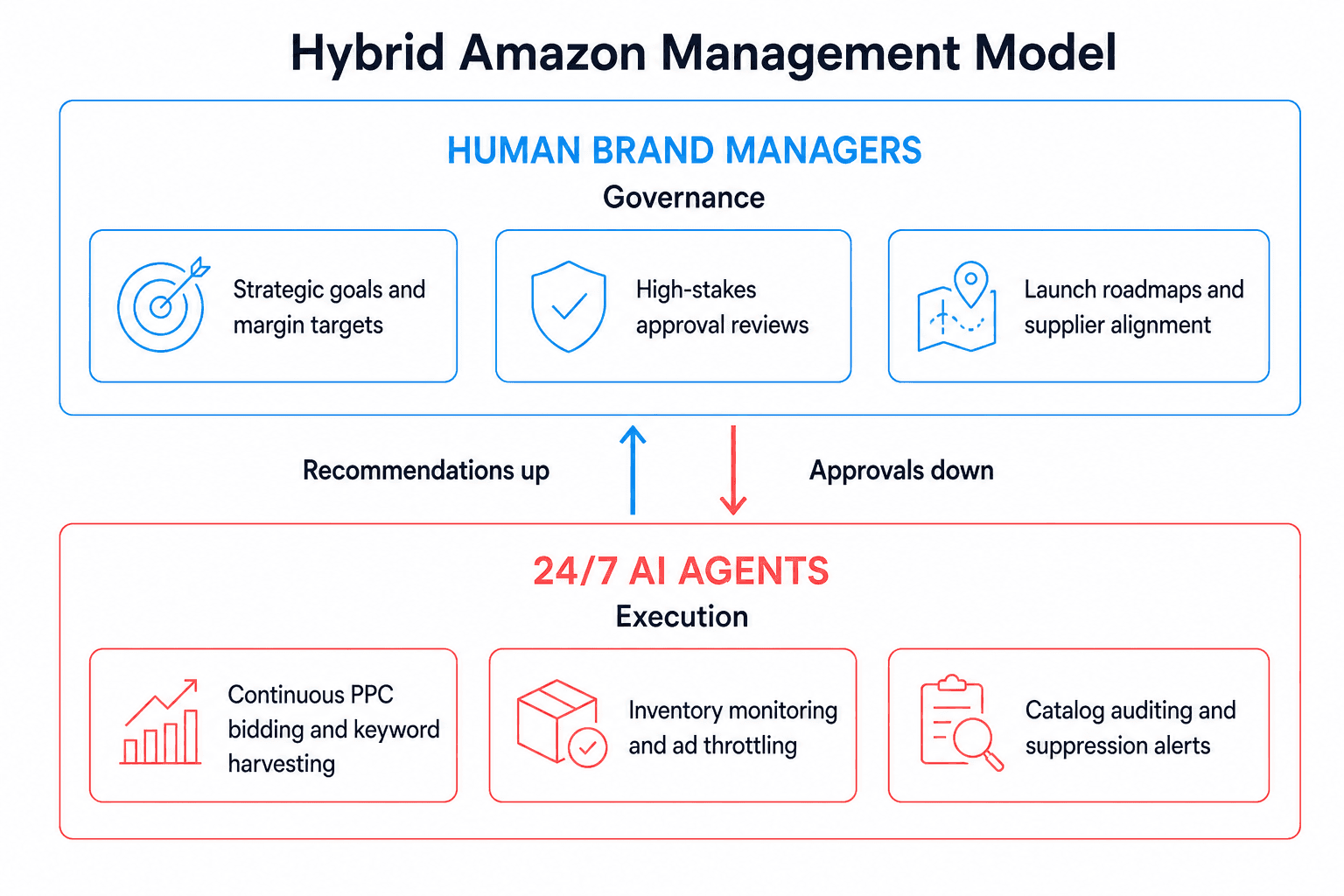
In a hybrid management structure, specialized AI agents handle routine 24/7 execution tasks like bid adjustments, keyword harvesting, and inventory tracking. Meanwhile, dedicated human brand managers focus on strategic direction, review high-impact recommendations, and manage long-term brand growth.
To discover how combining autonomous execution with human strategic oversight can accelerate your marketplace growth, see how Lumian pairs AI agents with dedicated brand managers, or request an account review.
Frequently Asked Questions
Can an AI agent completely replace my Amazon account manager?
No. AI agents automate data processing, continuous PPC bidding, and catalog auditing, but human brand managers are still essential for high-level strategy, product launches, supplier negotiations, and overall channel growth.
How do AI agents prevent accidental price drops or budget overruns?
Enterprise AI agents operate within defined parameter guardrails, such as maximum bid ceilings, daily budget caps, and gross margin price floors. High-consequence adjustments require explicit approval from human brand managers before executing via Amazon APIs.
What is the biggest advantage of using AI agents for Amazon PPC?
Speed and continuity. While human managers review ad performance weekly or bi-weekly, AI agents analyze conversion probabilities continuously, harvesting negative keywords and tuning bids 24/7.
How does an AI agent know when a product is about to run out of stock?
AI agents track real-time sales velocity alongside supplier lead times and warehouse stock levels via the Amazon Selling Partner API. If stock levels drop below safety thresholds, the agent automatically throttles ad spend to stretch stock availability.
How long does it take to onboard an Amazon account with an AI-powered agency?
At Lumian, onboarding typically takes under 14 days: historic account data is ingested, safety parameters and price floors are set, and your brand manager configures the agent workflows.
Co-Founder & CEO, Lumian
Robin Lobo is Co-Founder and CEO of Lumian. He built and sold a seven-figure eyeglasses brand on Amazon and spent several years on the client side of traditional agencies before founding Lumian, an AI-native Amazon agency backed by $3M led by Bowery Capital.

AI Agent
Your Amazon business, fully managed.

Brand ManAger

Expert Team
Can AI Actually Run Your Amazon Business? An Honest Look at What Agents Can and Can't Do Yet
AI agents can run Amazon PPC, inventory throttling, and catalog audits 24/7, but not product strategy, supplier deals, or brand positioning. Here's where the line sits in 2026.
TL;DR
AI agents can reliably run the execution layer of an Amazon business today: continuous PPC bidding, inventory-aware ad throttling, and 24/7 catalog auditing. They cannot run the strategic layer: product development, supplier negotiations, brand positioning, or IP defense. This article maps exactly where the line sits in 2026.
Key Takeaways
High-Velocity Strengths: AI agents excel at continuous API-driven tasks like keyword harvesting, PPC bid adjustments, and 24/7 catalog auditing.
Current Limitations: AI models cannot negotiate supplier terms, design original physical products, or resolve complex intellectual property (IP) disputes independently.
PPC-Inventory Sync: The most effective AI agents throttle ad spend based on warehouse stock levels to prevent stockouts.
Governance Requirement: Bounded parameter guardrails, price floors, and human-in-the-loop approval gates are mandatory to prevent automated execution mistakes.
Can AI Fully Automate an Amazon Business?
The discussion surrounding artificial intelligence in e-commerce has reached a tipping point. Software marketing often promises fully autonomous stores where machine learning models handle every operational detail, allowing founders to step away completely.
While agentic technology has advanced significantly, claims of total hands-off automation overlook the realities of managing a marketplace account. Running an Amazon brand involves two distinct operational tiers: high-frequency quantitative execution and high-stakes qualitative strategy.
AI agents process data and execute repetitive tasks at speeds humans cannot match. However, trusting an unmonitored algorithm to manage supplier relationships, brand positioning, or capital allocation introduces severe operational risk. Evaluating what AI agents can and cannot do provides a realistic framework for scaling your marketplace brand.
What AI Agents Can Do Today: The High-Velocity Layer
Modern AI agents connect directly to Amazon Seller Central via the Selling Partner API (SP-API). Unlike static reporting dashboards that merely visualize historical sales graphs, real agents perceive live account events, evaluate context across data sources, and dispatch corrective actions.
1. Continuous Pay-Per-Click (PPC) Bid Tuning
Managing Amazon Sponsored Products and Sponsored Display campaigns manually requires hours of spreadsheet analysis. Human specialists typically review campaign reports weekly or bi-weekly.
AI agents analyze search term conversion probabilities continuously. When search velocity surges or competitor bids shift, agents adjust keyword bids in real time. According to industry data from a Clear Ads Agency PPC Strategy Guide, average Amazon CPCs saw a 15.5% jump in 2025, with projected increases of 8-12% through 2026. In an environment of rising ad costs, automated agents harvest negative keywords and reallocate budgets away from non-converting search terms to protect profit margins.
2. Inventory-Aware Advertising Throttling
One of the most valuable capabilities of an agentic workflow is cross-functional reasoning. Traditional PPC software operates in an isolated silo, spending ad budgets aggressively regardless of warehouse stock levels.
When ad campaigns run on products nearing a stockout, inventory depletes prematurely. Running out of stock causes a listing to lose the Buy Box and degrades organic keyword rank. An AI agent tracks daily sell-through velocity alongside supplier lead times. If warehouse days-of-cover drop below safety thresholds, the agent automatically throttles ad spend to stretch stock availability until replenishment arrives.
3. Automated Catalog Auditing and Policy Alerting
Catalog listings across large parent-child variations are vulnerable to unexpected title truncations, detail page suppressions, or category misclassifications. AI agents scan account feeds 24/7, detecting suppressions within minutes and alerting operators before organic sales momentum suffers.
For the full breakdown of how this architecture works, see what an Amazon AI agent is and how it works.
What AI Agents Cannot Do Yet: The Strategic Hard Boundaries
Despite impressive technical gains, current Large Language Models (LLMs) and autonomous agents operate strictly within the boundaries of available training data and API parameters. They lack human intuition, creative judgment, and real-world negotiation skills.
1. Physical Product R&D and Manufacturing Strategy
An AI agent can summarize customer review files to identify common product flaws, such as a weak zipper or poor packaging. However, the agent cannot design a physical replacement, evaluate material sourcing tradeoffs, or judge sample quality. Product innovation remains an inherently human capability.
2. Complex Supplier and Vendor Negotiations
Managing profit margins requires negotiating unit costs, minimum order quantities (MOQs), and payment terms with overseas manufacturers. AI agents cannot build long-term relationships with suppliers, navigate international supply chain disruptions, or negotiate favorable credit terms during economic shifts.
3. High-Stakes Brand Positioning and IP Defense
While generative models write functional listing copy, crafting a distinct brand voice requires human creative direction. Furthermore, when an account faces complex legal challenges - such as counterfeit claims, patent infringement notices, or brand registry disputes, AI models cannot replace experienced legal counsel or specialized brand strategists.
According to research from SellerSprite Amazon Conversion Benchmarks, average conversion rates on Amazon range from 3% to 10% for standard sellers, with top-performing brands exceeding 15%. Reaching top-tier conversion rates requires combining high-resolution visual storytelling and lifestyle positioning that AI tools cannot generate in isolation.
The Danger of Ungoverned Automation
Deploying unconstrained AI on a live Amazon account creates significant financial risk. Machine learning models optimize strictly for defined mathematical objectives. Without hard parameters, automated execution can produce unintended consequences:
Margin Erosion: An unmonitored repricing agent attempting to win the Buy Box can trigger a price war with competitors, eroding product margins below wholesale cost.
Ad Budget Burn: An ad bidding agent optimizing purely for impression share might inflate bids on broad search terms, burning daily ad budgets without generating profitable sales.
Policy Violations: Generative text tools drafting product titles might inadvertently include restricted promotional terms, triggering immediate listing suppression.
To mitigate these risks, enterprise AI platforms incorporate strict parameter guardrails, gross margin price floors, maximum bid caps, and multi-tier approval gates.
The Winning Framework: The Hybrid AI-Agency Model
Because AI agents excel at execution speed while human experts excel at strategic judgment, the most effective Amazon management model combines both.
In a hybrid management structure, specialized AI agents handle routine 24/7 execution tasks like bid adjustments, keyword harvesting, and inventory tracking. Meanwhile, dedicated human brand managers focus on strategic direction, review high-impact recommendations, and manage long-term brand growth.
To discover how combining autonomous execution with human strategic oversight can accelerate your marketplace growth, see how Lumian pairs AI agents with dedicated brand managers, or request an account review.
Frequently Asked Questions
Can an AI agent completely replace my Amazon account manager?
No. AI agents automate data processing, continuous PPC bidding, and catalog auditing, but human brand managers are still essential for high-level strategy, product launches, supplier negotiations, and overall channel growth.
How do AI agents prevent accidental price drops or budget overruns?
Enterprise AI agents operate within defined parameter guardrails, such as maximum bid ceilings, daily budget caps, and gross margin price floors. High-consequence adjustments require explicit approval from human brand managers before executing via Amazon APIs.
What is the biggest advantage of using AI agents for Amazon PPC?
Speed and continuity. While human managers review ad performance weekly or bi-weekly, AI agents analyze conversion probabilities continuously, harvesting negative keywords and tuning bids 24/7.
How does an AI agent know when a product is about to run out of stock?
AI agents track real-time sales velocity alongside supplier lead times and warehouse stock levels via the Amazon Selling Partner API. If stock levels drop below safety thresholds, the agent automatically throttles ad spend to stretch stock availability.
How long does it take to onboard an Amazon account with an AI-powered agency?
At Lumian, onboarding typically takes under 14 days: historic account data is ingested, safety parameters and price floors are set, and your brand manager configures the agent workflows.
Co-Founder & CEO, Lumian
Robin Lobo is Co-Founder and CEO of Lumian. He built and sold a seven-figure eyeglasses brand on Amazon and spent several years on the client side of traditional agencies before founding Lumian, an AI-native Amazon agency backed by $3M led by Bowery Capital.
AI Agent
Your Amazon business, fully managed.
Brand ManAger
Expert Team
Can AI Actually Run Your Amazon Business? An Honest Look at What Agents Can and Can't Do Yet
AI agents can run Amazon PPC, inventory throttling, and catalog audits 24/7, but not product strategy, supplier deals, or brand positioning. Here's where the line sits in 2026.
TL;DR
AI agents can reliably run the execution layer of an Amazon business today: continuous PPC bidding, inventory-aware ad throttling, and 24/7 catalog auditing. They cannot run the strategic layer: product development, supplier negotiations, brand positioning, or IP defense. This article maps exactly where the line sits in 2026.
Key Takeaways
High-Velocity Strengths: AI agents excel at continuous API-driven tasks like keyword harvesting, PPC bid adjustments, and 24/7 catalog auditing.
Current Limitations: AI models cannot negotiate supplier terms, design original physical products, or resolve complex intellectual property (IP) disputes independently.
PPC-Inventory Sync: The most effective AI agents throttle ad spend based on warehouse stock levels to prevent stockouts.
Governance Requirement: Bounded parameter guardrails, price floors, and human-in-the-loop approval gates are mandatory to prevent automated execution mistakes.
Can AI Fully Automate an Amazon Business?
The discussion surrounding artificial intelligence in e-commerce has reached a tipping point. Software marketing often promises fully autonomous stores where machine learning models handle every operational detail, allowing founders to step away completely.
While agentic technology has advanced significantly, claims of total hands-off automation overlook the realities of managing a marketplace account. Running an Amazon brand involves two distinct operational tiers: high-frequency quantitative execution and high-stakes qualitative strategy.
AI agents process data and execute repetitive tasks at speeds humans cannot match. However, trusting an unmonitored algorithm to manage supplier relationships, brand positioning, or capital allocation introduces severe operational risk. Evaluating what AI agents can and cannot do provides a realistic framework for scaling your marketplace brand.
What AI Agents Can Do Today: The High-Velocity Layer
Modern AI agents connect directly to Amazon Seller Central via the Selling Partner API (SP-API). Unlike static reporting dashboards that merely visualize historical sales graphs, real agents perceive live account events, evaluate context across data sources, and dispatch corrective actions.
1. Continuous Pay-Per-Click (PPC) Bid Tuning
Managing Amazon Sponsored Products and Sponsored Display campaigns manually requires hours of spreadsheet analysis. Human specialists typically review campaign reports weekly or bi-weekly.
AI agents analyze search term conversion probabilities continuously. When search velocity surges or competitor bids shift, agents adjust keyword bids in real time. According to industry data from a Clear Ads Agency PPC Strategy Guide, average Amazon CPCs saw a 15.5% jump in 2025, with projected increases of 8-12% through 2026. In an environment of rising ad costs, automated agents harvest negative keywords and reallocate budgets away from non-converting search terms to protect profit margins.
2. Inventory-Aware Advertising Throttling
One of the most valuable capabilities of an agentic workflow is cross-functional reasoning. Traditional PPC software operates in an isolated silo, spending ad budgets aggressively regardless of warehouse stock levels.
When ad campaigns run on products nearing a stockout, inventory depletes prematurely. Running out of stock causes a listing to lose the Buy Box and degrades organic keyword rank. An AI agent tracks daily sell-through velocity alongside supplier lead times. If warehouse days-of-cover drop below safety thresholds, the agent automatically throttles ad spend to stretch stock availability until replenishment arrives.
3. Automated Catalog Auditing and Policy Alerting
Catalog listings across large parent-child variations are vulnerable to unexpected title truncations, detail page suppressions, or category misclassifications. AI agents scan account feeds 24/7, detecting suppressions within minutes and alerting operators before organic sales momentum suffers.
For the full breakdown of how this architecture works, see what an Amazon AI agent is and how it works.
What AI Agents Cannot Do Yet: The Strategic Hard Boundaries
Despite impressive technical gains, current Large Language Models (LLMs) and autonomous agents operate strictly within the boundaries of available training data and API parameters. They lack human intuition, creative judgment, and real-world negotiation skills.
1. Physical Product R&D and Manufacturing Strategy
An AI agent can summarize customer review files to identify common product flaws, such as a weak zipper or poor packaging. However, the agent cannot design a physical replacement, evaluate material sourcing tradeoffs, or judge sample quality. Product innovation remains an inherently human capability.
2. Complex Supplier and Vendor Negotiations
Managing profit margins requires negotiating unit costs, minimum order quantities (MOQs), and payment terms with overseas manufacturers. AI agents cannot build long-term relationships with suppliers, navigate international supply chain disruptions, or negotiate favorable credit terms during economic shifts.
3. High-Stakes Brand Positioning and IP Defense
While generative models write functional listing copy, crafting a distinct brand voice requires human creative direction. Furthermore, when an account faces complex legal challenges - such as counterfeit claims, patent infringement notices, or brand registry disputes, AI models cannot replace experienced legal counsel or specialized brand strategists.
According to research from SellerSprite Amazon Conversion Benchmarks, average conversion rates on Amazon range from 3% to 10% for standard sellers, with top-performing brands exceeding 15%. Reaching top-tier conversion rates requires combining high-resolution visual storytelling and lifestyle positioning that AI tools cannot generate in isolation.
The Danger of Ungoverned Automation
Deploying unconstrained AI on a live Amazon account creates significant financial risk. Machine learning models optimize strictly for defined mathematical objectives. Without hard parameters, automated execution can produce unintended consequences:
Margin Erosion: An unmonitored repricing agent attempting to win the Buy Box can trigger a price war with competitors, eroding product margins below wholesale cost.
Ad Budget Burn: An ad bidding agent optimizing purely for impression share might inflate bids on broad search terms, burning daily ad budgets without generating profitable sales.
Policy Violations: Generative text tools drafting product titles might inadvertently include restricted promotional terms, triggering immediate listing suppression.
To mitigate these risks, enterprise AI platforms incorporate strict parameter guardrails, gross margin price floors, maximum bid caps, and multi-tier approval gates.
The Winning Framework: The Hybrid AI-Agency Model
Because AI agents excel at execution speed while human experts excel at strategic judgment, the most effective Amazon management model combines both.
In a hybrid management structure, specialized AI agents handle routine 24/7 execution tasks like bid adjustments, keyword harvesting, and inventory tracking. Meanwhile, dedicated human brand managers focus on strategic direction, review high-impact recommendations, and manage long-term brand growth.
To discover how combining autonomous execution with human strategic oversight can accelerate your marketplace growth, see how Lumian pairs AI agents with dedicated brand managers, or request an account review.
Frequently Asked Questions
Can an AI agent completely replace my Amazon account manager?
No. AI agents automate data processing, continuous PPC bidding, and catalog auditing, but human brand managers are still essential for high-level strategy, product launches, supplier negotiations, and overall channel growth.
How do AI agents prevent accidental price drops or budget overruns?
Enterprise AI agents operate within defined parameter guardrails, such as maximum bid ceilings, daily budget caps, and gross margin price floors. High-consequence adjustments require explicit approval from human brand managers before executing via Amazon APIs.
What is the biggest advantage of using AI agents for Amazon PPC?
Speed and continuity. While human managers review ad performance weekly or bi-weekly, AI agents analyze conversion probabilities continuously, harvesting negative keywords and tuning bids 24/7.
How does an AI agent know when a product is about to run out of stock?
AI agents track real-time sales velocity alongside supplier lead times and warehouse stock levels via the Amazon Selling Partner API. If stock levels drop below safety thresholds, the agent automatically throttles ad spend to stretch stock availability.
How long does it take to onboard an Amazon account with an AI-powered agency?
At Lumian, onboarding typically takes under 14 days: historic account data is ingested, safety parameters and price floors are set, and your brand manager configures the agent workflows.
Co-Founder & CEO, Lumian
Robin Lobo is Co-Founder and CEO of Lumian. He built and sold a seven-figure eyeglasses brand on Amazon and spent several years on the client side of traditional agencies before founding Lumian, an AI-native Amazon agency backed by $3M led by Bowery Capital.

AI Agent
Your Amazon business, fully managed.
Brand ManAger
Expert Team