Maximizing Fulfillment Efficiency: Inside Lumian Agent's Inventory and Restock Skill
Discover how Lumian Agent's Inventory and Restock skill automates supply chain tracking using direct SP-API metrics to prevent stockouts and resolve stranded items.
TL;DR
What to expect from this article:
An analytical breakdown of the automated inventory management architecture within Lumian Agent. This post outlines how connecting directly to Amazon's Selling Partner API replaces standard spreadsheet tracking with predictive restock triggers and active catalog diagnostics.
Key Takeaways:
Running out of stock or holding stranded inventory creates hidden structural costs that lower your organic search visibility and impact storage capacity.
The Inventory and Restock skill operates as an autonomous operational assistant, handling daily restock alerts, stranded inventory scans, and weekly automated purchase order creation.
Automating supply chain monitoring allows brands to maintain optimal sales velocity and protect their baseline cash flow.
Intro
Succeeding as a high volume brand within the Fulfillment by Amazon ecosystem requires constant oversight of your product supply chain. Unlike traditional e-commerce models where products sit in a centralized warehouse, FBA inventory is spread across a complex network of regional sorting facilities and fulfillment centers. Managing lead times, tracking manufacturing schedules, and maintaining catalog status across hundreds of active listings creates significant operational demands.
When stock levels are managed poorly, brands experience severe operational impacts. Stockouts drop your organic ranking down search pages, while excess inventory generates expensive storage fees that drain liquid capital. The Inventory and Restock skill inside Lumian Agent addresses these issues by automating the replenishment tracking process. By using secure, direct API integrations, the system updates operational numbers continuously to protect search visibility and preserve margin stability.
The Strategic Importance of Continuous Replenishment Monitoring
Managing product supply loops involves balancing complex operational timelines. To avoid losing search ranking, an enterprise store cannot rely on simple reorder lists or reactive inventory counts. True operational stability requires tracking a unified system that connects lead times, product sales velocity, manufacturing schedules, and Amazon storage limits.
Operating with fragmented reports creates measurable long term risks for growing brands. Research from IHL Group estimates that inventory distortion — the combined cost of out-of-stocks and overstocks — costs retailers an estimated 1.77 trillion dollars annually worldwide. When catalog managers rely on manual updates, they frequently miss subtle changes in product velocity. Discovering a stock issue days after it starts can lead to expensive air freight shipping costs or weeks of blank space on your active listings.
Core Capabilities of the Inventory and Restock Skill Architecture
The Inventory and Restock module functions as an automated supply chain assistant. It executes continuous diagnostics across your active catalog data, helping to optimize holding costs and maintain consistent catalog coverage.
1. Dynamic Daily Restock Protection
The agent monitors shifting sales patterns to calculate real-time runway numbers for every item in your catalog. By evaluating active data streams, the system monitors exact inventory levels, pending shipments, and changing customer demand. Instead of relying on static averages, the engine calculates a dynamic days of cover score per SKU. When a specific product line approaches its calculated safety limit, the agent triggers an immediate reorder notice to prevent inventory gaps.
2. Stranded Inventory Resolution Tracking
Inventory categorized as "stranded" represents products that physically sit inside an FBA warehouse but lack an active, buyable detail page. This error locks up your working capital while continuing to incur storage fees. The agent runs continuous automated scans across the catalog to isolate these stranded units. Once an error is detected, the agent identifies the precise cause—such as a missing price, a category listing error, or an unconfigured brand name—and provides step by step instructions to restore the listing.
3. Weekly Automated Purchase Order Drafting
Building manual purchase orders across comprehensive product lines requires hours of spreadsheet preparation. The agent simplifies this process by automating the baseline calculations. Every week, the engine reviews historical sales data, seasonal trends, current warehouse quantities, and defined manufacturing lead times to build a complete draft purchase order. Operators can access these pre-built drafts via their management board, adjust the order totals, and export the file directly to their manufacturing partners.
Shifting From Static Visual Grids to Direct Chat Interrogation
Traditional tracking tools display data across dense dashboard grids, forcing managers to hunt through rows of numbers to find critical issues. The platform changes this process by connecting automated backend tracking directly to a natural-language chat interface.
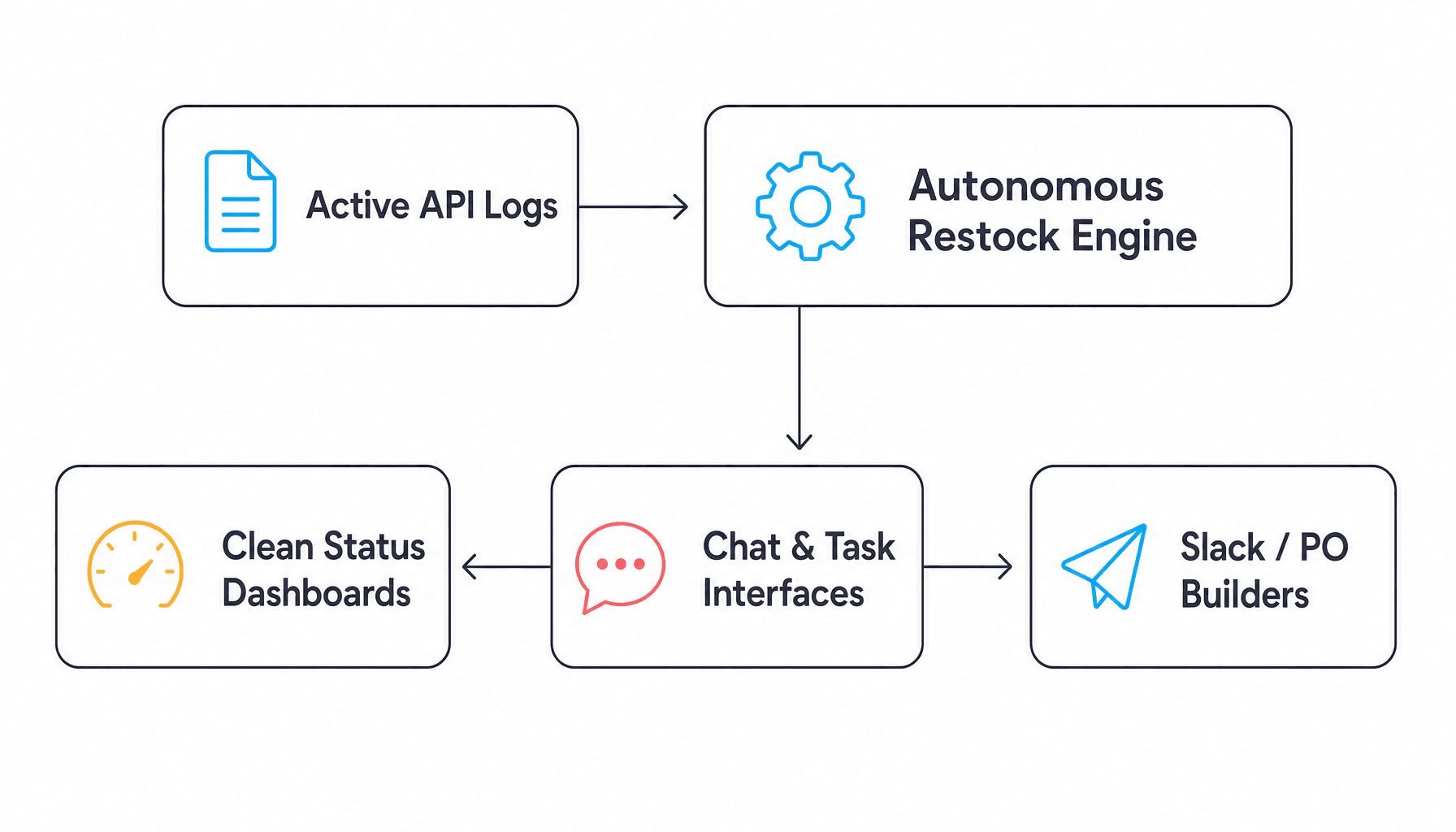
This structural setup simplifies how teams analyze their supply chain. If an operational manager needs a quick status update on a specific variant, they do not need to pull separate reports or calculate historical metrics manually.
Instead, they can ask the agent directly inside the chat workspace: "What are our days of cover for the top item?" The system reviews current sales data, cross-references arriving shipments, and presents a clear summary instantly. This rapid analysis helps companies minimize storage fees and optimize capital allocation.
Coordinating Supply Chain Pipelines Across System Interfaces
The Inventory and Restock skill runs across the platform's three primary interface environments to provide complete visibility into your logistics pipeline:
In the Conversational Chat: Teams can run quick inventory health checks or request instant purchase order updates using natural language commands, avoiding manual report creation.
On the Turnkey Dashboards: A clean, default metrics view displays your overall days of cover, stranded unit totals, and high priority restock tasks without confusing technical jargon.
Through Scheduled Tasks: The automated task manager runs weekly purchase order calculations and daily inventory scans, sending crucial logistics updates directly to your communication channels so your team stays aligned.
Frequently Asked Questions
How does the agent calculate days of cover without relying on generic sales averages?
The agent uses a direct Selling Partner API connection to evaluate live sales velocity trends, accounting for recent shifts in consumer demand, seasonal changes, and incoming promotional events. This dynamic tracking provides a more accurate runway calculation than standard historical spreadsheets.
What is the difference between standard out of stock status and stranded inventory?
Out of stock status means your physical inventory is completely depleted. Stranded inventory means your products are present inside an FBA warehouse, but a listing error or catalog issue prevents the detail page from appearing live to customers, causing you to pay storage fees for items that cannot be sold.
Can the agent place purchase orders directly with my manufacturers?
No. To maintain complete operational security, the agent does not communicate with external suppliers or place orders automatically. It handles the data processing and builds a verified draft purchase order on your dashboard, leaving final review and submission under the control of your team.
How does the system adjust reorder timing for international suppliers with long lead times?
The platform allows operators to input custom manufacturing and shipping lead times for individual SKUs. The predictive restock engine uses these parameters to adjust its alerts, ensuring items with long cross-border lead times trigger reorder notices earlier than domestically sourced products.
Does the inventory skill help track and lower excessive storage fees?
Yes. By tracking inventory ages, monitoring utilization limits, and identifying stranded stock early, the system helps you identify slow moving or blocked products before they cross key age limits and incur expensive aged inventory surcharges.

Co-Founder & CEO, Lumian
Robin Lobo is Co-Founder and CEO of Lumian. He built and sold a seven-figure eyeglasses brand on Amazon and spent several years on the client side of traditional agencies before founding Lumian, an AI-native Amazon agency backed by $3M led by Bowery Capital.