Amazon Sales Reporting Automation: Inside Lumian Agent’s Data Skill
An analytical breakdown of the Reporting and Sales skill within the Lumian Agent architecture.

TL;DR
What to expect from this article:
An analytical breakdown of the Reporting and Sales skill within the Lumian Agent architecture. You will learn how automated data tracking changes retail intelligence on Amazon by replacing manual CSV sheet downloads with continuous Selling Partner API reporting.
Key Takeaways:
Fragmented metrics hide structural margin risks, forcing e-commerce teams to spend valuable time pulling reports instead of planning strategy.
The Reporting and Sales skill simplifies Amazon business monitoring through autonomous data processing, tracking daily pulses, weekly analysis, and B2B growth metrics.
Transitioning from static visual dashboards to an integrated software assistant allows brands to quickly isolate why conversion rates shift and scale their store volume.
Intro
Succeeding on the modern Amazon marketplace requires clear visibility into store performance data. For expanding private-label brands and retail groups, managing everyday numbers can become an unexpected operational bottleneck. Business managers frequently find themselves logging into multiple seller portals, downloading large spreadsheets, and manually matching advertising spend against active warehouse stock just to calculate their accurate net margins.
When data remains scattered across different systems, executive teams are forced to make high-level decisions using old or incomplete information. The Reporting and Sales skill inside Lumian Agent addresses this issue by automating the data collection process. By using a secure, direct connection to official API networks, the system pulls performance data continuously to transform raw numbers into clear, operational updates.
The True Cost of Hidden Data Bottlenecks
Many growth challenges encountered by Amazon brands stem directly from fragmented data collection methods. When tracking store performance, a business cannot rely solely on isolated metrics like overall unit sales. True growth requires monitoring the clear links connecting your advertising costs, conversion drops, organic keyword placements, and warehouse restock schedules.
Relying on manual report extraction creates measurable operational risks for high-volume stores. Industry research on knowledge work consistently finds that operational teams lose a substantial share of each week, often a full workday or more simply gathering, cleaning, and formatting data before any analysis begins. This heavy administrative load delays regular strategy execution. If an account manager only discovers a conversion drop or a lost Buy Box days after the event occurs, the delay can lead to wasted ad spend and lost search visibility.
Core Analytical Capabilities of the Reporting Architecture
The Reporting and Sales skill operates as a central data engine for your brand. It runs continuous background routines to parse marketplace data, isolate performance shifts, and deliver clear summaries without requiring human database configuration.
1. The Daily Sales Pulse Automation
The platform features an automated morning update sequence that tracks core performance metrics across your entire catalog. Every morning, the agent reconciles your store's total gross sales, shipped unit counts, and real-time conversion percentages. Instead of forcing you to navigate through complex sub-menus in Seller Central, the agent packages these numbers into a clear, plain-English summary delivered directly to your team's connected Slack channels or email systems.
2. Deep Weekly Insight Synthesis
Isolating the underlying causes of a sudden change in product demand requires deep analytical cross-referencing. The weekly insights module reviews your historic performance to identify exactly what moved, why it moved, and what operational steps are required next.
If a specific product variant experiences a drop in sales volume, the agent scans related reports—including your active Sales and Traffic data, Search Query Performance metrics, and Buy Box ownership shares—to pinpoint the root cause. For instance, it will highlight if a conversion drop from 11.2% to 8.1% was driven by a third-party competitor undercutting your price on a shared listing.
3. Integrated Retail and B2B Trend Tracking
Business-to-Business (B2B) sales channels on Amazon follow completely different buyer habits and volume trends than standard consumer sales. The agent includes a dedicated trend analyzer that separates your standard consumer data from wholesale B2B purchases. This tracking allows brands to monitor volume discounts, track bulk pricing performance, and adjust their supply chain targets based on seasonal wholesale demand.
Moving Beyond Static Dashboards to Direct Chat Execution
Traditional software applications generally display metrics on static grids, leaving the work of interpretation and planning to a human operator. The platform architecture shifts this workflow into an interactive environment by integrating data tracking with a natural-language chat interface.
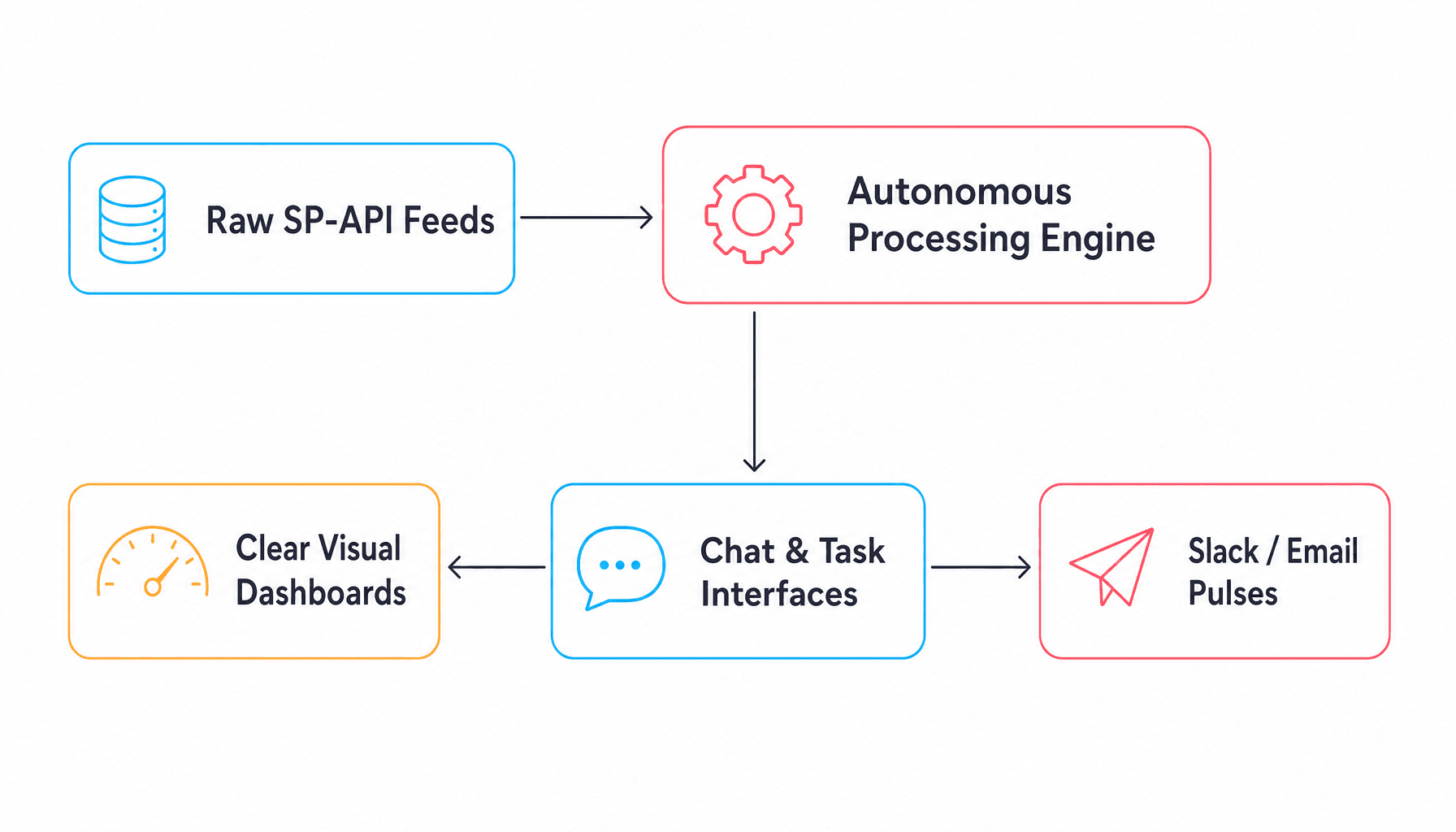
This structural connection changes how teams use data. If a manager spots an anomaly on their main dashboard, they do not need to build a new custom filter or run a manual spreadsheet calculation.
Instead, they can ask the agent directly inside the chat interface: "Why did sales drop on our top item last week?" The assistant reads the relevant report files, identifies the specific variables responsible for the change, and displays a clean summary instantly. This rapid analysis helps teams fix catalog issues quickly to protect their organic search rankings.
Coordinating Performance Data Across System Surfaces
The Reporting and Sales skill functions across the platform's three primary interface environments to ensure consistent data visibility:
In the Conversational Chat: Teams can run quick account health checks or request instant data pulls by using simple language commands, avoiding complex manual report generation.
On the Turnkey Dashboards: A clean, default metrics view summarizes your overall sales, traffic, conversion rates, and inventory status without confusing technical jargon.
Through Scheduled Tasks: The automated task manager runs regular daily updates and weekly analytical routines, sending crucial performance summaries directly to your communication channels so your team stays aligned.
Frequently Asked Questions
How does the agent access my sales data without sharing my account credentials?
The system utilizes official Amazon Selling Partner API protocols to build a secure data bridge. Account authorization occurs safely through Amazon's developer portal, allowing you to manage data permissions and revoke access at any time. The agent never asks for or stores your primary store passwords.
Does the system support data tracking for international Amazon marketplaces?
Yes. The data engine connects with global Amazon marketplaces across North America, Europe, and the Asia-Pacific region, combining international sales metrics into a single currency view on your dashboard while adjusting for regional time zones.
What is the precise advantage of separating B2B sales from retail numbers?
B2B transactions usually involve large, bulk orders with custom pricing models. Combining these with standard consumer sales can distort your average unit prices and conversion metrics. Separating these numbers allows brands to track wholesale demand accurately and manage inventory levels effectively.
Can the agent connect with external team communication tools like Slack?
Yes. The automated scheduled tasks module can be configured to push daily performance updates, weekly insight charts, and urgent compliance alerts directly to your team's connected Slack channels or corporate email systems.
Co-Founder & CEO, Lumian
Robin Lobo is Co-Founder and CEO of Lumian. He built and sold a seven-figure eyeglasses brand on Amazon and spent several years on the client side of traditional agencies before founding Lumian, an AI-native Amazon agency backed by $3M led by Bowery Capital.

AI Agent
Your Amazon business, fully managed.

Brand ManAger

Expert Team
Amazon Sales Reporting Automation: Inside Lumian Agent’s Data Skill
An analytical breakdown of the Reporting and Sales skill within the Lumian Agent architecture.
TL;DR
What to expect from this article:
An analytical breakdown of the Reporting and Sales skill within the Lumian Agent architecture. You will learn how automated data tracking changes retail intelligence on Amazon by replacing manual CSV sheet downloads with continuous Selling Partner API reporting.
Key Takeaways:
Fragmented metrics hide structural margin risks, forcing e-commerce teams to spend valuable time pulling reports instead of planning strategy.
The Reporting and Sales skill simplifies Amazon business monitoring through autonomous data processing, tracking daily pulses, weekly analysis, and B2B growth metrics.
Transitioning from static visual dashboards to an integrated software assistant allows brands to quickly isolate why conversion rates shift and scale their store volume.
Intro
Succeeding on the modern Amazon marketplace requires clear visibility into store performance data. For expanding private-label brands and retail groups, managing everyday numbers can become an unexpected operational bottleneck. Business managers frequently find themselves logging into multiple seller portals, downloading large spreadsheets, and manually matching advertising spend against active warehouse stock just to calculate their accurate net margins.
When data remains scattered across different systems, executive teams are forced to make high-level decisions using old or incomplete information. The Reporting and Sales skill inside Lumian Agent addresses this issue by automating the data collection process. By using a secure, direct connection to official API networks, the system pulls performance data continuously to transform raw numbers into clear, operational updates.
The True Cost of Hidden Data Bottlenecks
Many growth challenges encountered by Amazon brands stem directly from fragmented data collection methods. When tracking store performance, a business cannot rely solely on isolated metrics like overall unit sales. True growth requires monitoring the clear links connecting your advertising costs, conversion drops, organic keyword placements, and warehouse restock schedules.
Relying on manual report extraction creates measurable operational risks for high-volume stores. Industry research on knowledge work consistently finds that operational teams lose a substantial share of each week, often a full workday or more simply gathering, cleaning, and formatting data before any analysis begins. This heavy administrative load delays regular strategy execution. If an account manager only discovers a conversion drop or a lost Buy Box days after the event occurs, the delay can lead to wasted ad spend and lost search visibility.
Core Analytical Capabilities of the Reporting Architecture
The Reporting and Sales skill operates as a central data engine for your brand. It runs continuous background routines to parse marketplace data, isolate performance shifts, and deliver clear summaries without requiring human database configuration.
1. The Daily Sales Pulse Automation
The platform features an automated morning update sequence that tracks core performance metrics across your entire catalog. Every morning, the agent reconciles your store's total gross sales, shipped unit counts, and real-time conversion percentages. Instead of forcing you to navigate through complex sub-menus in Seller Central, the agent packages these numbers into a clear, plain-English summary delivered directly to your team's connected Slack channels or email systems.
2. Deep Weekly Insight Synthesis
Isolating the underlying causes of a sudden change in product demand requires deep analytical cross-referencing. The weekly insights module reviews your historic performance to identify exactly what moved, why it moved, and what operational steps are required next.
If a specific product variant experiences a drop in sales volume, the agent scans related reports—including your active Sales and Traffic data, Search Query Performance metrics, and Buy Box ownership shares—to pinpoint the root cause. For instance, it will highlight if a conversion drop from 11.2% to 8.1% was driven by a third-party competitor undercutting your price on a shared listing.
3. Integrated Retail and B2B Trend Tracking
Business-to-Business (B2B) sales channels on Amazon follow completely different buyer habits and volume trends than standard consumer sales. The agent includes a dedicated trend analyzer that separates your standard consumer data from wholesale B2B purchases. This tracking allows brands to monitor volume discounts, track bulk pricing performance, and adjust their supply chain targets based on seasonal wholesale demand.
Moving Beyond Static Dashboards to Direct Chat Execution
Traditional software applications generally display metrics on static grids, leaving the work of interpretation and planning to a human operator. The platform architecture shifts this workflow into an interactive environment by integrating data tracking with a natural-language chat interface.
This structural connection changes how teams use data. If a manager spots an anomaly on their main dashboard, they do not need to build a new custom filter or run a manual spreadsheet calculation.
Instead, they can ask the agent directly inside the chat interface: "Why did sales drop on our top item last week?" The assistant reads the relevant report files, identifies the specific variables responsible for the change, and displays a clean summary instantly. This rapid analysis helps teams fix catalog issues quickly to protect their organic search rankings.
Coordinating Performance Data Across System Surfaces
The Reporting and Sales skill functions across the platform's three primary interface environments to ensure consistent data visibility:
In the Conversational Chat: Teams can run quick account health checks or request instant data pulls by using simple language commands, avoiding complex manual report generation.
On the Turnkey Dashboards: A clean, default metrics view summarizes your overall sales, traffic, conversion rates, and inventory status without confusing technical jargon.
Through Scheduled Tasks: The automated task manager runs regular daily updates and weekly analytical routines, sending crucial performance summaries directly to your communication channels so your team stays aligned.
Frequently Asked Questions
How does the agent access my sales data without sharing my account credentials?
The system utilizes official Amazon Selling Partner API protocols to build a secure data bridge. Account authorization occurs safely through Amazon's developer portal, allowing you to manage data permissions and revoke access at any time. The agent never asks for or stores your primary store passwords.
Does the system support data tracking for international Amazon marketplaces?
Yes. The data engine connects with global Amazon marketplaces across North America, Europe, and the Asia-Pacific region, combining international sales metrics into a single currency view on your dashboard while adjusting for regional time zones.
What is the precise advantage of separating B2B sales from retail numbers?
B2B transactions usually involve large, bulk orders with custom pricing models. Combining these with standard consumer sales can distort your average unit prices and conversion metrics. Separating these numbers allows brands to track wholesale demand accurately and manage inventory levels effectively.
Can the agent connect with external team communication tools like Slack?
Yes. The automated scheduled tasks module can be configured to push daily performance updates, weekly insight charts, and urgent compliance alerts directly to your team's connected Slack channels or corporate email systems.
Co-Founder & CEO, Lumian
Robin Lobo is Co-Founder and CEO of Lumian. He built and sold a seven-figure eyeglasses brand on Amazon and spent several years on the client side of traditional agencies before founding Lumian, an AI-native Amazon agency backed by $3M led by Bowery Capital.
AI Agent
Your Amazon business, fully managed.
Brand ManAger
Expert Team
Amazon Sales Reporting Automation: Inside Lumian Agent’s Data Skill
An analytical breakdown of the Reporting and Sales skill within the Lumian Agent architecture.
TL;DR
What to expect from this article:
An analytical breakdown of the Reporting and Sales skill within the Lumian Agent architecture. You will learn how automated data tracking changes retail intelligence on Amazon by replacing manual CSV sheet downloads with continuous Selling Partner API reporting.
Key Takeaways:
Fragmented metrics hide structural margin risks, forcing e-commerce teams to spend valuable time pulling reports instead of planning strategy.
The Reporting and Sales skill simplifies Amazon business monitoring through autonomous data processing, tracking daily pulses, weekly analysis, and B2B growth metrics.
Transitioning from static visual dashboards to an integrated software assistant allows brands to quickly isolate why conversion rates shift and scale their store volume.
Intro
Succeeding on the modern Amazon marketplace requires clear visibility into store performance data. For expanding private-label brands and retail groups, managing everyday numbers can become an unexpected operational bottleneck. Business managers frequently find themselves logging into multiple seller portals, downloading large spreadsheets, and manually matching advertising spend against active warehouse stock just to calculate their accurate net margins.
When data remains scattered across different systems, executive teams are forced to make high-level decisions using old or incomplete information. The Reporting and Sales skill inside Lumian Agent addresses this issue by automating the data collection process. By using a secure, direct connection to official API networks, the system pulls performance data continuously to transform raw numbers into clear, operational updates.
The True Cost of Hidden Data Bottlenecks
Many growth challenges encountered by Amazon brands stem directly from fragmented data collection methods. When tracking store performance, a business cannot rely solely on isolated metrics like overall unit sales. True growth requires monitoring the clear links connecting your advertising costs, conversion drops, organic keyword placements, and warehouse restock schedules.
Relying on manual report extraction creates measurable operational risks for high-volume stores. Industry research on knowledge work consistently finds that operational teams lose a substantial share of each week, often a full workday or more simply gathering, cleaning, and formatting data before any analysis begins. This heavy administrative load delays regular strategy execution. If an account manager only discovers a conversion drop or a lost Buy Box days after the event occurs, the delay can lead to wasted ad spend and lost search visibility.
Core Analytical Capabilities of the Reporting Architecture
The Reporting and Sales skill operates as a central data engine for your brand. It runs continuous background routines to parse marketplace data, isolate performance shifts, and deliver clear summaries without requiring human database configuration.
1. The Daily Sales Pulse Automation
The platform features an automated morning update sequence that tracks core performance metrics across your entire catalog. Every morning, the agent reconciles your store's total gross sales, shipped unit counts, and real-time conversion percentages. Instead of forcing you to navigate through complex sub-menus in Seller Central, the agent packages these numbers into a clear, plain-English summary delivered directly to your team's connected Slack channels or email systems.
2. Deep Weekly Insight Synthesis
Isolating the underlying causes of a sudden change in product demand requires deep analytical cross-referencing. The weekly insights module reviews your historic performance to identify exactly what moved, why it moved, and what operational steps are required next.
If a specific product variant experiences a drop in sales volume, the agent scans related reports—including your active Sales and Traffic data, Search Query Performance metrics, and Buy Box ownership shares—to pinpoint the root cause. For instance, it will highlight if a conversion drop from 11.2% to 8.1% was driven by a third-party competitor undercutting your price on a shared listing.
3. Integrated Retail and B2B Trend Tracking
Business-to-Business (B2B) sales channels on Amazon follow completely different buyer habits and volume trends than standard consumer sales. The agent includes a dedicated trend analyzer that separates your standard consumer data from wholesale B2B purchases. This tracking allows brands to monitor volume discounts, track bulk pricing performance, and adjust their supply chain targets based on seasonal wholesale demand.
Moving Beyond Static Dashboards to Direct Chat Execution
Traditional software applications generally display metrics on static grids, leaving the work of interpretation and planning to a human operator. The platform architecture shifts this workflow into an interactive environment by integrating data tracking with a natural-language chat interface.
This structural connection changes how teams use data. If a manager spots an anomaly on their main dashboard, they do not need to build a new custom filter or run a manual spreadsheet calculation.
Instead, they can ask the agent directly inside the chat interface: "Why did sales drop on our top item last week?" The assistant reads the relevant report files, identifies the specific variables responsible for the change, and displays a clean summary instantly. This rapid analysis helps teams fix catalog issues quickly to protect their organic search rankings.
Coordinating Performance Data Across System Surfaces
The Reporting and Sales skill functions across the platform's three primary interface environments to ensure consistent data visibility:
In the Conversational Chat: Teams can run quick account health checks or request instant data pulls by using simple language commands, avoiding complex manual report generation.
On the Turnkey Dashboards: A clean, default metrics view summarizes your overall sales, traffic, conversion rates, and inventory status without confusing technical jargon.
Through Scheduled Tasks: The automated task manager runs regular daily updates and weekly analytical routines, sending crucial performance summaries directly to your communication channels so your team stays aligned.
Frequently Asked Questions
How does the agent access my sales data without sharing my account credentials?
The system utilizes official Amazon Selling Partner API protocols to build a secure data bridge. Account authorization occurs safely through Amazon's developer portal, allowing you to manage data permissions and revoke access at any time. The agent never asks for or stores your primary store passwords.
Does the system support data tracking for international Amazon marketplaces?
Yes. The data engine connects with global Amazon marketplaces across North America, Europe, and the Asia-Pacific region, combining international sales metrics into a single currency view on your dashboard while adjusting for regional time zones.
What is the precise advantage of separating B2B sales from retail numbers?
B2B transactions usually involve large, bulk orders with custom pricing models. Combining these with standard consumer sales can distort your average unit prices and conversion metrics. Separating these numbers allows brands to track wholesale demand accurately and manage inventory levels effectively.
Can the agent connect with external team communication tools like Slack?
Yes. The automated scheduled tasks module can be configured to push daily performance updates, weekly insight charts, and urgent compliance alerts directly to your team's connected Slack channels or corporate email systems.
Co-Founder & CEO, Lumian
Robin Lobo is Co-Founder and CEO of Lumian. He built and sold a seven-figure eyeglasses brand on Amazon and spent several years on the client side of traditional agencies before founding Lumian, an AI-native Amazon agency backed by $3M led by Bowery Capital.

AI Agent
Your Amazon business, fully managed.
Brand ManAger
Expert Team