Outsmarting the Competition: Inside Lumian Agent's Search and Competitor Intel Skill
Discover how Lumian Agent's Search and Competitor Intel skill automates keyword gap analysis and search query performance tracking to protect your FBA market share.
TL;DR
What to expect from this article:
An analytical breakdown of how autonomous data extraction transforms organic discoverability and competitor intelligence on Amazon. This guide details how to move beyond manual reverse ASIN lookups to capture market share using live data pipelines.
Key Takeaways:
Amazon's Search Query Performance (SQP) data holds the real metrics for customer purchase paths, yet most teams mine it too infrequently to act on what it shows.
The Search and Competitor Intel skill runs 24/7 background mining routines to uncover hidden keywords, isolate keyword gaps, and map alternative category products.
Transitioning from static third party index checkers to an autonomous system allows brands to outmaneuver competitor price shifts and rank drops in real time.
Intro
Maintaining dominant organic visibility on Amazon requires constant optimization of search data. E-commerce managers frequently struggle to stay on top of daily keyword movements, changing search trends, and sudden catalog adjustments made by competing brands. When a brand relies on delayed, manually exported reports, it remains exposed to rapid market changes that can quickly pull down listing visibility.
Traditional keyword software tools rely on estimated search volumes — modeled guesses about what shoppers type — rather than the actual funnel data generated inside your Seller Central account. The Search and Competitor Intel skill inside Lumian Agent takes a different approach. It pulls your first-party Search Query Performance data through the official Selling Partner API and pairs it with public marketplace signals — competitor rankings, pricing, and category movements — to track customer purchase paths, identify positioning gaps, and isolate market share opportunities.
The Strategic Importance of Direct Search Query Performance
Succeeding in competitive Amazon categories depends heavily on capturing high intent consumer traffic. The launch of Amazon's native Search Query Performance (SQP) dashboard provided brands with access to first party funnel metrics, outlining exactly how many impressions, clicks, cart additions, and purchases a brand captures for specific search phrases.
However, extracting real value from these datasets requires continuous processing. In practice, most brand teams pull Search Query Performance data infrequently — often monthly or less — because downloading and cross-referencing the dense report tables by hand is slow, repetitive work. This delayed approach introduces operational risk. If a competitor changes their pricing structure or updates an active listing to target your core search terms, manual tracking will miss the initial shift, leading to sudden rank drops and wasted PPC automation spend before your team notices the trend.
Core Capabilities of the Search and Intel Architecture
The Search and Competitor Intel skill operates as an automated market monitoring assistant. It executes continuous background diagnostic routines across your marketplace category to protect organic keyword rankings and discover hidden traffic sources.
1. Search Term Gold Miner Automation
The platform utilizes an automated extraction process that monitors Amazon's Search Query Performance data streams every week. The system tracks high volume search terms where your product variants capture strong impression metrics but fall behind on actual click or purchase shares. By isolating these specific visibility gaps, the agent identifies exact terms where your catalog is losing traffic, allowing your content optimization teams to update listing bullet points or tweak backend search terms to recapture shoppers.
2. Autonomous Keyword Gap and Category Mapping
Understanding where competing products outrank your catalog is essential to growing your market share. The agent continuously monitors public search and category data for your top competitor ASINs, building a live keyword matrix. The system identifies terms where multiple competing brands secure high organic rankings while your listing remains unindexed or pushed down to secondary search pages. This analysis highlights traffic opportunities, helping you adjust your ad targeting parameters to win back visibility.
3. The 24/7 Category Launch Radar
Category landscapes can change rapidly when new brands enter the market using low pricing structures or heavy initial advertising spend. The agent includes a continuous category scanning engine that tracks your primary browse nodes for new product additions and sudden threats. When a new competitor enters your core category or experiences a rapid increase in sales velocity, the agent flags the event on your operations dashboard, outlining their entry price points and active review collection growth so you can protect your market share.
Moving Beyond Static Spreadsheets to Conversational Querying
Traditional e-commerce tools display tracking data across complex, multi-row software grids, forcing managers to spend hours sorting columns to isolate valuable insights. The platform simplifies this workflow by connecting automated data analysis directly with a natural language chat interface.
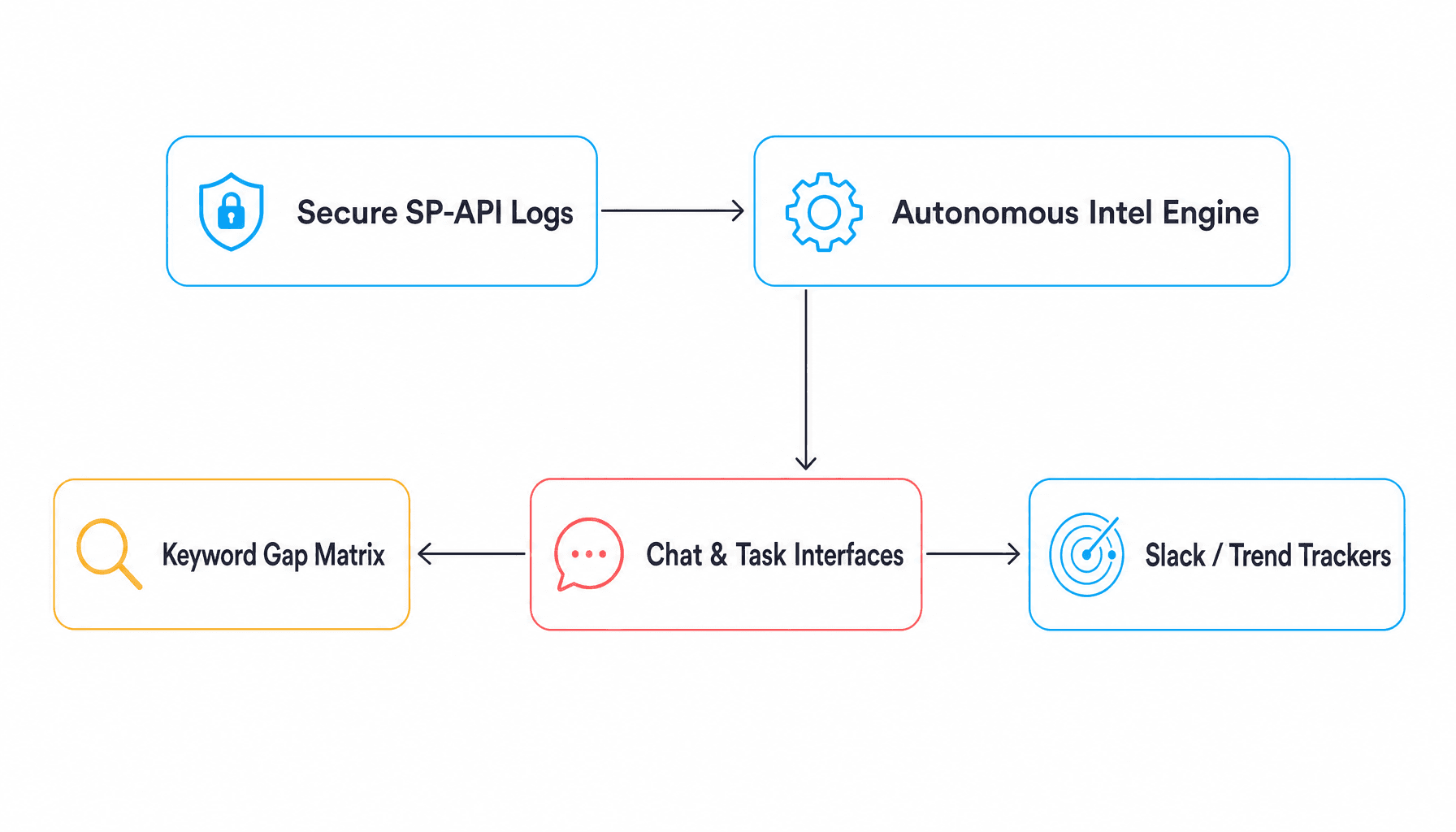
This integrated architecture changes how teams deploy competitor intelligence. If a brand manager notices an unexpected drop in organic sales volume on a core item, they do not need to log into multiple tracking tools or build manual spreadsheet calculations.
Instead, they can ask the agent directly inside the chat workspace: "Which keywords did we lose market share on last week?" The system reviews recent SQP datasets, compares your performance against competitor trends, and displays a clear summary instantly. This rapid analysis helps companies identify search changes early to protect their organic rankings.
Coordinating Competitor Insights Across Platform Interfaces
The Search and Competitor Intel skill functions seamlessly across the platform's three primary interface environments to keep your team aligned:
In the Conversational Chat: Management teams can run quick category health checks or request instant keyword gap updates by using natural language commands, avoiding manual report creation.
On the Turnkey Dashboards: A clean, default metrics view displays your overall keyword indexing progress, active competitor gap lists, and high priority launch radar notices without confusing technical jargon.
Through Scheduled Tasks: The automated task manager runs regular daily catalog scans and weekly search funnel audits, sending crucial positioning updates directly to your connected team channels so your operations specialists can react quickly to market movements.
Frequently Asked Questions
What is the exact difference between third party keyword scraping and direct SQP data mining?
Standard third party keyword tools rely on estimation algorithms to guess keyword traffic metrics, which introduces inaccuracies you can't audit. The agent pulls your Search Query Performance reports directly through Amazon's official Selling Partner API — real, verified funnel data from your own Seller Central account and layers competitor context from public marketplace data on top. Your numbers are exact; only the competitive landscape is observed externally, the same way any shopper sees it.
Can the Launch Radar skill identify when a competitor runs an off-site traffic campaign?
While the system cannot track external websites directly, it monitors rapid, unusual increases in an ASIN's BSR (Best Sellers Rank) alongside drops in organic keyword visibility. When these patterns occur, it alerts your team to potential external competitor campaigns.
How does identifying keyword gaps help lower my total advertising costs?
Isolating keywords where your competitors rank highly but your brand lacks organic presence allows you to target those terms precisely with your PPC campaigns. Winning back organic placement on these high intent terms helps reduce your long term reliance on expensive paid ads.
Does using the competitor intel skill reveal my brand's secure sales data to other sellers?
No. The platform utilizes completely isolated data environments for every connected seller account. Your performance metrics, search data, and API tokens are encrypted and used solely to run the skills for your brand, ensuring your information is never shared or aggregated.
How often does the system update competitor indexing tracks?
The agent runs background automated scans every week to process updated Search Query Performance files and category browse node distributions, ensuring your operations dashboard always reflects recent marketplace changes.

Co-Founder & CEO, Lumian
Robin Lobo is Co-Founder and CEO of Lumian. He built and sold a seven-figure eyeglasses brand on Amazon and spent several years on the client side of traditional agencies before founding Lumian, an AI-native Amazon agency backed by $3M led by Bowery Capital.