What Does a 90-Day Onboarding and Growth Plan from an Amazon Agency Look Like?
Discover what to expect during a 90-day Amazon agency onboarding plan, from baseline PPC audits and listing optimization to organic rank growth and TACoS compression.
TL;DR
What to Expect:
A detailed breakdown of the 90-day onboarding and growth trajectory when transitioning your Amazon account to a hybrid agency model powered by autonomous AI execution and human strategic oversight.
Key Takeaways:
Phase 1 (Days 1 - 30): Focuses on account auditing, technical setup, establishing parameter guardrails, and eliminating wasted advertising spend.
Phase 2 (Days 31 - 60): Activates continuous 24/7 campaign optimization, A/B listing experiments, and inventory velocity calibration.
Phase 3 (Days 61 - 90): Capitalizes on organic keyword ranking gains, compressing Total Advertising Cost of Sales (TACoS) and expanding profit margins.
Core Success Metric: Success in the first 90 days is defined by reduced ad leakage, improved unit session percentages, and a clear shift toward organic sales velocity.
Intro
Partnering with an Amazon growth partner requires a clear operational roadmap. Onboarding an enterprise account or a multi-SKU product catalog is a complex process where hasty adjustments can destabilize active keyword rankings, trigger listing policy flags, or disrupt inventory reorder cycles.
A structured 90-day onboarding plan provides predictable milestones, establishes risk guardrails, and lays the groundwork for sustainable marketplace growth. By shifting routine execution to autonomous AI agents while relying on dedicated human strategists for governance, brands can transition from manual firefighting to systematic scaling within three months.
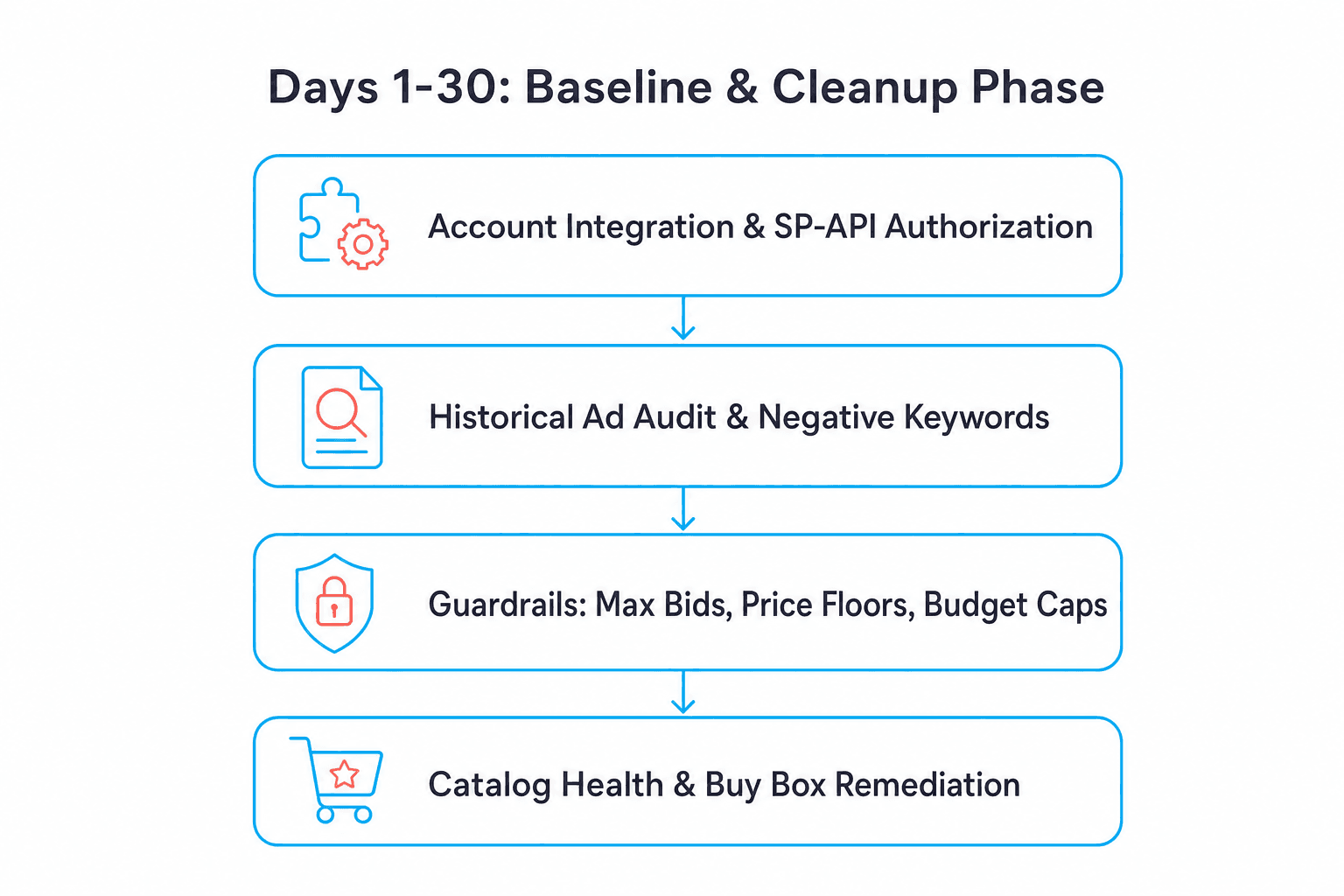
Phase 1 (Days 1 - 30): Baseline Audits, Technical Integration, and Risk Controls
The initial 30 days focus on diagnostic evaluation, account cleanup, and establishing operational parameters. Before launching aggressive growth initiatives, the account infrastructure must be stabilized.
Account Integration and Security Authorization
Onboarding begins by establishing secure, programmatic connections via Amazon's Selling Partner API (SP-API). Using Login with Amazon (LWA) OAuth 2.0 protocols, data access is granted without sharing primary account passwords or sensitive disbursement settings.
Comprehensive Historical Account Audit
Engineers and strategists analyze up to 24 months of historical performance data to establish clear baselines across four core areas:
Advertising Efficiency: Identifying non-converting search terms, high-cost placements, and budget leaks across Sponsored Products and Sponsored Brands.
Catalog Integrity: Scanning detail pages for title truncation, missing main image assets, or improper node categorizations.
Inventory Velocity: Evaluating lead times, historical sell-through rates, and stockout risk across all active SKUs.
Pricing & Buy Box Health: Checking for unauthorized resellers, MAP compliance breaches, or price suppression flags.
Establishing Parameter Guardrails
To prevent automated errors, hard boundary conditions are configured before active optimizations begin. Maximum bid caps, gross margin price floors, and daily budget ceilings are locked into the execution layer. Any proposed change exceeding these parameters triggers a mandatory review queue for human brand managers.
Immediate Waste Elimination
During the first three weeks, automated sweeps harvest non-converting search terms and apply negative keyword targets. Keyword harvesting data shows exact-match terms promoted from search-term reports can deliver roughly 34% lower CPC and more than double the conversion rate compared to broad-match-only campaigns, which is why eliminating wasted spend on non-converting terms is typically the first lever pulled in an audit.
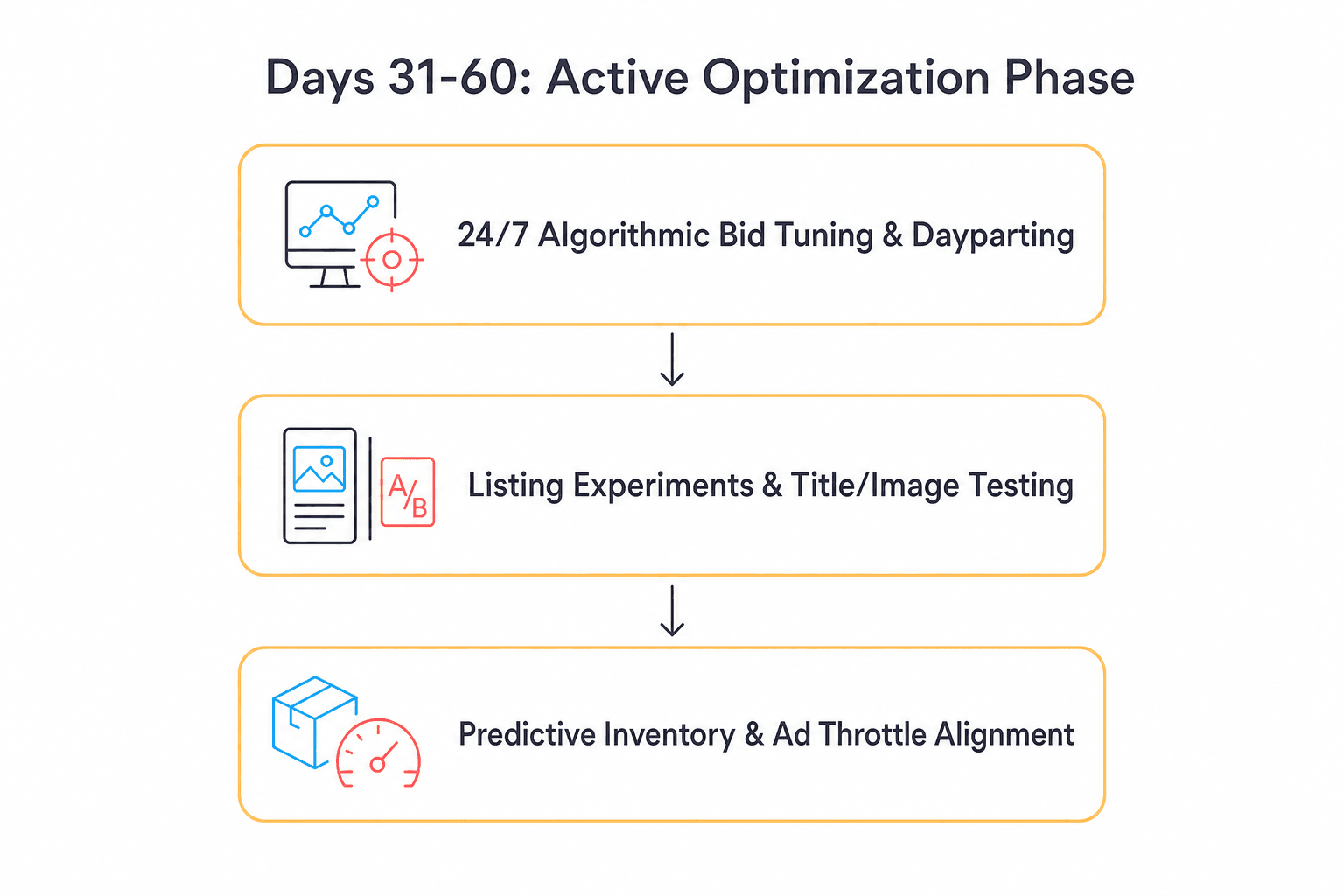
Phase 2 (Days 31 - 60): Algorithmic Scaling, Listing Optimization, and Supply Calibration
Once baseline audit tasks are complete and safety parameters are active, the focus shifts to continuous optimization and listing performance.
Continuous 24/7 Campaign Optimization
With risk parameters active, autonomous agents take over daily PPC execution. Instead of weekly or bi-weekly manual bid adjustments, bidding algorithms evaluate keyword conversion probabilities continuously across different time-of-day traffic patterns and placement types.
Listing Conversion Rate (CVR) Optimization
Traffic acquisition requires high-converting detail pages. During Phase 2, creative teams and AI agents launch structured listing experiments:
Main Image Refresh: Testing main image variations to increase organic Click-Through Rates (CTR) in search results.
Title & Feature Bullet Restructuring: Updating copy to incorporate high-intent seed keywords while maintaining readability and compliance.
A+ Content Upgrades: Designing comparison charts and brand story modules to drive cross-SKU discovery.
Syncing Ad Velocity with Inventory Supply
To avoid stockouts, advertising software must integrate directly with warehouse inventory levels. Industry adoption data from NVIDIA's 2025 State of AI in Retail and CPG report shows demand forecasting is now the leading AI use case in supply chain management, with 64% of retailers using it, well ahead of other operational AI applications, reflecting how directly predictive modeling ties to preventing stockouts and lost sales. If stock levels drop below safety thresholds, ad campaigns throttle back automatically to preserve inventory for organic shoppers.
Brand teams interested in evaluating real-world campaign workflows can explore Lumian AI's platform capabilities to see how automated optimizations function alongside human governance.
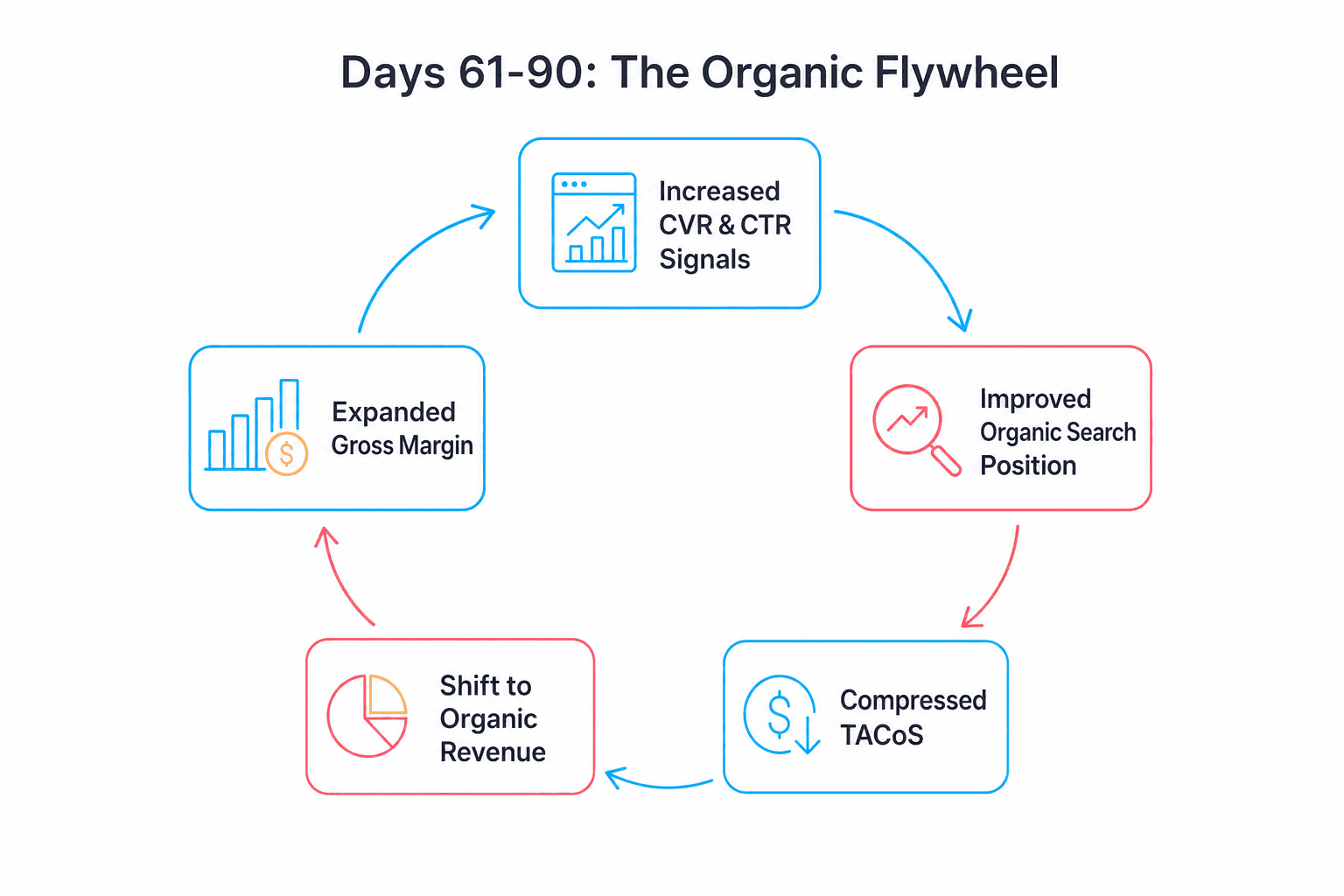
Phase 3 (Days 61 - 90): Organic Flywheel Acceleration and TACoS Compression
The final phase of the 90-day onboarding strategy transitions the account from ad-driven growth to organic momentum.
Building Organic Share of Voice (SoV)
As conversion rates improve and targeted PPC campaigns capture high-intent search share, Amazon's search algorithm recognizes the increased product relevance. Higher conversion rates signal value to the platform, driving organic ranking gains on primary seed keywords.
Total Advertising Cost of Sales (TACoS) Compression
During the initial launch phase, ad spend may represent a higher percentage of total revenue. As organic search ranks improve, organic sales volume grows faster than paid ad volume. This shift compresses Total Advertising Cost of Sales (TACoS), expanding net profit margins.
Long-Term Strategic Planning
By Day 90, the account reaches a stable operational state. Dedicated e-commerce strategists meet with brand leadership to review performance benchmarks and establish long-term expansion goals, including:
Launching new product variations or secondary catalog lines.
Expanding into international Amazon marketplaces.
Adjusting seasonal promotional strategies for peak sales events.
Expected Benchmarks by Day 90
Evaluating the success of a 90-day onboarding plan requires looking at specific operational indicators across advertising, listing conversion, and supply stability.
Performance Metric | Baseline (Day 1) | Target Benchmark (Day 90) | Primary Driver |
Optimization Velocity | Weekly manual adjustments | Continuous 24/7 bid tuning | Algorithmic API execution |
ACoS Reduction | Unoptimized historical baseline | 20% to 35% improvement | Automated negative harvesting & bid tuning |
Conversion Rate (CVR) | Category average (8% - 12%) | 15% to 25% relative uplift | Listing image & copy A/B experiments |
TACoS Stability | Volatile ad spend ratio | Declining trend toward 8% - 12% | Organic keyword ranking gains |
Stockout Incidents | Reactive inventory reorders | 25% reduction in out-of-stock days | Predictive lead time & run-rate modeling |
To review additional performance benchmarks across diverse product categories, explore Lumian AI's case study portfolio for detailed performance breakdowns.
Frequently Asked Questions
How quickly can a brand expect to see performance improvements during onboarding?
Initial improvements in ad spend efficiency typically occur within the first 14 to 30 days as automated sweeps eliminate wasted spend on non-converting search terms. Broader conversion rate uplifts and organic rank improvements usually manifest between Days 45 and 90.
Will onboarding require sharing primary Seller Central passwords?
No. Onboarding uses Amazon's official Selling Partner API (SP-API) via Login with Amazon (LWA) OAuth 2.0 workflows. Primary passwords and banking details remain completely secure and untouched.
What is the role of human strategists during the 90-day onboarding plan?
Human strategists establish parameter guardrails, review high-impact campaign changes, oversee creative listing updates, and ensure that automated execution aligns with long-term brand objectives.
How does an AI-powered onboarding plan prevent stockouts?
AI agents track sales velocity alongside supplier lead times and warehouse stock levels. If inventory drops below safety thresholds, ad spend throttles automatically to stretch stock availability until replenishment arrives.
What happens if an automated campaign adjustment does not yield positive results?
Every system adjustment is logged in a time-stamped audit ledger. If market conditions shift unexpectedly, operators can execute a single-click rollback to restore historical campaign settings immediately.