How AI Monitoring Prevents Stockouts and Optimizes Amazon Ad Spend
Discover how real-time AI monitoring syncs inventory velocity with Amazon PPC ad spend to prevent stockouts, lower TACoS, and protect organic rankings.
TL;DR
What to Expect:
A detailed breakdown of how real-time artificial intelligence monitoring connects supply chain data with pay-per-click (PPC) advertising execution to prevent costly stockouts, protect organic rank, and eliminate wasted ad spend on Amazon.
Key Takeaways:
The Stockout Trap: Running out of stock while running ad campaigns destroys organic search rank, wastes advertising historical equity, and lowers overall account profitability.
Inventory-Driven PPC: Autonomous AI monitoring dynamically adjusts bid strategies and daily budgets based on real-time stock velocity and lead times.
Budget Conservation: Intelligent throttle systems automatically pause or reduce PPC spend on low-stock items before inventory depletion triggers Buy Box suppression.
Unified Strategy: Combining automated supply chain forecasting with ad governance protects Total Advertising Cost of Sales (TACoS) and maintains profit margins.
Intro
Scaling a retail brand on Amazon requires managing a delicate balance between demand generation and inventory availability. Brand managers often run aggressively optimized Sponsored Products and Sponsored Brands campaigns to capture search share. However, when sales velocity outpaces supply chain replenishment, products run out of stock.
Stockout events trigger severe penalties within Amazon's search algorithm. When an ASIN becomes unavailable, the listing loses the Buy Box, keyword rankings drop rapidly, and historical advertising relevance deteriorates. Once inventory is replenished, brands are forced to re-spend heavily on PPC campaigns just to regain their former organic search positioning.
The Hidden Cost of Stockouts on Amazon Advertising
Running ad campaigns without real-time inventory visibility creates significant financial leakage. Traditional PPC management tools optimize bids based purely on ad performance metrics such as Cost Per Click (CPC), Advertising Cost of Sales (ACoS), and Click-Through Rate (CTR). These tools generally lack real-time integration with warehouse stock levels, inbound shipments, or supplier lead times.
When a high-converting product approaches critical stock levels, unmonitored ad campaigns continue driving high-intent traffic. This creates two distinct failure points:
Accelerated Stock Depletion: Advertising accelerates the exact moment of inventory failure, cutting short the selling window before purchase orders arrive.
Wasted Historical Ad Equity: Once stock hits zero, active campaigns pause automatically due to Buy Box loss, but the accumulated organic velocity drops instantly.
According to enterprise supply chain research published by Gitnux on AI supply chain statistics, organizations utilizing machine learning forecasting reduce stockout occurrences by up to 65% while improving inventory turnover efficiency. Connecting these predictive models directly to advertising execution bridges the gap between sales generation and inventory health.
How AI Monitoring Syncs Inventory Velocity with Ad Spend
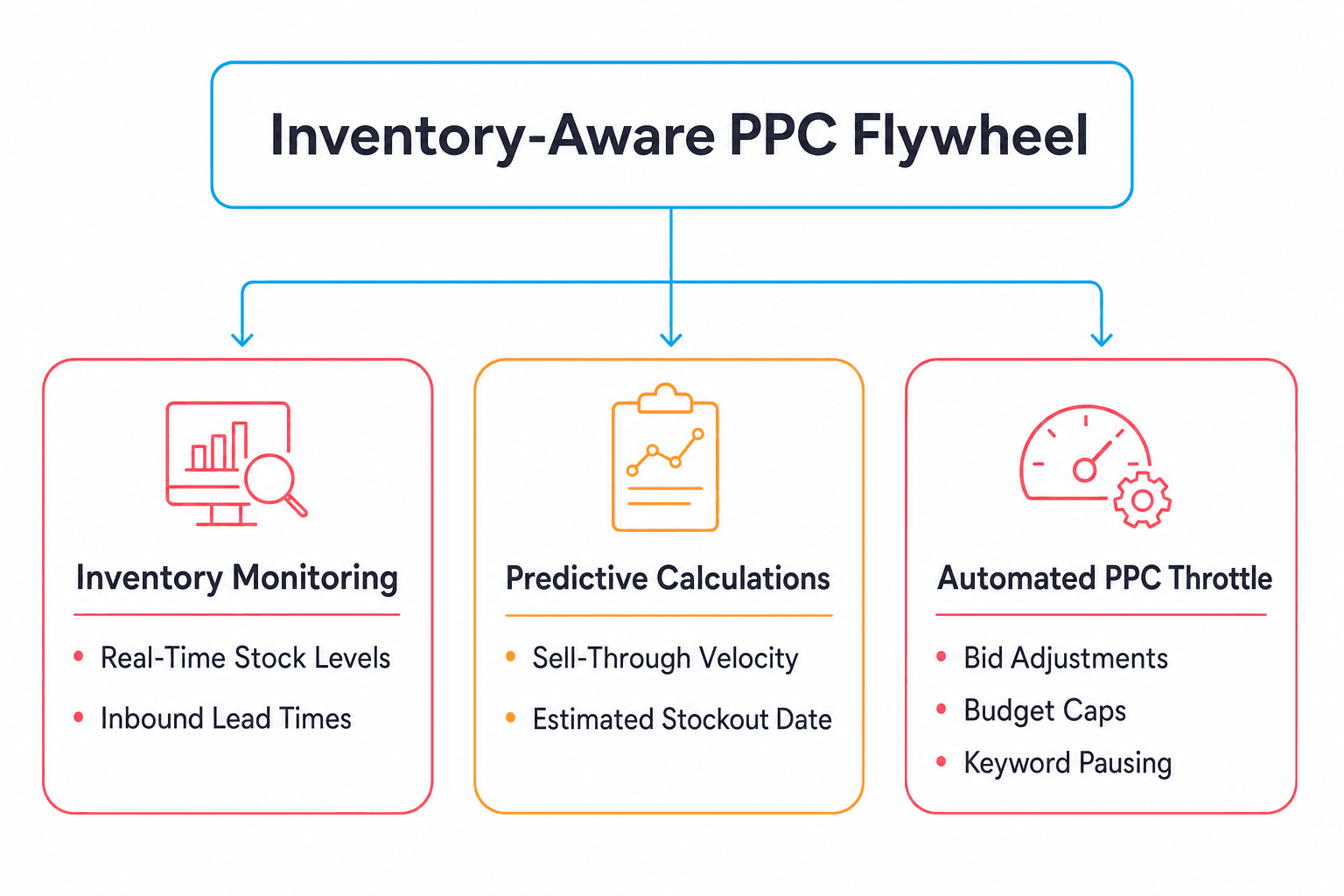
AI monitoring systems act as a continuous feedback loop between warehouse operations and marketplace ad consoles. By processing inventory replenishment metrics alongside real-time sales velocity, autonomous agents calculate the exact run-rate required to maintain stock availability until the next reorder arrives.
Predictive Sales Velocity Tracking
Standard inventory systems calculate reorder points using static historical averages. Modern AI models analyze dynamic demand signals, including seasonal search trends, promotional velocity, and category growth patterns. If an ad campaign drives a 40% surge in daily unit sales, the monitoring system recalculates the remaining days of inventory in real time.
Automated Lead-Time Integration
Supply chain delays are common in global retail. AI models track supplier lead times, port transit durations, and Amazon fulfillment center receiving times. If an inbound shipment is delayed by two weeks, the system adjusts the product's daily sales targets to stretch remaining stock across the revised timeline.
Preventing Budget Waste: Automating Dynamic Ad Throttling
When an ASIN enters a high-risk stockout zone, AI monitoring protocols enforce automated ad throttling instead of allowing campaigns to run at full spend.
Bid Compression on Non-Essential Keywords: The system reduces bids on broad, top-of-funnel search terms while retaining targeted exact-match keywords that convert at higher profit margins.
Budget Reallocation to Healthy SKUs: Capital is automatically shifted away from low-stock listings toward secondary SKUs or catalog variations with healthy inventory buffers.
Targeted Campaign Pausing: If inventory drops below safety thresholds, ad spend pauses entirely before stock hits zero, preserving inventory for organic buyers and extending listing uptime.
As documented in reporting benchmark guides from Ad Badger on Amazon advertising statistics, maintaining consistent account efficiency requires balancing ad spend against total sales velocity. Controlling ad spend through dynamic throttling protects Total Advertising Cost of Sales (TACoS) during tight inventory periods.
Rebuilding Organic Rank and Sales Momentum Post-Stockout
When stockouts do occur, returning to full sales velocity requires a structured recovery strategy. Restoring advertising spend immediately to pre-stockout levels often leads to inflated ACoS because search algorithms re-evaluate the listing's conversion reliability.
AI monitoring assists post-stockout recovery through phased campaign reactivations:
Phase 1 (Stock Arrival Verification): The system confirms that inventory is physically checked in at Amazon fulfillment centers before reactivating campaigns, preventing ad clicks on backordered items.
Phase 2 (High-Intent Keyword Focus): Campaigns restart focusing strictly on high-converting branded and exact-match keywords to establish a strong initial Conversion Rate (CVR).
Phase 3 (Gradual Budget Scaling): As conversion history stabilizes and organic keyword rank recovers, ad budgets scale back to standard growth targets.
The Lumian AI Solution: Intelligent Governance for Amazon Brands
Managing the connection between ad performance and inventory supply requires technology built specifically for marketplace complexities. The platform offered by Lumian AI combines continuous autonomous execution with dedicated human expertise to protect brand margins.
Autonomous Inventory-Aware Execution
Lumian's specialized AI agents monitor catalog metrics, search term velocity, and stock levels around the clock. By syncing ad management with stock availability, the platform adjusts PPC bids dynamically to prevent stockout events while maximizing market share.
Human-in-the-Loop Guardrails
Automation operates best within defined strategic boundaries. Lumian enforces strict parameter limits, gross margin price floors, and multi-tier approval gates. High-stakes operational decisions are reviewed by experienced e-commerce strategists, ensuring that automated execution aligns with long-term brand objectives.
Complete Audit Transparency
Every bid adjustment, budget shift, and inventory alert is recorded in a transparent, timestamped audit log. Brand managers maintain full visibility over account actions with instant rollback capabilities if market conditions shift unexpectedly.
To learn how integrated AI monitoring can safeguard your catalog against stockouts and optimize ad efficiency, explore the platform capabilities available through Lumian AI.
Frequently Asked Questions
How does AI monitoring detect impending stockouts on Amazon?
AI monitoring continuously analyzes real-time sales velocity, ongoing ad campaign acceleration, historical seasonality, and supplier lead times. By comparing daily burn rates against available inventory and inbound shipments, the system calculates estimated stockout dates in real time.
Why should PPC ad spend be paused before a product completely runs out of stock?
Pausing or throttling ad spend before inventory reaches zero stretches remaining stock over a longer period. This keeps the listing active longer, preserves organic search rankings, and prevents wasting ad capital on traffic that accelerates a stockout.
What happens to an Amazon listing's organic rank during a stockout?
When a product runs out of stock, its listing loses the Buy Box and organic search positioning drops significantly. Amazon's algorithm prioritizes available products, forcing sellers to re-invest heavily in PPC advertising once stock is replenished.
How does Lumian AI connect ad spend management with inventory data?
Lumian's autonomous AI agents track product stock levels alongside PPC performance metrics. When stock drops below safety thresholds, the system automatically adjusts bids, caps daily budgets, or reallocates capital to healthy SKUs.
What is the role of human strategists when using Lumian AI?
Human strategists establish strategic guardrails, approve high-impact campaign changes, manage long-term brand positioning, and ensure that autonomous AI execution remains aligned with business goals.