Should I Hire an AI-Powered Amazon Agency or a Traditional Agency for My Brand?
Compare traditional Amazon agencies, standalone AI software, and hybrid agency models to discover which partner offers the best speed, strategy, and ROI for your brand.
TL;DR
What to Expect:
An objective analysis comparing traditional Amazon management agencies, standalone PPC software tools, and hybrid AI-powered agency platforms. This guide evaluates operational velocity, cost efficiency, risk management, and strategic depth to help brand leaders choose the right growth partner.
Key Takeaways:
Traditional Agencies: Offer deep human strategic alignment and creative branding, but face operational constraints due to account manager bandwidth and manual execution delays.
Standalone AI Software: Provides rapid algorithmic data processing and continuous bid adjustments, but lacks strategic brand context, creative judgment, and nuanced compliance oversight.
Hybrid AI-Powered Agencies: Combine 24/7 autonomous execution with dedicated human strategist governance, ensuring fast operational velocity while protecting profit margins and account health.
The Ideal Solution: Modern brands benefit most from platforms like Lumian AI, which pair specialized autonomous agents with experienced e-commerce strategists to eliminate manual operational bottlenecks.
The Evolving Landscape of Amazon Account Management
Scaling a brand on Amazon requires managing dozens of interconnected variables simultaneously. From dynamic PPC bid adjustments and search term harvesting to inventory reorder modeling, listing suppression monitoring, and Buy Box defense, the daily operational workload grows exponentially alongside SKU count.
Historically, brand owners faced a straightforward choice: hire an in-house marketplace team or outsource operations to a traditional full-service Amazon agency. However, the rapid advancement of machine learning and agentic workflows has reshaped e-commerce management. According to market research published by Triple Whale on AI adoption in e-commerce, over 80% of retail organizations are actively deploying or piloting generative AI and algorithmic automation across core business functions.
As machine learning tools become standard across advertising and inventory management, brand executives must evaluate whether traditional agency models remain competitive, or if an AI-powered approach offers a superior path to sustainable growth.
Evaluating Traditional Amazon Agencies: Strengths and Limitations
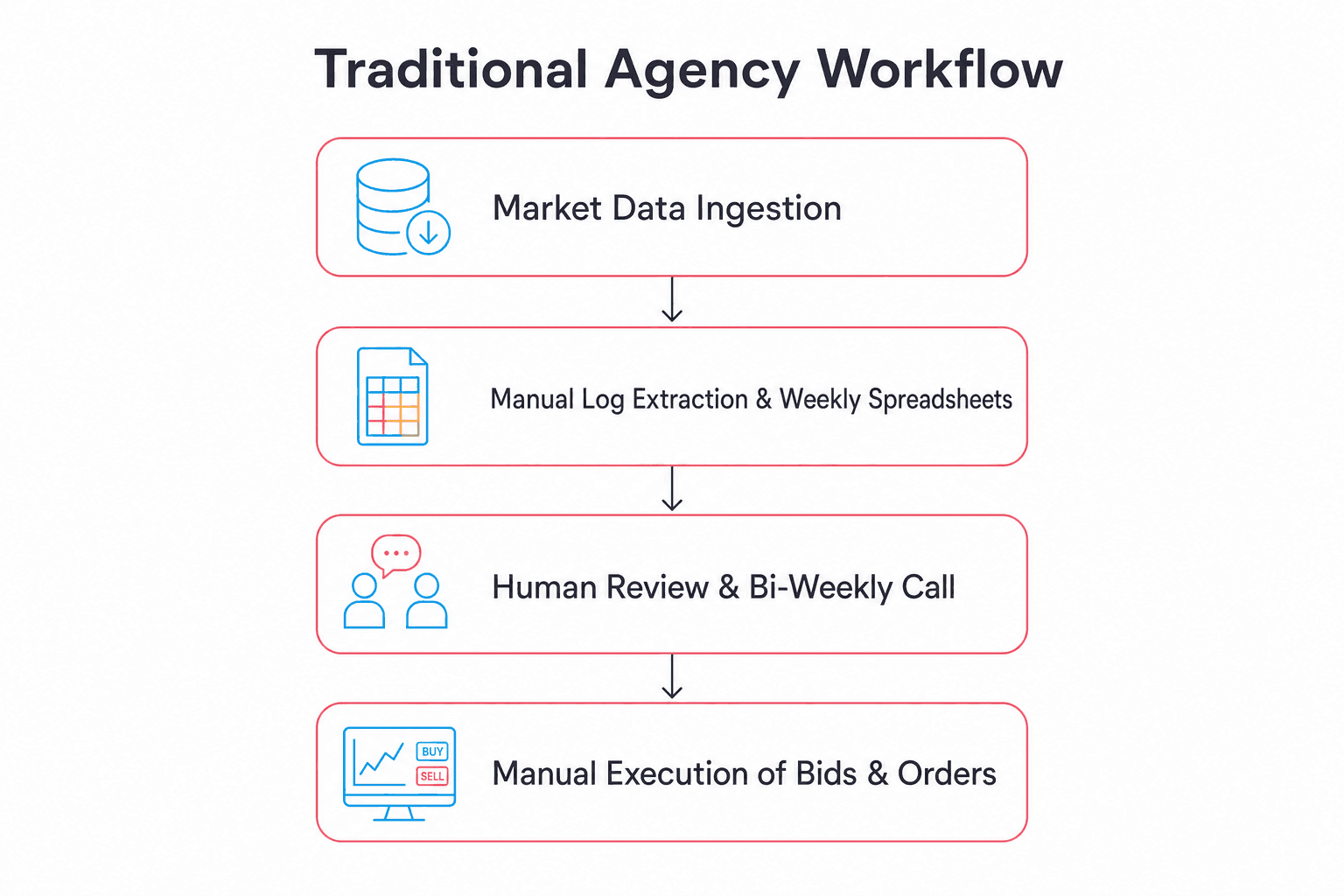
Traditional agencies have served as the standard choice for growing brands for over a decade. These organizations rely on dedicated account managers, PPC specialists, and content teams who manually execute marketplace strategies.
Advantages of Traditional Agencies
Strategic Human Context: Experienced account managers understand broader brand positioning, seasonal promotional calendars, and long-term capital allocation goals.
Creative & Brand Development: Human teams excel at crafting brand stories, conducting lifestyle photography shoots, and building custom A+ Content layouts.
Direct Relationship: Brands receive dedicated communication channels, structured status calls, and customized executive reporting.
Operational Limitations
Bandwidth Bottlenecks: The average agency account manager handles between 8 and 15 complex brand accounts simultaneously. This workload limits active management to periodic optimization sweeps rather than continuous account monitoring.
Slow Execution Velocity: Industry benchmark data compiled by Ryze AI on Amazon campaign management indicates that manual account management requires 12 to 15 hours per week per account. Consequently, bid changes and negative keyword harvesting typically occur on a weekly or bi-weekly cycle.
High Overhead Costs: Traditional agencies carry substantial labor costs, which are passed to clients through high monthly retainer fees or percentage-of-ad-spend pricing structures.
Evaluating Standalone AI Software: Speed vs. Context
To overcome human bandwidth limitations, many brands turn to standalone PPC software tools and automated bid management algorithms.
Advantages of Standalone AI Software
Continuous 24/7 Execution: Machine learning algorithms process keyword conversion probabilities, competitor price shifts, and search trends every hour.
Data Scale: Algorithms evaluate thousands of search terms simultaneously, identifying micro-trends that human managers might overlook during manual reviews.
Cost Lowering: Software subscriptions generally cost significantly less than full-service human agency retainers.
Operational Limitations
Lack of Strategic Vision: Pure software engines optimize strictly for mathematical objective functions (such as target ACoS). Without human context, an algorithm may cut ad spend on high-value seed keywords that drive organic ranking or brand discovery.
Operational Silos: Standalone PPC software operates independently from supply chain lead times, catalog compliance, and inventory levels. An ad algorithm may aggressively drive traffic to a SKU that is nearing a stockout, eroding profit margins and organic rank.
Management Burden: Software tools require internal staff to configure rules, monitor outputs, and troubleshoot anomalies. The operational workload shifts back to the brand.
The Hybrid Model: Combining AI Speed with Human Oversight
The most effective modern approach merges the speed of autonomous AI execution with the strategic direction of human brand managers.
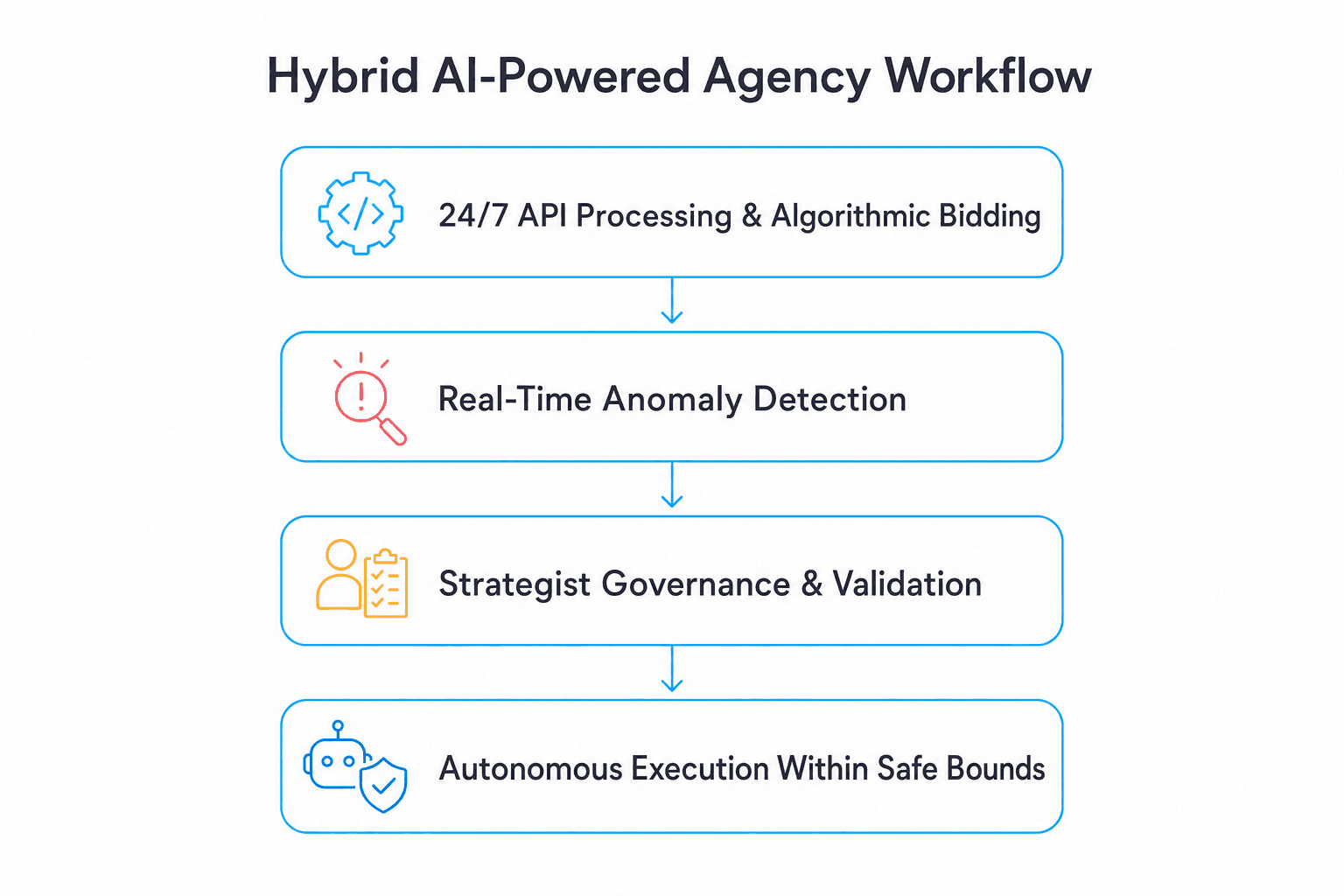
In a hybrid framework, autonomous agents handle real-time execution velocity - such as hourly bid adjustments, listing suppression alerts, and search term harvesting. Meanwhile, senior human strategists focus on goal setting, catalog expansion, margin balancing, and promotional planning.
According to research from McKinsey & Company on enterprise AI implementation, organizations that combine machine learning automation with human governance achieve higher operational scaling speed while maintaining strict risk containment.
Side-by-Side Comparison Matrix
To evaluate which model fits your business structure, compare how each operational approach handles core marketplace functions:
Operational Feature | Traditional Agency | Standalone AI Software | Hybrid AI-Powered Agency |
PPC Optimization Frequency | Weekly or bi-weekly manual sweeps | Continuous 24/7 algorithmic execution | Continuous 24/7 algorithmic execution |
Strategic Goal Alignment | High - driven by human strategists | Low - strictly mathematical algorithms | High - human oversight guides AI agents |
Inventory & Supply Integration | Reactive manual checks | None - operates in an isolated silo | Dynamic ad adjustments based on inventory |
Human Bandwidth Constraints | High - managers capped at 8-15 accounts | None - fully automated execution | Minimal - AI handles execution workload |
Risk & Compliance Management | Manual reviews; delayed error detection | High risk of runaway optimization | Multi-tiered approval gates & circuit breakers |
Cost Structure | High retainers + % of spend fees | Flat low-cost software subscriptions | Optimized cost structure pairing AI + experts |
Key Factors to Consider When Selecting an Amazon Partner
Before signing a service agreement, brand leaders should evaluate four critical operational criteria:
1. Catalog Complexity and Velocity
Brands managing hundreds of parent-child SKUs or operating across multiple international marketplaces require continuous optimization. Human teams cannot manually review bid structures across thousands of keyword variations every day without missing opportunities.
2. Execution Speed vs. Strategic Guardrails
Pure automation carries risks if left completely unmonitored. Look for platforms that implement clear safety guardrails, such as maximum bid caps, gross margin price floors, and automated circuit breakers that pause spending during conversion anomalies.
3. Integrated Catalog and Inventory Awareness
Advertising performance is tied directly to inventory health. Choosing a partner whose technology integrates ad management with real-time stock forecasting ensures ad budgets pause automatically when safety stock thresholds are breached, protecting organic rank and margins.
4. Transparent Audit Capabilities
Opaque agencies and black-box software tools often make it difficult to verify what changes were made to an account. Ensure your growth partner provides a transparent, time-stamped audit ledger detailing every bid modification, keyword harvest, and listing update.
The Bottom Line: Why Lumian AI Delivers the Best of Both Worlds
Choosing between a traditional agency and an AI-powered partner does not require sacrificing strategic human relationships for algorithmic speed.
By combining always-on AI execution with dedicated human e-commerce expertise, Lumian AI's Amazon brand management solutions eliminate the trade-offs inherent in legacy agency models:
Continuous 24/7 Optimizations: Autonomous agents analyze keyword performance, competitor positioning, and listing integrity every hour, delivering optimization frequency that manual agency teams cannot match.
Dedicated Strategist Governance: Every account is paired with experienced e-commerce specialists who set growth parameters, review high-impact recommendations, and align platform execution with long-term brand objectives.
Integrated Operational Safety: Built-in risk management guardrails, multi-tier approval gates, and time-stamped audit logs protect account health and prevent unauthorized changes.
Capital Efficiency: By automating routine operational tasks, brand capital goes directly toward profitable growth rather than funding traditional agency overhead.
To learn how an AI-powered hybrid model can accelerate your Amazon growth while safeguarding brand equity, explore Lumian AI's platform features and case studies or request a comprehensive account audit.
Frequently Asked Questions
What is an AI-powered Amazon agency?
An AI-powered Amazon agency utilizes specialized autonomous software agents to handle real-time data ingestion, bid optimization, and catalog monitoring, paired with experienced human e-commerce strategists who manage brand governance and long-term growth planning.
Will hiring an AI-powered agency mean my account gets no human attention?
No. In a hybrid agency model, human strategists actively govern the system. While AI agents handle high-velocity execution tasks like hourly bid adjustments, human experts focus on strategic decision-making, promotional planning, and catalog expansion.
How does an AI-powered agency prevent automated mistakes on my account?
AI-powered agencies like Lumian implement strict parameter guardrails, including maximum bid caps, price floors, and automated circuit breakers. High-stakes actions require explicit human approval before being executed on marketplace APIs.
How quickly can a brand transition from a traditional agency to Lumian AI?
Onboarding typically takes less than 14 days. During this period, historic account data is ingested, baseline parameters and safety guardrails are established, and dedicated brand strategists configure agent workflows.
Is an AI-powered agency more cost-effective than a traditional agency?
Yes. Because AI agents handle labor-intensive data processing and routine campaign adjustments, operational overhead is significantly reduced. This allows brands to receive higher optimization frequency at a more efficient cost structure.

Co-Founder & CEO, Lumian
Robin Lobo is Co-Founder and CEO of Lumian. He built and sold a seven-figure eyeglasses brand on Amazon and spent several years on the client side of traditional agencies before founding Lumian, an AI-native Amazon agency backed by $3M led by Bowery Capital.