Demystifying AI Oversight: Human-in-the-Loop Policies, Approval Gates, and Rollback Safeguards
Discover how human-in-the-loop policies, multi-tier approval gates, and automated rollbacks prevent AI execution mistakes in enterprise e-commerce management.
TL;DR
What to Expect: A clear operational breakdown of enterprise AI governance, detailing how human-in-the-loop (HITL) policies, multi-tier approval gates, and automated rollback mechanisms prevent high-risk execution errors in autonomous e-commerce management.
Key Takeaways:
Governance Necessity: As enterprise automation shifts from simple insights to autonomous execution, structured oversight prevents margin erosion and platform compliance failures.
Approval Gates: Categorizing actions by risk tier ensures routine data tasks execute instantly while high-consequence decisions require explicit human validation.
Deterministic Rollbacks: Comprehensive audit logging enables single-click reversion to safe historical states whenever market anomalies or API shifts occur.
Safety Boundaries: Explicit parameter limits block unauthorized pricing shifts, ad spend spikes, and catalog modifications before changes hit live marketplace APIs.
Why Autonomous Execution Requires Structural Governance
The rapid adoption of artificial intelligence across digital sales channels has transformed how enterprise brands manage daily operations. In high-velocity environments like Amazon and global e-commerce marketplaces, algorithmic systems handle millions of data points across keyword bidding, catalog maintenance, and inventory planning. However, transitioning from passive analytics to active agentic execution introduces distinct operational risks.
Without clear governance boundaries, unconstrained machine learning models can make mathematically logical decisions that yield catastrophic business outcomes. For example, an ad-bidding algorithm prioritizing top-of-search impression share might drastically inflate Cost Per Click (CPC) on low-converting terms, draining daily budgets within hours. Similarly, an automated pricing model attempting to win the Buy Box could trigger a race to the bottom, breaching Minimum Advertised Price (MAP) agreements and destroying product margins.
According to research from the Human-in-the-Loop AI Market Report by Research and Markets, the global market for human-supervised AI infrastructure is expanding from $5.4 billion in 2025 to $6.73 billion in 2026. This rapid growth reflects an industry-wide recognition that autonomous efficiency must be paired with strict risk management frameworks. Building reliable AI workflows requires moving past blind trust and implementing structured oversight mechanisms.
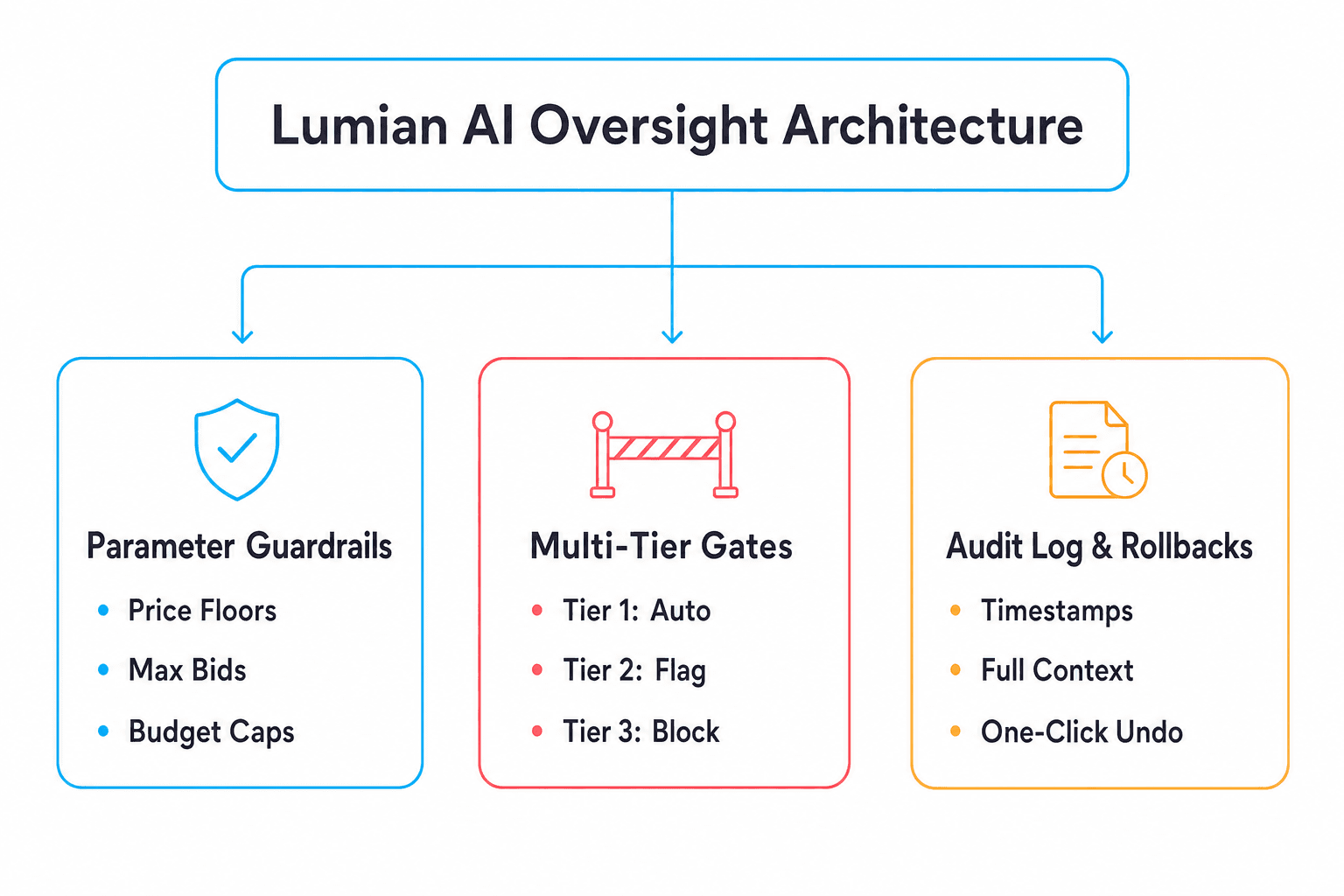
Understanding Human-in-the-Loop (HITL) Architecture
At its core, Human-in-the-Loop (HITL) architecture is a design pattern that integrates human judgment directly into automated decision cycles. Rather than allowing an AI agent to operate as an unmonitored closed loop, HITL establishes explicit checkpoints where human expertise evaluates model recommendations.
The primary goal of HITL is not to slow down execution, but to manage action risk. In traditional software, bugs result in static error codes. In AI systems, errors manifest as confident, syntactically correct actions that carry unintended real-world consequences. By embedding human expertise at critical inflection points, organizations maintain full operational control while leveraging machine processing speed.
This balanced approach aligns directly with the standards established in the NIST AI Risk Management Framework 1.0, which emphasizes that trustworthy AI systems must remain safe, transparent, and human-governed throughout their operational lifecycle.
The Role of Multi-Tier Approval Gates
To maintain high execution velocity without exposing the business to unnecessary risk, governance frameworks utilize multi-tier approval gates. These gates categorize proposed actions based on financial impact, brand sensitivity, and system reversibility.
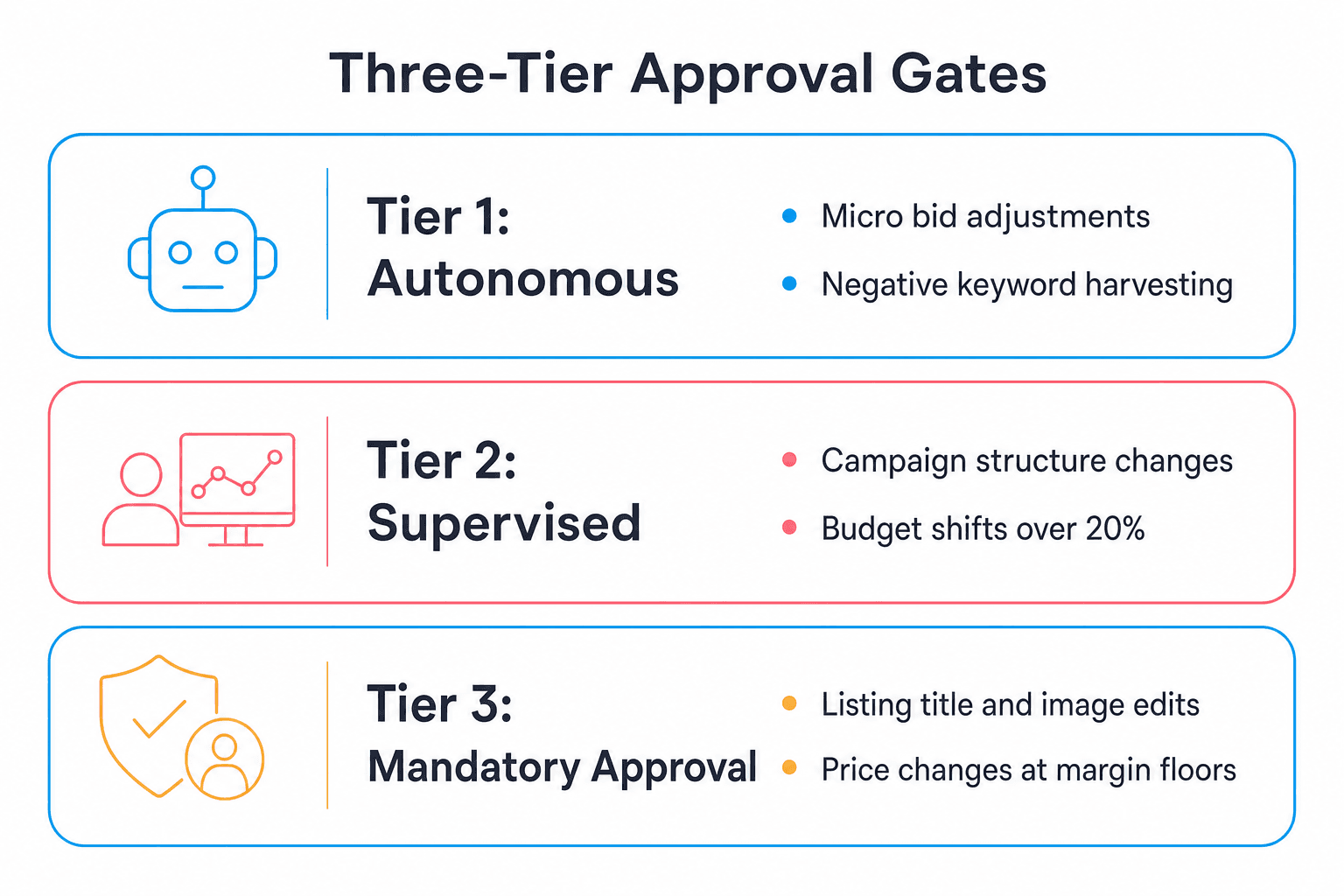
Tier 1: Low-Risk Autonomous Execution
Tier 1 encompasses routine, highly reversible decisions that operate within tight, pre-approved parameters. These actions execute automatically around the clock without manual intervention.
Micro PPC Adjustments: Raising or lowering keyword bids by small percentages based on historical conversion probability.
Negative Keyword Harvesting: Automatically blocking search terms that have generated high click volume without producing sales.
Routine Monitoring: Aggregating session data and organic rank tracking for performance reporting.
Tier 2: Medium-Risk Escalation and Review
Tier 2 covers actions that carry moderate financial or strategic weight. These decisions are drafted by AI agents and placed into a supervised review queue for brand managers.
Budget Reallocations: Moving ad spend between top-performing campaigns when requested shifts exceed 20% of baseline budgets.
Campaign Expansion: Launching new ad groups or targeting seller-identified competitor SKUs.
Secondary Listing Tweaks: Updating backend search terms or metadata variations to capture emerging search demand.
Tier 3: High-Risk Mandatory Sign-Off
Tier 3 represents high-consequence operations that can impact brand equity, buy box eligibility, or legal compliance. AI agents are strictly blocked from executing Tier 3 actions directly.
Price Adjustments: Any pricing modification that approaches wholesale margins or MAP compliance limits.
Core Detail Page Updates: Changes to main image assets, brand titles, or primary bullet points.
Catalog Re-categorization: Modifying node assignments or product tax codes across marketplace catalogs.
By routing proposed changes through structured tiers, platforms powered by Lumian AI's Amazon brand management solutions ensure that routine efficiency gains never trigger unvetted operational changes.
Rollback Procedures and Audit Ledger Integrity
Even with strict approval gates, dynamic marketplace environments can produce unpredictable outcomes. External factors - such as sudden platform API changes, competitor stockouts, or category fee updates - can alter the effectiveness of an optimization strategy after execution.
To guarantee operational resilience, an enterprise AI system must feature deterministic rollback capabilities backed by an immutable audit log.
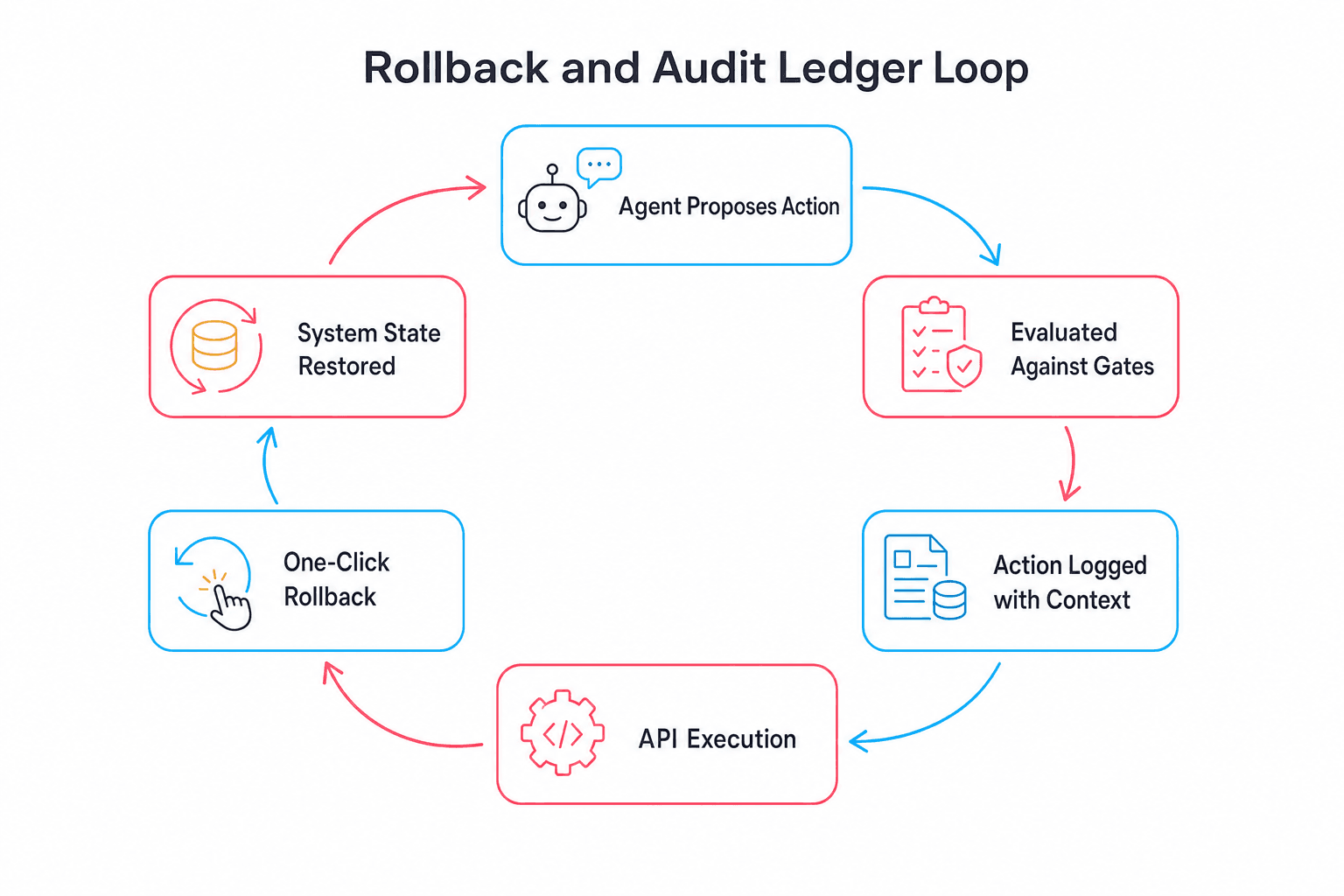
Key Components of a Robust Rollback Framework
State Snapshotting: Before executing any batch modification, the system captures a complete snapshot of current parameters, including active bids, content fields, and price matrices.
Contextual Event Logging: Every automated action is recorded in a centralized ledger. The log stores the exact timestamp, the agent rationale, the target SKU, and the previous system state.
One-Click Reversion: If an executed change results in an unexpected performance drop or policy warning, account operators can trigger a single-click rollback to restore historical settings instantly.
Automated Anomaly Circuit Breakers: If account monitoring detects sudden conversion drops or listing suppression following an automated update, the system halts pending changes and reverts recent modifications automatically.
Reviewing detailed operational workflows within Lumian AI's platform case studies demonstrates how comprehensive event logging protects catalog stability during high-volume sales events.
Real-World Scenarios: When AI Actions Are Blocked or Escalated
Examining specific operational conditions highlights how safety guardrails prevent common automation pitfalls in practice.
Scenario A: Prevented Buy Box Suppression
Context: An automated repricing tool detects an aggressive competitor price drop on a key hero SKU and attempts to match the price to maintain Buy Box share.
Trigger: The required price point falls below the predefined gross margin floor of 18%.
Governance Action: The Tier 3 approval gate blocks the price change instantly. The system flags the competitor activity, pauses ad spend acceleration on that SKU to prevent margin loss, and escalates the issue to the human strategist review queue.
Scenario B: Blocked Listing Attribute Modification
Context: A generative content agent analyzes search trends and drafts an updated product title containing trending seasonal keywords.
Trigger: The proposed title exceeds Amazon's character limits for the specific category and contains restricted promotional terms.
Governance Action: The system's compliance parser identifies the policy conflict and blocks the API payload. The agent receives feedback on the policy failure, rewrites the title within compliance guidelines, and submits the revised draft for manager approval.
Scenario C: Automated Ad Spend Escalation
Context: An ad management agent identifies a sudden conversion spike during an off-peak hour and attempts to increase campaign budgets by 300%.
Trigger: The proposed adjustment exceeds the maximum daily spending threshold defined in the account parameters.
Governance Action: The system caps the immediate budget expansion at the maximum allowable 25% threshold (Tier 1 limit) and generates an urgent Tier 2 alert asking the brand manager to approve additional capital allocation.
Building Sustainable AI Governance for Long-Term Growth
Deploying autonomous AI agents across enterprise sales channels offers immense competitive advantages, but scaling successfully requires prioritizing execution safety. By establishing parameter guardrails, multi-tier approval gates, deterministic rollback procedures, and continuous audit logging, brand owners can harness machine velocity without sacrificing operational control.
Enterprise governance is not about limiting technology - it is about creating a stable environment where human expertise and artificial intelligence work in tandem to drive sustainable, profitable growth. To discover how guardrailed automation can protect and scale your product catalog, schedule a strategy consultation through Lumian AI's enterprise contact portal.
Frequently Asked Questions
What is the difference between Human-in-the-Loop and complete AI autonomy?
Human-in-the-Loop (HITL) integrates human decision checkpoints into automated workflows, ensuring high-risk actions are validated by experts. Complete autonomy allows AI models to execute decisions directly on external systems without human review.
Why are approval gates necessary for e-commerce AI agents?
Approval gates prevent high-consequence errors - such as unauthorized price drops, listing suppressions, or budget overruns - by categorizing actions by risk and requiring human authorization for critical changes.
How do automated rollback procedures work during an account anomaly?
Rollback procedures utilize timestamped audit logs and historical system snapshots. If an automated change causes performance drops or policy flags, operators or circuit breakers can instantly restore previous account settings.
Can AI agents operate safely during peak shopping events like Prime Day?
Yes. By setting strict parameter bounds (such as maximum bid caps and inventory safety thresholds) prior to peak events, AI agents can execute real-time optimizations safely while high-impact shifts escalate to human managers.
What happens when an AI agent encounters an unexpected marketplace API error?
When API calls fail or return unexpected payloads, built-in circuit breakers halt agent adjustments, revert recent pending states, and notify technical administrators to prevent data corruption.

Co-Founder & CEO, Lumian
Robin Lobo is Co-Founder and CEO of Lumian. He built and sold a seven-figure eyeglasses brand on Amazon and spent several years on the client side of traditional agencies before founding Lumian, an AI-native Amazon agency backed by $3M led by Bowery Capital.