How Lumian Manages AI Risks and Prevents AI Mistakes on Accounts
Learn how Lumian prevents AI errors on Amazon accounts using hard parameter guardrails, real-time anomaly detection, and human-in-the-loop oversight.
TL;DR
What to Expect:
A comprehensive breakdown of the operational safety architecture, risk management guardrails, and human-in-the-loop governance mechanisms that protect enterprise Amazon and e-commerce accounts from AI errors.
Key Takeaways:
Deterministic Safety Rails: AI agents run within predefined parameter bounds (such as maximum bid caps, price floors, and daily budget limits) to prevent runaway automated changes.
Human-in-the-Loop Oversight: Critical or high-impact actions require explicit validation by expert brand managers before execution on marketplace APIs.
Real-Time Anomaly Detection: Continuous monitoring algorithms flag unexpected catalog suppressions, price drops, or listing changes within minutes.
Structured Rollback Capabilities: Every automated change is logged in a tamper-evident audit trail, allowing instant single-click rollbacks if account conditions change unexpectedly.
The Rising Imperative of AI Safety in E-Commerce Operations
Deploying autonomous artificial intelligence across enterprise marketplace accounts offers unprecedented scaling velocity. However, unconstrained AI execution introduces operational, financial, and brand equity risks. On platforms like Amazon, an undetected algorithmic pricing glitch or improper bulk keyword update can trigger buy box loss, listing suppression, or substantial margin erosion in a matter of hours.
As organizations accelerate the adoption of autonomous workflows, governance frameworks must evolve alongside model capabilities. McKinsey's 2026 AI Trust Maturity survey found that while most organizations are moving toward scaled agentic AI deployment, only a minority report having mature governance frameworks in place for it — a gap McKinsey identifies as the primary barrier to safely scaling autonomous execution. Establishing rigorous risk guardrails is no longer optional - it is a foundational requirement for operational resilience.
Lumian addresses these challenges through a multi-layered security architecture. By combining strict programmatic constraints, real-time anomaly detection, and expert human oversight, the platform ensures that AI velocity never compromises account safety.
The Four Pillars of Lumian's Risk Mitigation Architecture
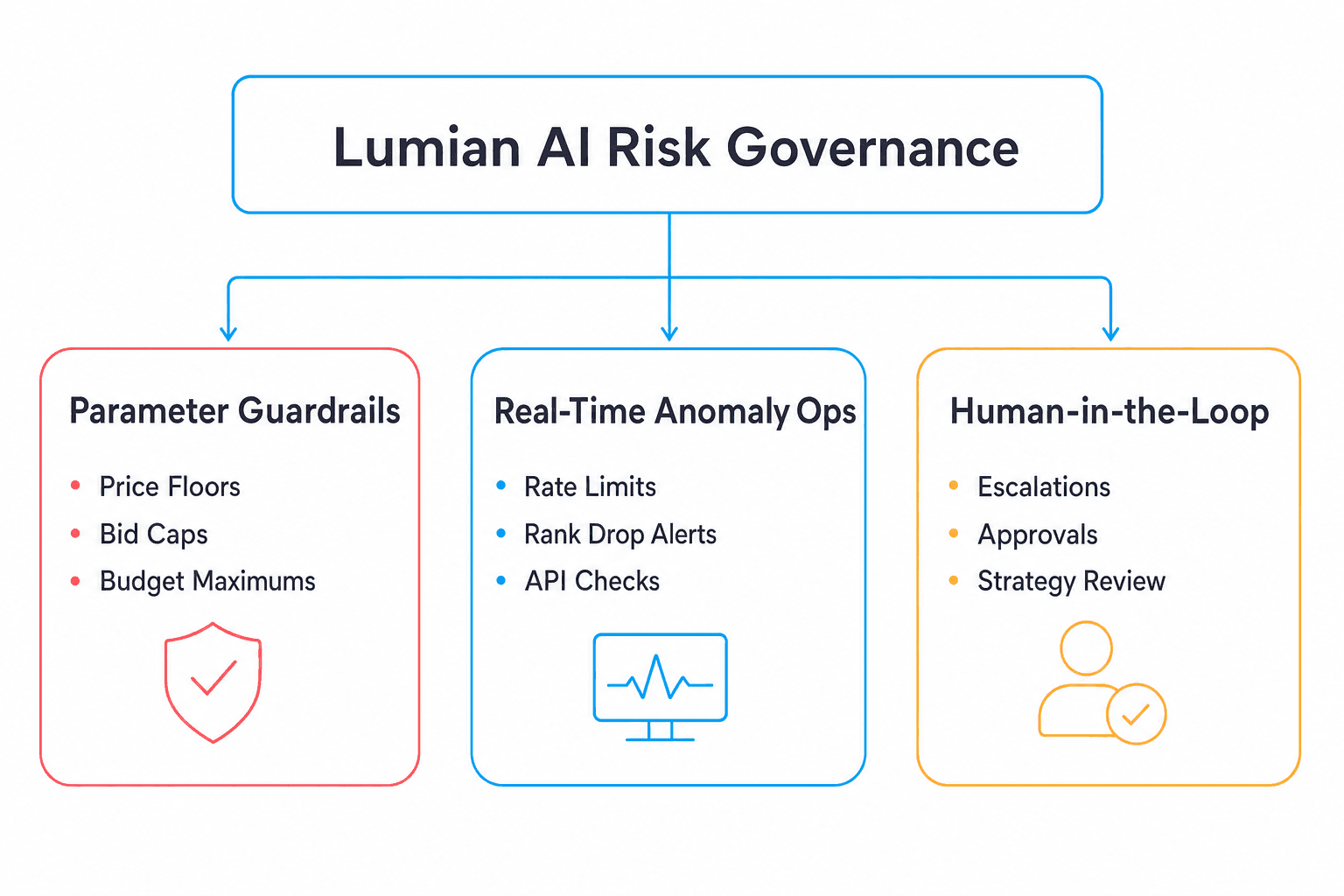
To eliminate the risks associated with black box automation, Lumian structures its execution engine around four distinct safety layers.
1. Hard Parameter Limits and Bounding
AI models optimize based on objective functions, but without strict bounds, mathematical optimization can produce unintended side effects. Lumian enforces immutable parameter ceilings and floors directly at the execution layer:
Bid and Budget Caps: PPC bid adjustments operate within user-defined percentage caps per iteration, preventing sudden, disproportionate budget burn.
Price Guardrails: Pricing recommendations strictly respect minimum MAP (Minimum Advertised Price) thresholds and gross margin floors to guarantee profitability.
Bulk Action Throttling: Updates to catalog attributes or keyword targeting are batched and rate-limited to align with official platform constraints, such as the Amazon Selling Partner API rate limits.
2. Real-Time Anomaly Detection and Circuit Breakers
Operational risks often stem from external market changes - such as hijacker activity, sudden category fee changes, or competitor stockouts. Lumian incorporates automated circuit breakers that pause agent activity when anomalous behavior is detected:
Automated Pause Triggers: If conversion rates or session volumes drop sharply outside historical standard deviations, active ad spend adjustments freeze automatically.
Catalog Integrity Monitoring: Continuous polling checks for detail page changes, title truncations, or search suppression, alerting managers before organic keyword positions suffer.
API Response Safeguards: If marketplace APIs return unexpected error codes or payload structures, agents immediately revert to safe baseline states.
3. Human-in-the-Loop (HITL) Governance
Fully autonomous systems should never make high-stakes decisions in isolation. Gartner has predicted that explainable AI and human-in-the-loop mechanisms will become required components of automated decision systems in regulated and high-accountability contexts, a trend increasingly extending to enterprise operations managing real financial risk.
Lumian implements a tiered authorization protocol where routine, low-risk actions run autonomously, while strategic or high-impact changes require human verification:
Tier 1 (Autonomous Execution): Micro-adjustments within validated parameter bands execute automatically around the clock.
Tier 2 (Supervised Execution): Medium-impact adjustments - such as harvesting new campaign structures or expanding target lists - are queued for manager review.
Tier 3 (Mandatory Approval): Core pricing updates, brand registry edits, and major budget reallocations require explicit sign-off from dedicated e-commerce strategists via Lumian AI's management platform solutions.
4. Auditability, Transparency, and One-Click Rollbacks
When an issue occurs, speed of resolution is paramount. Opaque AI platforms make root cause analysis difficult, leaving brand owners uncertain about what caused a specific metrics drift.
Lumian maintains a comprehensive, immutable ledger of every action taken across connected accounts. Every bid change, keyword harvest, and listing update is recorded with exact timestamp data, historical context, and the underlying algorithmic rationale. If a market shift invalidates a previous change, account administrators can initiate a full one-click rollback to restore previous settings instantly.
Enterprise AI Governance Framework Comparison
Understanding how structured risk controls compare against traditional automation approaches highlights the necessity of multi-layered safety.
Governance Feature | Legacy Rules Engine | Unconstrained Black-Box AI | Lumian Guardrailed AI Model |
Execution Flexibility | Rigid, manual conditional logic | High adaptability, low control | Adaptive learning within hard bounds |
Risk Containment | High manual maintenance | High risk of runaway optimization | Automated circuit breakers & price floors |
Oversight Model | Fully manual oversight required | Zero human validation mechanisms | Hybrid Human-in-the-Loop tiering |
Rollback & Audit Trail | Limited to platform logs | Opaque / non-traceable decisions | Full timestamped history & instant rollback |
API Compliance Safeguards | Basic error catching | Frequent rate limit breaches | Embedded SP-API throttling controls |
Deploying guardrailed AI allows enterprise brands to gain operational speed while maintaining complete control over brand compliance and margin health. Explore how these capabilities protect catalog performance across Lumian AI's case study portfolio.
Best Practices for Brand Teams Managing AI Workflows
Implementing automated account management requires clear operational guidelines. Brand leadership should adopt three core practices to ensure seamless collaboration between AI tools and human teams:
Establish Clear Operational Boundary Conditions: Define strict price floors, target TACoS ceilings, and restricted keyword lists prior to initializing autonomous agents.
Review Tier 2 Escalation Queues Daily: Maintain steady operational momentum by auditing pending optimization recommendations during morning workflow reviews.
Conduct Monthly Governance Audits: Evaluate agent performance logs against broader corporate strategy, updating parameter bands as product lines mature or seasonal trends shift.
To learn more about implementing secure AI execution tailored to your product catalog, schedule a security and account review with Lumian AI's team of specialists.
Frequently Asked Questions
What happens if an AI agent suggests a bid that exceeds my budget limits?
Lumian enforces hard programmatic ceilings at the execution layer. Any recommendation that violates user-defined maximum bid caps or daily budget thresholds is automatically blocked before reaching the marketplace API.
Can Lumian AI make unauthorized changes to my product listings or prices?
No. High-stakes actions, including price updates and core listing attribute changes, are classified as Tier 3 operations that require explicit confirmation from a human brand manager.
How does Lumian protect against Amazon API rate limits and connection failures?
The platform features built-in payload throttling and adaptive backoff algorithms that strictly adhere to Amazon Selling Partner API rate limits, preventing API lockouts or missed updates.
Is every automated action logged for auditing purposes?
Yes. Every automated action is recorded in a transparent, time-stamped audit log containing the exact change made, the context behind the decision, and an option for instant one-click rollback.
How does Human-in-the-Loop oversight differ from traditional account management?
Rather than manually calculating data and pulling reports, human strategists focus on goal setting, reviewing high-impact recommendations, and evaluating brand strategy while AI agents handle real-time execution velocity.