Amazon Agency vs. In-House Team: How to Choose the Right Operating Model
Compare in-house, agency, and hybrid Amazon operating models by ownership, specialist depth, cost, cadence, and accountability.
Design the operating model, not the org chart
The agency-versus-in-house decision is often framed as a contest between expertise and control. That framing is too simple. Amazon performance depends on who owns the strategy, how quickly specialists can act, whether the account receives daily attention, and how decisions connect across advertising, content, inventory, finance, and account health.
TL;DR
Build in-house when Amazon is strategically central, the workload is large enough to support specialist roles, and the company can recruit and manage those roles well. Hire an agency when speed, cross-functional expertise, and operating capacity matter more than building the capability internally. Use a hybrid model when the brand should retain commercial decisions while an external team executes specialized work. In every model, define decision rights and evidence standards before discussing channels or fees.
Key takeaways
The real choice is not people versus vendor. It is an operating design: ownership, capacity, expertise, cadence, and accountability.
A single in-house generalist can provide brand context but may not cover the specialist depth Amazon now demands.
An agency should be judged on the quality and speed of its operating system, not the polish of its reports.
Hybrid models work when internal and external decision rights are explicit. They fail when both sides assume the other owns the outcome.
Compare total operating cost, including management time, tools, hiring gaps, and the cost of delayed action.
What the Amazon workload actually includes
A serious Amazon operation crosses several disciplines:
Commercial strategy, pricing, promotion, and P&L ownership.
Sponsored Ads, DSP, measurement, and budget control.
Listing copy, images, A+ Content, Brand Stores, and ongoing testing.
Inventory forecasting, inbound management, stranded stock, and storage exposure.
Account health, cases, compliance, reviews, and seller feedback.
Catalog troubleshooting, variations, Brand Registry, and content overwrites.
Reporting, fee reconciliation, reimbursements, and executive communication.
The first planning mistake is treating this as one job. A capable leader can coordinate the work, but expecting one person to be expert in every function creates a fragile account.
When in-house or an agency fits
When an in-house team is the better choice
An internal team is attractive when Amazon is a core strategic channel and the work is steady enough to justify dedicated roles. Internal operators build deep knowledge of the product, margin model, supply constraints, promotion calendar, and brand voice. They can make tradeoffs without waiting for a vendor briefing.
In-house also makes sense when the company has unusual operational requirements, sensitive information, or tight coordination with product development, finance, retail, and supply chain.
The model works best when three conditions are true:
There is a clear Amazon leader with decision authority.
The company can hire or develop specialists rather than relying on one generalist.
Management is willing to fund systems, training, and coverage when people are unavailable.
The hidden risk is underbuilding. A company may compare an agency fee with one salary, then discover that advertising, creative, catalog, analytics, and operations still need separate capacity.
When an Amazon agency is the better choice
An agency can be the faster route to specialist coverage. A strong agency already has advertising, content, inventory, catalog, finance, and account-health operators, plus playbooks built across multiple accounts. That experience matters when a brand faces an unfamiliar suppression, a complex variation problem, or a sudden efficiency decline.
An agency is especially useful when the company is entering Amazon, recovering from weak execution, or scaling faster than the internal team can hire. It can also provide continuity across vacations and turnover.
The hidden risk is distance. If the agency does not understand the brand’s economics, inventory constraints, or approval process, it may optimize the visible metric instead of the business. Reporting can become a substitute for ownership.
Evaluate an agency by asking:
Who owns the account day to day?
Which specialists will actually do the work?
How are margin, inventory, and brand constraints incorporated?
What is monitored daily, weekly, and monthly?
How are material changes approved?
How is completed work verified in the live account?
The hybrid model: internal ownership, external depth
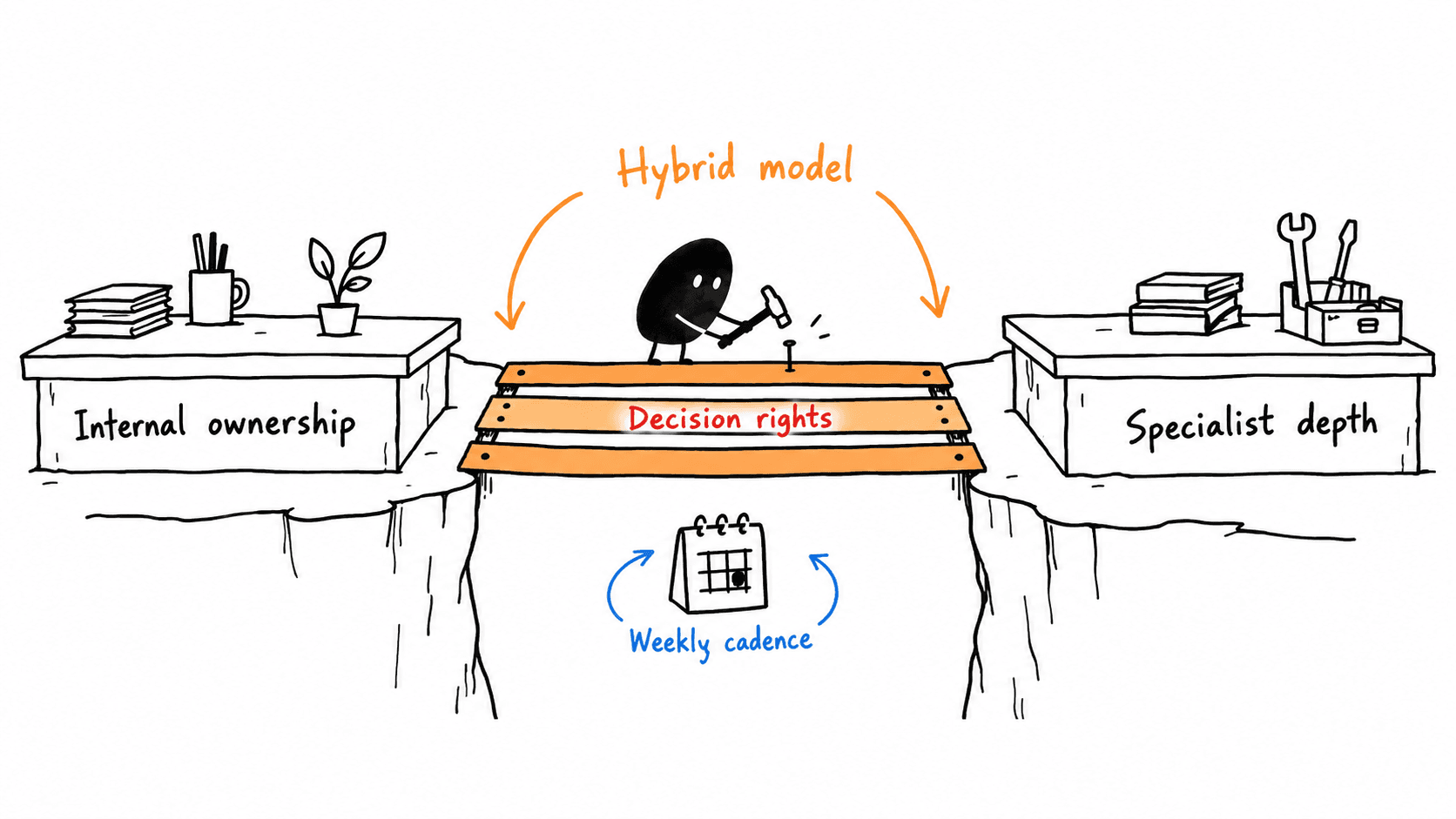
For many established brands, the strongest design is hybrid. The internal team retains commercial authority and brand context. The agency supplies specialist execution, monitoring, and additional capacity.
A practical division might look like this:
Internal channel lead: P&L, assortment, price architecture, promotions, and cross-company alignment.
Agency brand manager: operating plan, prioritization, coordination, and escalation.
Specialists: advertising, content, catalog, inventory, finance, and account health.
AI agents: continuous monitoring, report analysis, routine checks, and evidence preparation within defined approval rules.
This is not outsourcing the strategy. It is designing a system in which the person closest to the business makes the high-context decisions and specialists execute with speed.
Compare total cost, not the headline price
The true in-house cost includes compensation, benefits, recruiting, management, training, software, coverage gaps, and the time needed to build a working cadence. The true agency cost includes fees, onboarding time, internal oversight, and any work that remains outside scope.
Delayed action belongs in the model too. A suppressed listing, missed stockout warning, unresolved fee error, or poorly timed advertising decision has an opportunity cost even when it does not appear on a vendor invoice.
Instead of asking which option is cheaper, compare the cost of achieving the required coverage and response time.
Define decision rights and test the model
Define decision rights before the contract
Most delivery problems begin with ambiguity. Write down who can recommend, approve, execute, and verify each material decision.
For example:
Bid and budget changes inside agreed limits may be executed by the advertising team.
Price changes require internal approval.
Listing copy can be drafted externally but must pass brand review.
Critical account-health issues trigger an immediate escalation with a named owner.
Inventory recommendations must state forecast assumptions and cash implications.
The approval map should be short enough to use. If every action requires a meeting, the model will be slow. If consequential changes have no owner, it will be unsafe.
Run a 30-day operating test
Before committing to a broad transformation, test the model against real work. Select one portfolio or marketplace and measure:
Time from signal to diagnosis.
Time from approval to execution.
Percentage of actions verified in the live account.
Quality of the evidence and recommendation.
Number of handoffs required.
Whether internal leaders received decisions or only reports.
A credible partner should welcome this level of clarity. The test exposes whether the proposed team can operate, not merely present.
Warning signs on both sides
An in-house model is under strain when urgent work depends on one person, strategic reviews are repeatedly displaced by manual reporting, or specialist issues remain open because nobody has handled them before.
An agency relationship is under strain when the brand receives generic recommendations, account changes are difficult to trace, reports arrive without decisions, or the internal team must repeatedly explain the same commercial context.
Both are governance problems. Solve them by clarifying ownership, inputs, cadence, and verification rather than adding another meeting.
Frequently Asked Questions
Is an Amazon agency cheaper than hiring in-house?
It can be, particularly when the brand needs several specialist disciplines but not a full-time employee in each one. Compare total operating cost and required coverage rather than one agency fee with one salary.
What should remain in-house?
The brand should usually retain authority over P&L, assortment, pricing boundaries, inventory commitments, brand standards, and major strategic tradeoffs. Execution can be shared or delegated according to clear rules.
What is the biggest agency risk?
Misaligned incentives and weak context. An agency can improve a channel metric while harming margin, inventory, or brand position if those constraints are not built into the operating plan.
How does a hybrid model work in practice?
An internal leader owns commercial decisions. An external brand manager and specialists run the operating cadence. Data and AI systems monitor the account, prepare evidence, and route material changes through agreed approvals.

Co-Founder & CEO, Lumian
Robin Lobo is Co-Founder and CEO of Lumian. He built and sold a seven-figure eyeglasses brand on Amazon and spent several years on the client side of traditional agencies before founding Lumian, an AI-native Amazon agency backed by $3M led by Bowery Capital.