Lumian for Amazon Brands: How AI Agents and Expert Operators Work Together
See how Lumian combines AI agents, Amazon specialists, and a Brand Manager to turn account signals into governed action.
Lumian closes the Amazon operating gap
Amazon software has become very good at showing operators what happened. The unresolved problem is what happens next. A lost Buy Box, a suppressed listing, an inventory risk, or a fee discrepancy still needs to be investigated, prioritized, approved, executed, and checked.
Lumian is built around that operating gap. It combines AI agents that monitor and analyze Amazon data, specialist teams that execute domain work, and a dedicated Brand Manager who owns priorities across the account.
TL;DR
Lumian is not positioned as another collection of isolated dashboards. Its model connects Amazon data to recurring jobs across advertising, content, inventory, account health, reporting, and reimbursements. AI agents surface and prepare work; specialists handle execution and judgment; a Brand Manager connects decisions to the brand’s P&L and goals. Material write actions follow approval settings.
Key takeaways
Amazon performance is cross-functional. Advertising cannot be managed well without inventory, margin, conversion, and Buy Box context.
Lumian Agents are organized around jobs such as account-health audits, Buy Box tracking, restock warnings, sales updates, listing work, and reimbursement review.
Every agent identifies the report it used, which makes conclusions easier to inspect.
Specialists and a Brand Manager remain part of the model because strategy, exceptions, and brand judgment cannot be reduced to alerts.
The goal is shorter time from signal to verified action, with explicit approvals for consequential changes.
Why a stack of dashboards creates operational drag
A typical Amazon brand may use one tool for keywords, another for advertising, another for inventory, and spreadsheets for profitability and cases. Each tool can be useful on its own. The friction appears between them.
An inventory warning may not reach the advertising operator. A content change may go live without a clean before-and-after conversion view. A fee discrepancy may be found but never assembled into a complete claim. The business has data, yet the work still depends on a person remembering to connect it.
This is why adding software can increase workload. Every dashboard creates another place to check and another queue to reconcile.
The three layers of the Lumian model
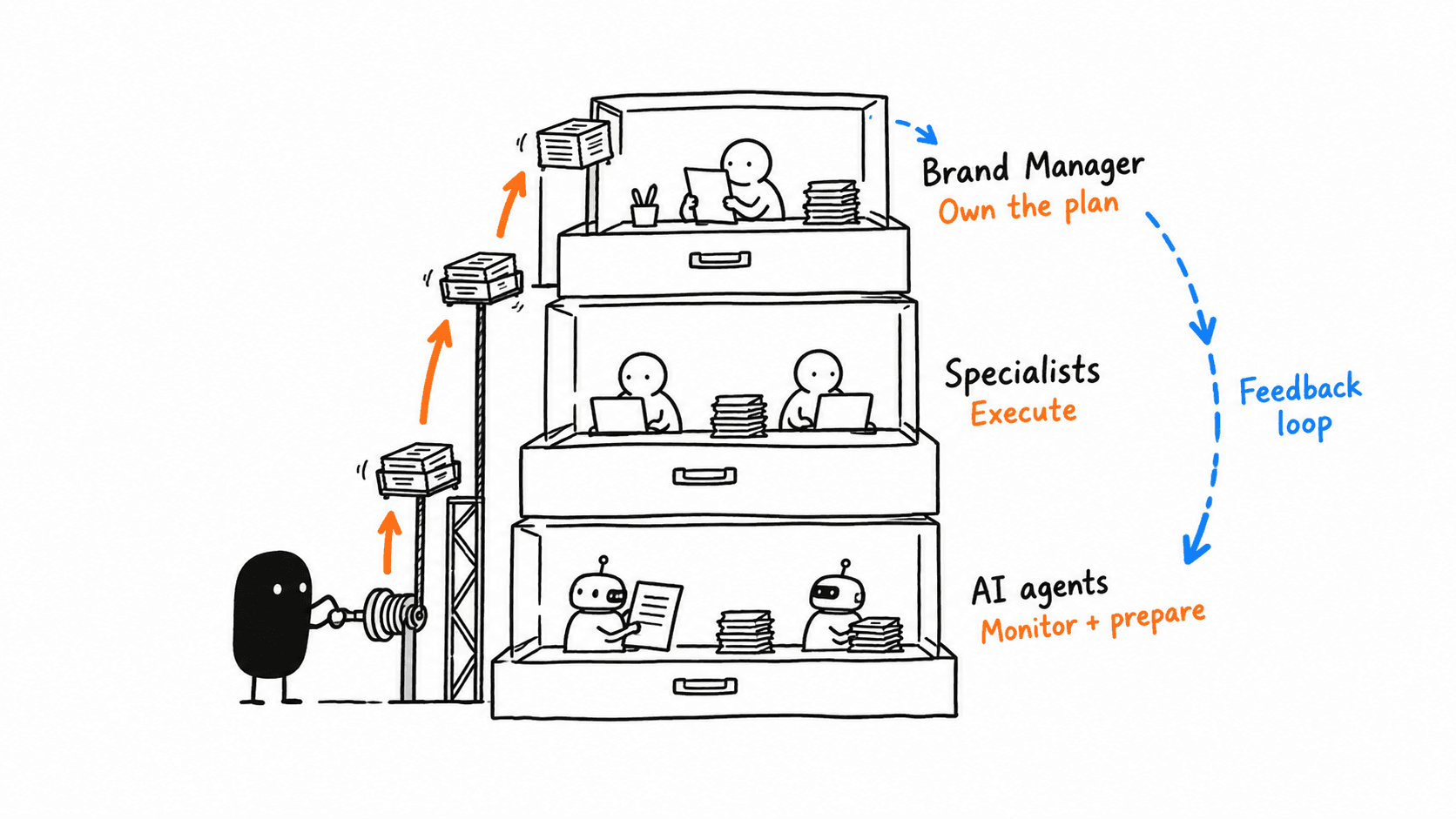
1. AI agents monitor and prepare the work
Lumian Agents connect to Amazon through the official Selling Partner API and read the relevant reports. The current agent library includes jobs such as Daily Account Health Audit, Buy Box Tracker, Restock Warning, Daily Sales Update, Title Optimizer, Market Researcher, Suppressed Listing Fixer, Weekly Analysis, and Reimbursement Finder.
The useful distinction is that an agent is tied to a defined job. It should explain what changed, identify the supporting report, and move the issue toward a decision. Agents can run on demand or on a schedule.
2. Specialists execute domain work
Amazon work still requires expertise. Advertising structure, creative judgment, catalog repair, reimbursement evidence, and compliance issues do not become simple because a system found them quickly.
Lumian’s specialist teams cover advertising, content, inventory, finance, data, and account health. Their role is to apply the context and judgment required to turn a finding into correct execution.
3. A Brand Manager owns the operating plan
A dedicated Brand Manager connects the work to growth targets, margin, inventory commitments, competitive position, and the quarterly roadmap. This layer matters because teams can otherwise optimize separate functions against one another.
For example, an advertising opportunity may be unattractive if the ASIN has limited stock. A content test may need to wait for an approved image set. A price move may protect Buy Box share but weaken contribution margin. Someone needs authority to sequence those decisions.
Connected operations, approvals, and traceability
What connected operations look like
Consider a week in which units decline on one high-value ASIN. A dashboard can show the decline. A connected operating system should trace the cause.
The relevant path might be:
Sessions remain stable.
Conversion falls.
Buy Box share drops after a competitor price move.
Advertising continues driving traffic to the weaker offer.
Inventory remains healthy, so availability is not the cause.
The decision is not “increase traffic.” It is to review offer competitiveness, margin boundaries, and advertising exposure together. The system should surface the evidence, route the decision to the right owner, and confirm any approved change.
The same pattern applies to stockout risk. An inventory signal should inform advertising pacing and promotion plans before the stockout happens, not become a retrospective explanation in the next monthly review.
Approvals and traceability
Automation without governance is not an operating advantage. Lumian’s public Agents model states that connector and Amazon write actions require approval in chat, while scheduled runs follow the approval setting chosen by the user.
Brands should define those settings by action type. A daily report can run automatically. A bid change may be allowed inside agreed limits. A listing, price, or sensitive account change may require explicit approval.
Every important action should retain four pieces of context:
The signal that triggered the work.
The source report or evidence.
The person or rule that approved the action.
The verification that the intended result reached the live account.
That record makes automation easier to trust and easier to improve.
Where Lumian fits and what it does not replace
Where Lumian fits in the Amazon stack
Lumian can reduce the need for separate monitoring and workflow tools, but it does not make every specialist data source irrelevant. A brand may still use dedicated market-intelligence software for competitor estimates or retain finance systems as the accounting source of truth.
The clean division is:
Use market-intelligence tools for external demand, competitor, and category questions.
Use Amazon and finance sources for first-party performance and ledger data.
Use Lumian to coordinate recurring monitoring, analysis, decisions, and execution across the account.
The objective is not to force every question into one interface. It is to remove duplicated checking and broken handoffs.
How to evaluate Lumian in practice
Start with one recurring job that is currently costly or unreliable. Good candidates include daily account-health review, Buy Box loss, restock risk, weekly performance diagnosis, suppressed listings, or reimbursement reconciliation.
Define the current baseline:
How often is the work performed?
How long does diagnosis take?
Which reports are consulted?
How many handoffs occur?
How is completion verified?
Then run the same job through the new model. Evaluate the evidence, response time, quality of the recommendation, approval path, and final verification. The result should be a more reliable operating process, not merely a faster alert.
What Lumian does not remove
Brands still need clear goals, economic boundaries, inventory commitments, and brand standards. They still need people to make high-context choices. Poor inputs do not become good strategy because an agent processes them quickly.
The value comes from combining machine consistency with accountable human judgment. Agents handle repetitive monitoring and evidence assembly. Specialists handle domain execution. The Brand Manager decides how the pieces fit together.
Frequently Asked Questions
Is Lumian an Amazon agency or software platform?
It is an AI-native Amazon operating model that combines managed services with AI agents. Brands can engage expert operators, while the Agents product provides defined Amazon jobs through chat, automations, data, and approvals.
Does Lumian change an Amazon account automatically?
Write actions follow approval settings. Brands should configure those settings according to risk and keep explicit approval for consequential actions.
Can a brand keep its existing tools?
Yes. Retain a tool when it supplies unique data or a workflow the team relies on. Remove it only when the same job is covered and the new process has been verified.
What should a brand automate first?
Choose a high-frequency, evidence-based task with a clear output, such as account-health checks, Buy Box monitoring, sales updates, or inventory warnings. Establish trust before expanding to more consequential workflows.

Co-Founder & CEO, Lumian
Robin Lobo is Co-Founder and CEO of Lumian. He built and sold a seven-figure eyeglasses brand on Amazon and spent several years on the client side of traditional agencies before founding Lumian, an AI-native Amazon agency backed by $3M led by Bowery Capital.