Navigating Onboarding: Seller Central Permissions, API Integrations, and Data Security at Lumian
Learn what Seller Central permissions, SP-API integrations, and data security controls Lumian requires during onboarding to protect your brand data.
TL;DR
What to Expect:
A comprehensive overview of the exact permissions, Selling Partner API (SP-API) integrations, and data security standards required when onboarding your Amazon business with Lumian AI.
Key Takeaways:
Granular API Scopes: Integrations rely on official Amazon SP-API OAuth workflows, granting read and write access strictly tailored to advertising, inventory, and catalog management.
Zero Password Sharing: Lumian never asks for primary Seller Central credentials; access is granted exclusively through secure OAuth tokenization and secondary user permissions where required.
Strict Security Compliance: Data is encrypted at rest and in transit adhering to Amazon's Data Protection Policy (DPP) and industry-standard security frameworks.
Continuous Governance: Role-based access control (RBAC), multi-factor authentication (MFA), and automated audit logs ensure complete visibility over every account action.
Intro
Onboarding a new growth partner to manage your Amazon Seller Central account is a critical milestone for any brand. While automation and autonomous execution speed up daily operations, delegating access to your marketplace store requires total clarity around data security, permission boundaries, and system governance.
Enterprise brand leaders must know exactly what access is being granted, how data flows between systems, and what security controls protect their proprietary commercial information. Establishing transparent protocols from day one ensures seamless operational performance without exposing your account to unauthorized changes or policy violations.
Understanding the Integration Architecture: Amazon SP-API and OAuth
Modern marketplace management has evolved beyond manual password sharing and risky login delegates. Lumian integrates with your Seller Central account through the official Selling Partner API (SP-API), Amazon's REST-based interface designed for secure, programmatic data exchange.
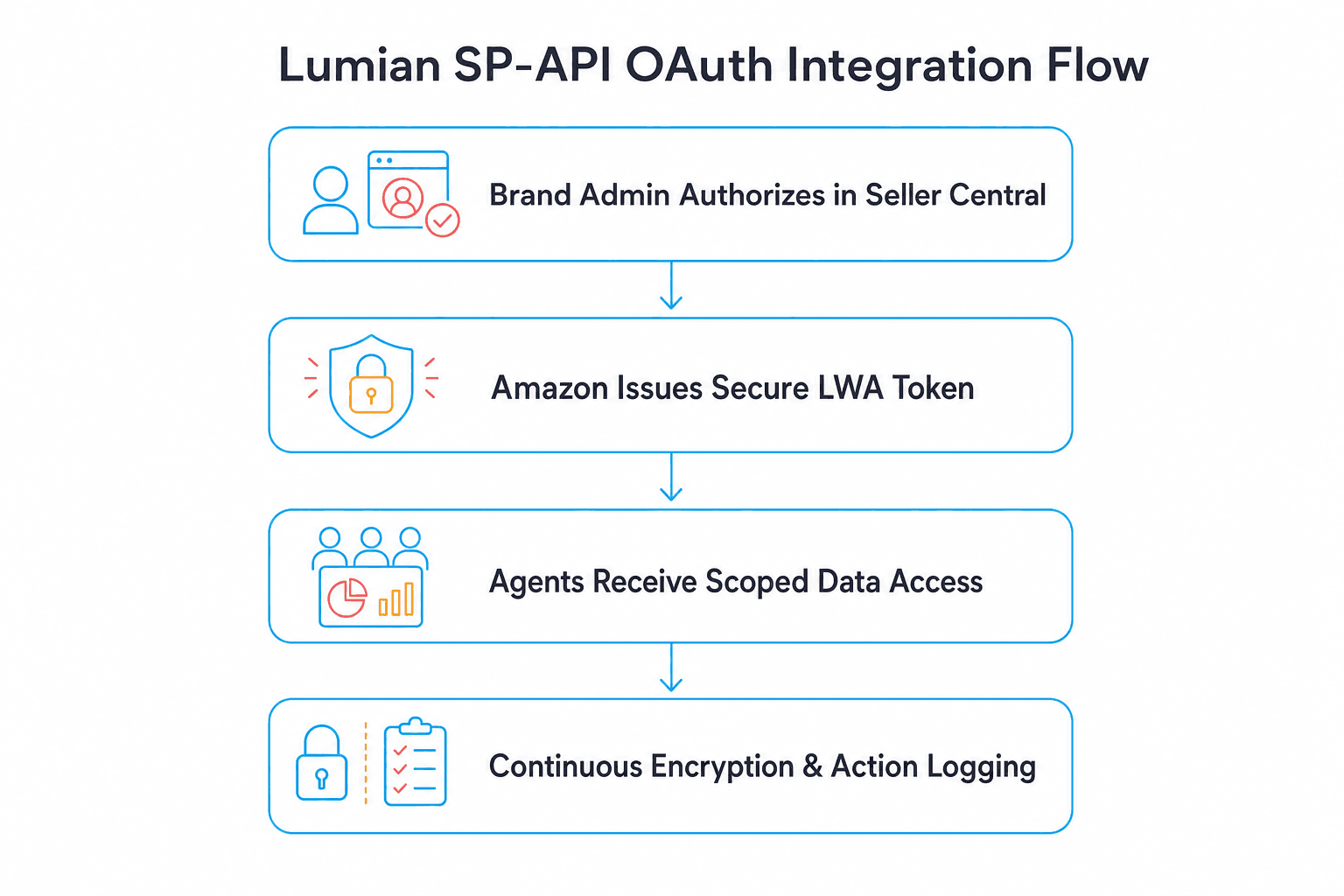
Connecting your account uses Login with Amazon (LWA) based on OAuth 2.0 standards. During onboarding, your primary account administrator authorizes the integration directly within Seller Central. This process generates an encrypted access token that enables automated agents to sync operational data without ever exposing primary account credentials or banking information.
Required Seller Central Permissions and API Scopes
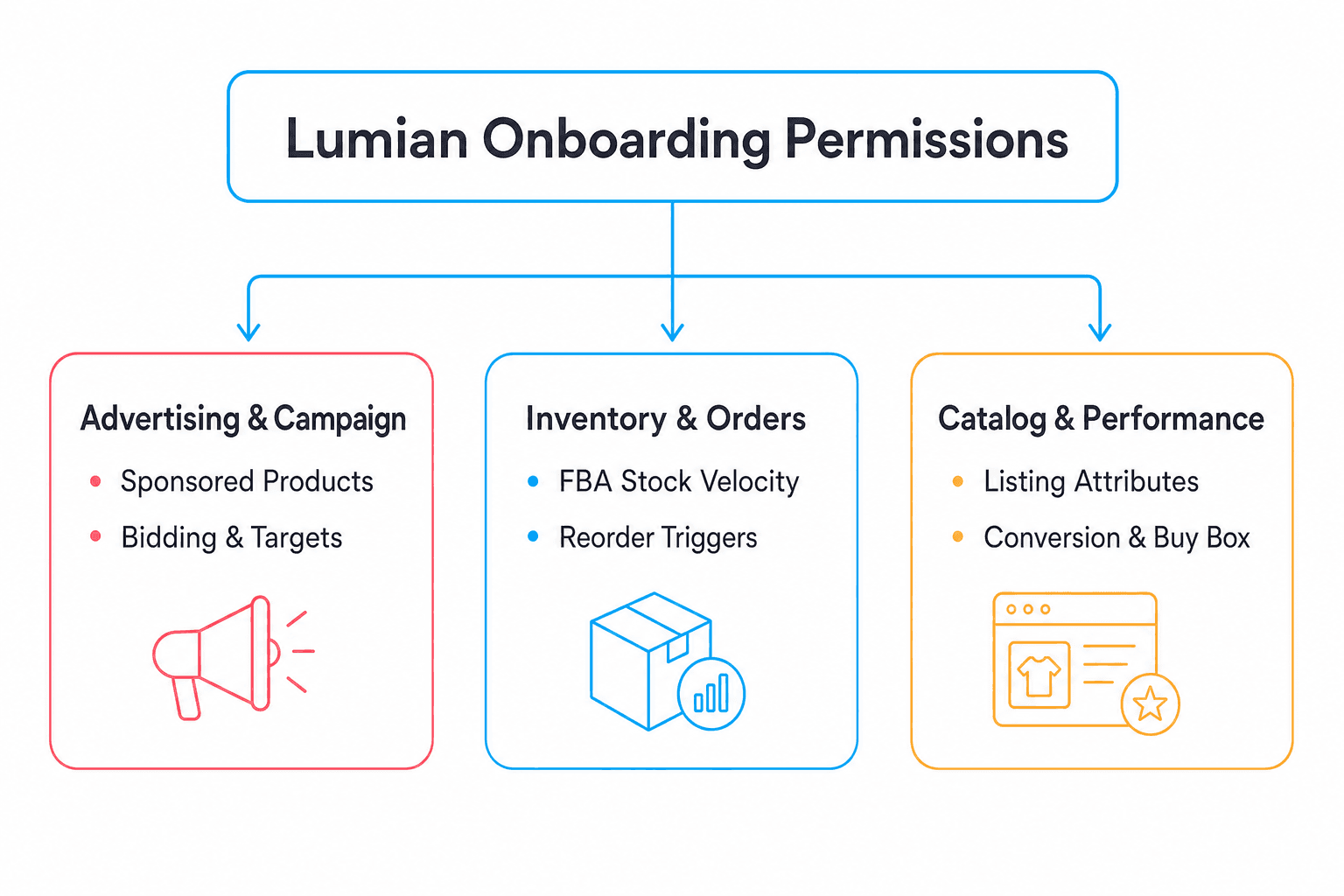
To execute real-time campaign optimizations, monitor stock velocity, and prevent catalog suppressions, Lumian requests specific, limited permissions across key operational roles.
1. Advertising and Campaign Management
Automated pay-per-click (PPC) optimization requires access to Amazon Advertising APIs. This scope allows agents to process search term reports, adjust keyword bids, apply negative targets, and reallocate daily campaign budgets based on target Advertising Cost of Sales (ACoS) and Total Advertising Cost of Sales (TACoS) goals.
2. Inventory and Order Data
To sync ad spend with warehouse supply, the integration accesses inventory velocity metrics and Fulfillment by Amazon (FBA) stock levels. This data allows system guardrails to throttle ad spend when stock levels drop below critical thresholds, preventing stockouts and protecting organic keyword ranks.
3. Product Catalog and Listing Performance
Access to catalog listing data allows the platform to monitor Unit Session Percentage (conversion rate), Buy Box ownership, and detail page attributes. Agents track search indexing and detect listing suppressions before sales momentum is impacted.
Secondary User Permissions (When Applicable)
In cases where specialized brand strategists provide manual account governance alongside automated agents, secondary user permissions may be configured in Seller Central. These permissions are restricted strictly to campaign management, catalog view access, and performance reporting. Critical administrative areas - including disbursement settings, tax documentation, and bank account details - remain completely inaccessible.
Data Security Controls and Compliance Standards
Protecting proprietary sales data, customer records, and commercial metrics requires multi-layered security infrastructure. Lumian's architecture aligns with rigorous corporate standards and official platform developer requirements.
Encryption at Rest and in Transit
All data transmitted between Amazon's Selling Partner API and internal processing engines is encrypted using TLS 1.3 protocols. At rest, database assets and historical performance logs are encrypted using AES-256 standards, matching the baseline security expectations outlined in official Amazon SP-API Data Protection Policy requirements.
Adherence to Amazon Data Protection Policies
Amazon enforces strict rules regarding seller data handling, data retention limits, and Personally Identifiable Information (PII) access. Non-PII operational data - such as keyword conversion rates and inventory counts - is stored securely to power machine learning performance models. Any restricted customer data retrieved for order fulfillment is handled under 30-day auto-deletion cycles, fully satisfying platform compliance mandates.
Cloud Infrastructure and Enterprise Certification Standards
Data processing takes place on enterprise cloud infrastructure built to satisfy AWS SOC 2 compliance standards. This foundation ensures continuous vulnerability monitoring, isolated database environments, automated patch management, and strict physical server security.
Access Control and Operational Risk Management
Granting API access does not mean relinquishing operational control. Lumian incorporates built-in risk governance mechanisms to ensure automation runs within safe, predictable parameters.
Role-Based Access Control (RBAC): Internal access to client data is governed by strict principle-of-least-privilege rules. Human strategists access account analytics through multi-factor authentication (MFA) and dedicated single sign-on (SSO) portals.
Immutable Action Audit Logging: Every automated bid adjustment, keyword harvest, and budget reallocation is logged in a transparent audit ledger. Brand teams can view the exact timestamp, agent rationale, and metric impact for every change.
Multi-Tiered Approval Gates: High-risk actions - such as price modifications or listing title updates - are routed through approval gates that require explicit manager sign-off before being dispatched to the API.
Deterministic Rollback Capabilities: If market shifts or unexpected inventory disruptions occur, operators can execute a one-click rollback to restore historical campaign settings immediately.
Brands seeking to streamline onboarding while protecting account security can review tailored integration workflows through Lumian AI's Amazon account management solutions or consult with an integration specialist during technical setup.
Frequently Asked Questions
Will Lumian ever require my primary Seller Central password?
No. Lumian never asks for primary Seller Central passwords or master account credentials. Integrations are established exclusively through Amazon's secure OAuth 2.0 authorization framework via the official Selling Partner API.
Can Lumian access my banking, disbursement, or tax information?
No. API scopes and secondary user permissions granted during onboarding strictly exclude access to financial disbursement settings, bank account details, and corporate tax documentation.
What happens to my data if we terminate our onboarding agreement?
Upon service termination or API deauthorization in Seller Central, active access tokens are invalidated immediately. Any restricted PII is deleted within 30 days per Amazon's Data Protection Policy; non-PII operational data is retained only as long as required for reporting continuity, per the same policy's retention limits.
How are API rate limits managed during high-volume sales events?
The integration platform features adaptive request throttling and backoff algorithms designed to comply with Amazon SP-API rate limits, ensuring continuous data availability during peak shopping events like Prime Day.
How does Lumian prevent an AI agent from making unauthorized campaign changes?
AI agents operate within hard programmatic guardrails, including maximum bid caps, daily budget limits, and gross margin price floors. Strategic actions that fall outside predefined parameter bands require explicit confirmation from human brand managers.