Top Jungle Scout Alternatives for 2026: Choose the Right Tool for the Job
Compare Jungle Scout, Helium 10, SmartScout, Data Dive, and Lumian by the Amazon operating constraint each solves.
Choosing a Jungle Scout alternative: start with the constraint
Jungle Scout remains a capable research platform. The more useful question for a growing Amazon brand is whether research is still the main constraint. Once a catalog expands, the bottleneck often shifts from finding information to deciding what matters, assigning work, and confirming that the fix reached Seller Central.
TL;DR
Choose an alternative according to the job you need done. Helium 10 offers a broad seller toolkit. SmartScout is strongest when the decision starts at the category, brand, or seller level. Data Dive is built around keyword research, listing optimization, and launch workflows. Lumian Agents is for teams that want Amazon data connected to recurring operational work. Jungle Scout is still a sound choice when product and keyword research are the center of the workflow.
Key takeaways
Do not compare platforms by feature count alone. Compare the decision each platform helps you make and the work that remains afterward.
Research suites are useful when a person has the time and skill to interpret the output. An execution system matters when the backlog is the problem.
Amazon estimates, first-party account data, and operator judgment serve different purposes. A mature stack makes those boundaries explicit.
The right choice depends on catalog size, channel complexity, team capacity, and how much work must happen inside Seller Central.
Start with the constraint, not the software
Most Amazon software comparisons begin with a grid of features. That is tidy, but it hides the operating question: where does your team lose time or money today?
If you are deciding what to launch, you need market estimates, keyword demand, and competitor context. If your product is already live, you may need listing diagnostics, advertising control, inventory coordination, or account-health monitoring. If the data is available but actions still sit in a weekly spreadsheet, another dashboard will not remove the bottleneck.
Use four questions before evaluating any platform:
What decision should become faster or more reliable?
Which data is estimated market intelligence, and which comes from our own account?
Who is responsible for acting on an alert or recommendation?
How will we verify that the intended change actually happened?
Those questions separate research software from operational systems. Neither category is inherently better. They solve different problems.
The five alternatives compared
1. Helium 10: broad coverage for hands-on operators
Helium 10 is the closest like-for-like alternative for sellers who want a large collection of Amazon tools in one subscription. Its public toolset spans product research, keyword research, listing optimization, advertising, operations, analytics, and inventory management.
That breadth is useful for a founder or small team that wants one place to investigate a product, build a listing, track keywords, and review performance. It also means the user still owns the workflow: choosing the right report, interpreting it, and carrying the decision into the account.
Best fit: sellers who want a broad self-serve toolkit and are comfortable operating it directly.
Watch for: overlapping modules and unused capabilities. A wide suite only creates value when the team has a repeatable process for each tool it pays for.
2. SmartScout: category, brand, and seller intelligence
SmartScout approaches Amazon from a wider market map. Its product, brand, seller, category, traffic, and search-term views are useful when the question is not merely “Is this product attractive?” but “How is this market structured, who owns it, and where does demand move?”
That makes SmartScout especially relevant to wholesale operators, agencies, aggregators, and brands that need category-level context. Its Traffic Graph, seller and brand databases, and historical views can reveal relationships that are difficult to see from a single ASIN.
Best fit: teams making category, assortment, competitive, or acquisition decisions.
Watch for: market intelligence does not replace account execution. Define who will translate an insight into a listing, advertising, pricing, or inventory action.
3. Data Dive: structured keyword and listing workflows
Data Dive is designed for operators who want a more opinionated workflow around product validation, keyword research, listing optimization, rank tracking, and PPC. It connects seller and advertising data to features such as Product Catalog, Rank Radar, PPC Manager, and reporting.
The appeal is process discipline. Instead of collecting keywords in several exports, teams can move from research to listing and ranking work inside a consistent system. That is particularly useful for private-label launches and catalog refreshes.
Best fit: private-label teams that treat keyword strategy and listing optimization as a core operating capability.
Watch for: keyword coverage is only one part of account performance. Inventory, margin, Buy Box, and account-health constraints still need an owner.
4. Lumian Agents: recurring operations, not another dashboard
Lumian Agents is built for a different stage of the problem. It connects to Amazon through the Selling Partner API, reads the underlying reports, and runs defined jobs such as daily account-health checks, Buy Box tracking, restock warnings, sales updates, listing monitoring, and reimbursement review.
The distinction is actionability. Each agent is tied to a job, cites the report it used, and can route write actions through approvals. That is useful when a team already has enough data but lacks the bandwidth to monitor it continuously and turn it into completed work.
Best fit: established brands and operator teams that want recurring Amazon work monitored, explained, and moved forward with clear approvals.
Watch for: autonomy still needs governance. Set approval rules, decision rights, and escalation thresholds before allowing any system to change listings, bids, or other account settings.
5. Jungle Scout: still a strong research-first choice
An alternatives article should not pretend the incumbent stopped being useful. Jungle Scout Catalyst remains focused on product discovery, Keyword Scout, listing optimization, sales and profit analytics, advertising analytics, basic inventory tracking, and review automation. Its browser extension and research databases are familiar to many sellers and easy to incorporate into an analyst-led process.
Best fit: new and growing sellers whose primary needs are product validation, keyword discovery, listing work, and performance analysis.
Watch for: as the brand scales, measure the time between insight and action. If issues are found but not closed, the next investment may need to be in operating capacity rather than another research feature.
A practical decision framework
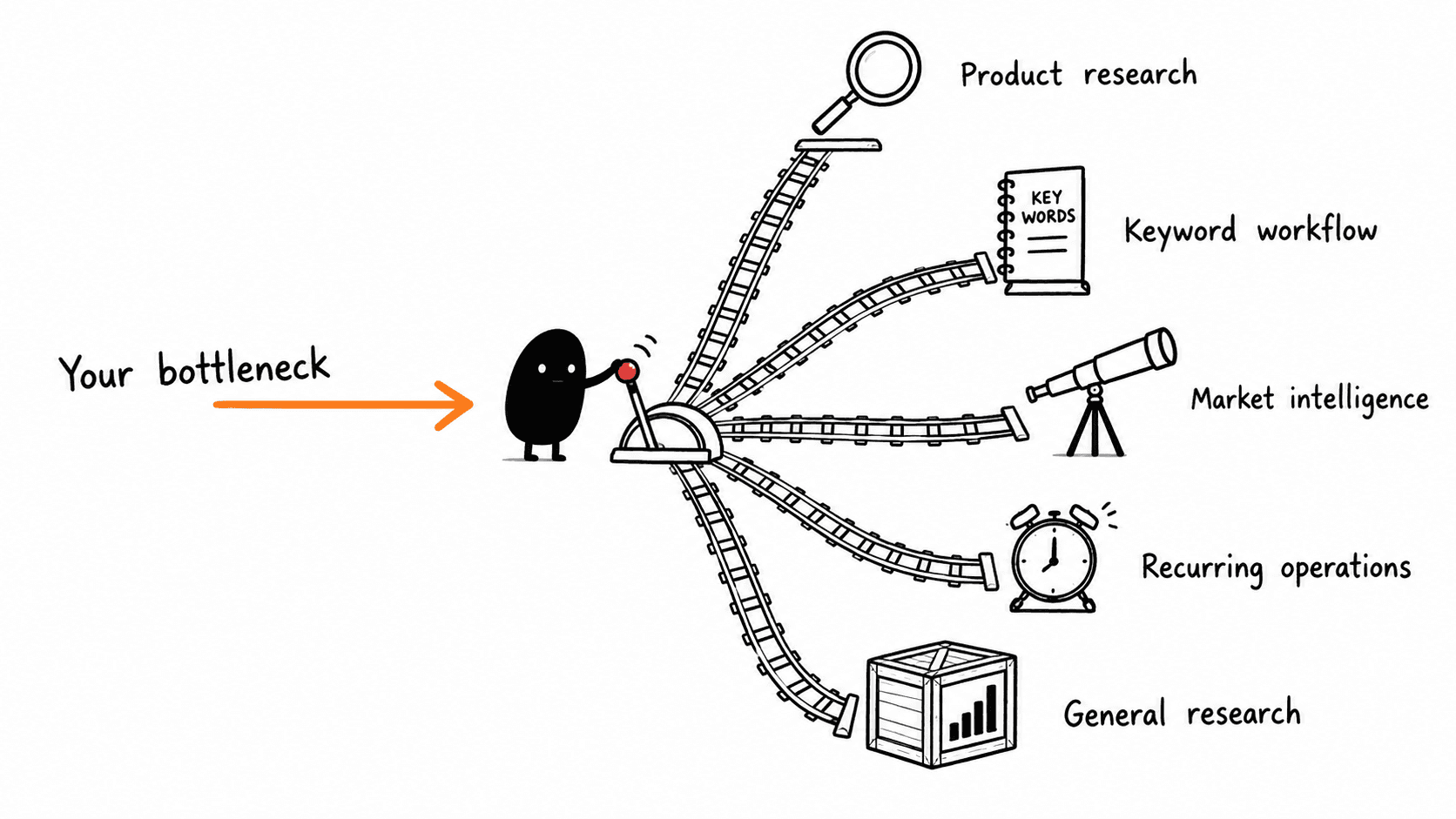
Choose Helium 10 when you want broad self-serve coverage. Choose SmartScout when the important question sits at category, brand, seller, or traffic-flow level. Choose Data Dive when keyword and listing workflows are the heart of the job. Choose Lumian Agents when recurring monitoring and execution are the constraint. Stay with Jungle Scout when research remains the work your team most needs to improve.
Before signing an annual contract, run the same real decision through each shortlisted platform. Use one product launch, one listing problem, or one week of operating issues. Record the time to a defensible decision, the number of manual handoffs, and whether the result led to a verified change. That small trial is more informative than a long feature table.
What an effective Amazon stack looks like
The strongest stack is usually smaller than the one it replaces. It has three clear layers:
Market intelligence for questions about demand, competition, keywords, and category structure.
First-party account data for sales, traffic, advertising, inventory, fees, and account health.
An operating layer that assigns work, applies guardrails, records approvals, and verifies outcomes.
Problems appear when the layers are confused. Estimated competitor sales should not be treated like ledger data. A dashboard alert is not the same as a completed fix. An automated change without an approval model is not operational maturity.
Frequently Asked Questions
Is Helium 10 better than Jungle Scout?
It depends on the workflow. Helium 10 offers a broader collection of tools, while Jungle Scout remains strong in research and market intelligence. Test both against the decision you make most often rather than choosing on total feature count.
Which option is best for product research?
Jungle Scout and Helium 10 are the most direct starting points for general product and keyword research. SmartScout is compelling when category structure, brands, sellers, and traffic relationships matter. Data Dive is useful when research must flow into a structured listing and ranking process.
When does an AI agent make more sense than a dashboard?
When the team already sees the problem but cannot monitor, triage, and complete the follow-up consistently. The agent should still show its source, operate within limits, and require approval for material write actions.
Can one platform replace every Amazon tool?
Rarely. Market estimates, first-party account reporting, creative work, financial controls, and execution have different requirements. The goal is not one vendor at any cost; it is the fewest systems that cover the work without creating blind spots.

Co-Founder & CEO, Lumian
Robin Lobo is Co-Founder and CEO of Lumian. He built and sold a seven-figure eyeglasses brand on Amazon and spent several years on the client side of traditional agencies before founding Lumian, an AI-native Amazon agency backed by $3M led by Bowery Capital.