Amazon FBA Reimbursement Tracker: Recover What the Business Is Owed
Build an FBA reimbursement workflow that tracks evidence, claim windows, case decisions, and cash recovery.
Track claims, not a single recovery number
FBA reimbursement work is not a one-time audit. Inventory events, customer returns, removal orders, and claim decisions move on different timelines, while Amazon’s eligibility rules can change. A reliable tracker keeps the event, evidence, policy window, submission, and outcome in one controlled workflow.
TL;DR
Build the tracker around claim-level evidence, not a single estimated recovery number. Reconcile Amazon reports on a fixed cadence, calculate the filing window from the relevant event, retain the documents needed for each claim type, and track every submission through decision and payment. Amazon updated several FBA claim windows effective October 15, 2025, so teams should verify the current Seller Central policy before filing.
Key takeaways
Use Amazon’s current policy window for each claim type. Do not rely on an old universal deadline.
Separate detected discrepancies from eligible claims, submitted claims, approved claims, and cash received.
The tracker should preserve source report, event date, eligibility date, deadline, evidence, case ID, status, and reimbursement amount.
Reconcile inventory and payments together. An approved case is not complete until the credit appears in the account.
Automate matching and deadline monitoring, but keep evidence quality and final submission under accountable review.
What an FBA reimbursement tracker should cover
The exact categories vary by marketplace and policy, but most workflows need to account for several types of events:
Inventory reported lost or damaged in Amazon fulfillment centers.
Customer returns that were refunded but not received or correctly reconciled.
Removal orders that were lost, damaged, or graded incorrectly.
Shipment and receiving discrepancies where the applicable policy permits a claim.
Re-evaluation of a denied or underpaid claim.
Reimbursement payments that were approved but have not appeared correctly in the ledger.
Do not assume every discrepancy is eligible. The tracker should make the policy test visible rather than treating detection as proof of money owed.
Claim windows and the minimum viable tracker
Current FBA claim windows
Amazon announced updated windows effective October 15, 2025. Its notice lists the following submission periods:
Lost or damaged items: within 60 days of the reported loss or damage.
Customer returns: between 45 and 105 days after the customer refund or replacement.
Removal orders lost: between 15 and 135 days from shipment creation.
Removal orders damaged: within 120 days from the shipment delivery date.
Removal-order grading disputes: within 120 days from the date the item was removed from the fulfillment network.
Re-evaluation requests: within 90 days of the initial claim.
Policies can differ by event and marketplace and may change again. Treat the Seller Central policy page available to the account as the controlling source. Store the policy version or access date with the claim record when the deadline is material.
The minimum viable tracker
A useful tracker needs enough structure to survive a handoff. Include these fields:
Marketplace and account.
Claim category.
SKU, FNSKU, ASIN, shipment ID, order ID, or removal-order ID as applicable.
Quantity and estimated financial exposure.
Source report and source event date.
Earliest eligible filing date.
Filing deadline.
Evidence status and evidence links.
Case or claim ID.
Submission date and current status.
Amazon response deadline.
Approved amount.
Payment or ledger confirmation date.
Owner and next action.
Use a stable unique key. For example, the combination of marketplace, event type, reference ID, SKU, and event date can prevent duplicate claims while still allowing multiple units or decisions to be tracked correctly.
A five-step operating workflow
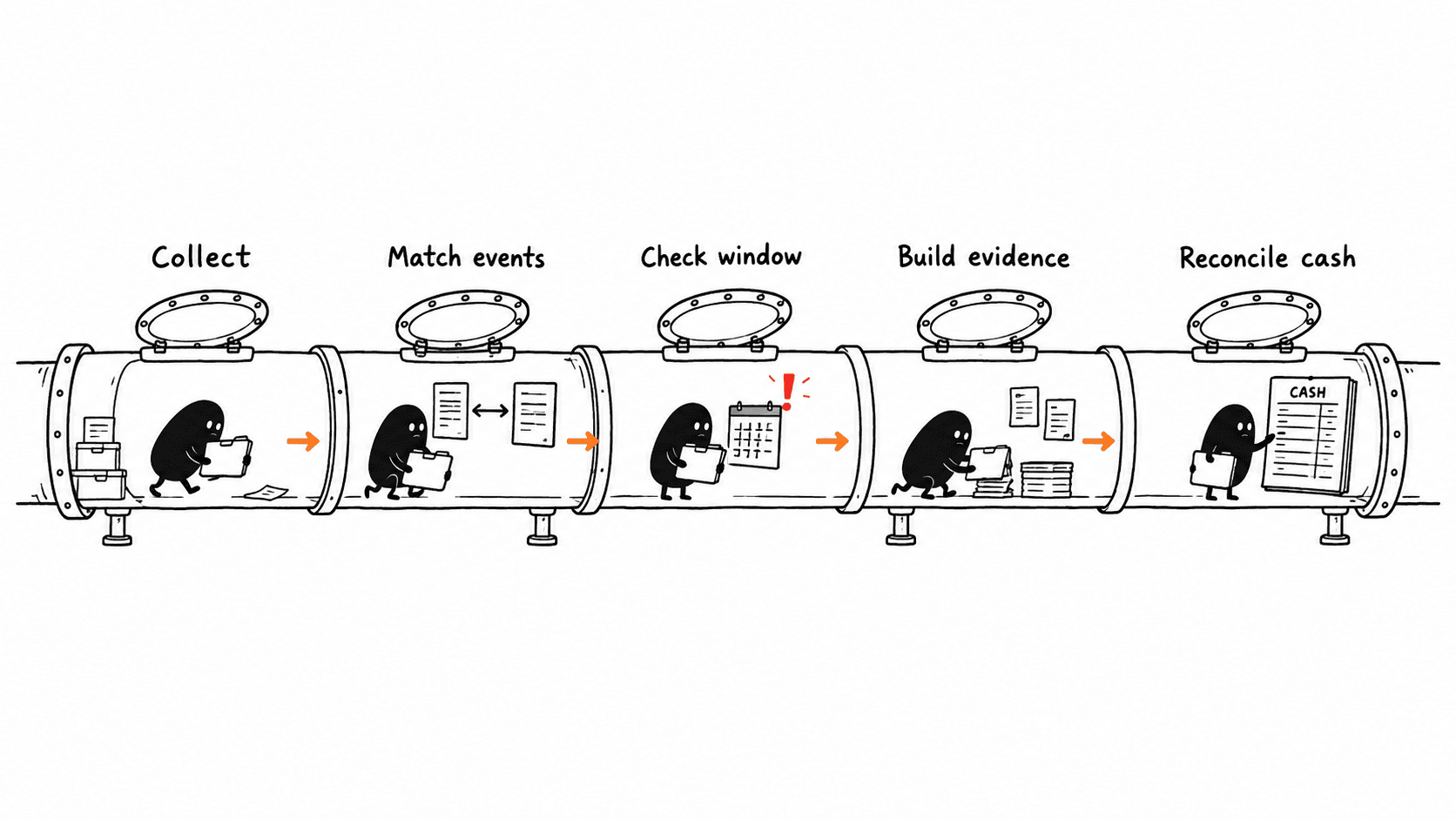
1. Collect the source reports
Pull the Amazon reports relevant to inventory adjustments, returns, removals, shipments, reimbursements, and payments. Record the report period and extraction time. If the workflow uses an API, retain the report identifier or equivalent provenance.
The purpose is repeatability. A reviewer should be able to reconstruct why an item entered the claim queue.
2. Match events before declaring a discrepancy
A loss event may later be reversed. A customer return may arrive after the refund. A reimbursement may be issued under a separate transaction. Match the full event chain before calculating exposure.
Use deterministic rules first: identifiers, quantities, dates, disposition, and transaction references. Flag exceptions for review rather than forcing uncertain records into a claim.
3. Apply the correct policy window
Calculate the earliest eligible date and deadline from the trigger specified for that claim type. This is where many spreadsheets fail: they store one due date without preserving the trigger or policy version.
The tracker should distinguish:
Not yet eligible.
Eligible and awaiting evidence.
Ready to submit.
Submitted and awaiting Amazon.
Response required.
Approved, denied, or closed.
Paid and reconciled.
4. Build the evidence packet
Evidence requirements depend on the event. A strong packet uses the identifiers Amazon expects and explains the discrepancy without speculation. It may include invoices, proof of ownership, shipment or delivery records, product and packaging information, photos, or report excerpts.
Keep the narrative short: what happened, how the records were matched, what remains unresolved, and what resolution is requested. More pages do not compensate for a missing identifier.
5. Reconcile the outcome to cash
Track the claim after submission. Record information requests and response deadlines. When a claim is approved, locate the reimbursement transaction and compare the paid amount with the decision.
This closes the loop. “Approved” is a workflow status; “received and reconciled” is the financial outcome.
Measure recovery and avoid common failures
Measure the process without inflating recovery
Avoid presenting the total value of detected discrepancies as money recovered. Use separate measures:
Gross discrepancy value detected.
Value that passed the eligibility review.
Value submitted.
Value approved.
Cash received and reconciled.
Denied value and denial reason.
Aging by status.
These measures reveal whether the bottleneck is detection, documentation, submission, or follow-up. They also prevent optimistic recovery estimates from reaching the P&L.
What to automate
Automation is well suited to scheduled report collection, identifier matching, deadline calculation, evidence checklists, status polling, and reminders. It can also prioritize high-value cases or clusters that suggest a broader catalog problem.
Human review is still important when the event chain is ambiguous, the evidence is incomplete, the policy interpretation is uncertain, or a re-evaluation requires judgment. Submission volume should never replace claim quality.
A useful automated finding should say more than “possible reimbursement.” It should show the event, unmatched quantity, reports compared, policy window, evidence still required, and next action.
Common failure modes
Filing too early or after the applicable window.
Using a payment estimate without confirming eligibility.
Submitting duplicate claims because unique keys are inconsistent.
Ignoring later reversals, returns, or reimbursements.
Losing the source report or evidence after a team handoff.
Treating an approved case as complete before the payment is reconciled.
Reusing an old deadline after Amazon changes the policy.
Most of these are process failures, not analytical failures. A disciplined tracker prevents them.
Frequently Asked Questions
How often should FBA reimbursements be reviewed?
A weekly reconciliation is a practical baseline for active accounts, with daily monitoring for response deadlines or high-value exceptions. The cadence should match volume and the shortest relevant policy window.
What is the deadline for an FBA claim?
There is no single deadline for every event. Current windows depend on the claim type and trigger date. Verify the relevant Seller Central policy before filing.
Can software guarantee a reimbursement?
No. Software can identify discrepancies, organize evidence, and manage deadlines. Amazon determines eligibility and the reimbursement outcome under its policies.
What should happen after Amazon approves a claim?
Locate the payment or reimbursement transaction, compare it with the approved amount, record the settlement date, and close the item only after reconciliation.

Co-Founder & CEO, Lumian
Robin Lobo is Co-Founder and CEO of Lumian. He built and sold a seven-figure eyeglasses brand on Amazon and spent several years on the client side of traditional agencies before founding Lumian, an AI-native Amazon agency backed by $3M led by Bowery Capital.