Is It Safe to Connect an AI Agent to Your Amazon Seller Central Account?
Yes, if it connects via Amazon's official SP-API with OAuth 2.0: no password sharing, scoped permissions, instant revocation. Here's how to verify a tool is safe and spot red flags.

TL;DR
Yes, connecting an AI agent to Seller Central is safe when the platform uses Amazon's official SP-API with OAuth 2.0. Your password and banking details are never shared, permissions are scoped, and access is revocable instantly from Seller Central. The real safety question is execution governance: guardrails, approval gates, and audit logs. Here's how to verify all of it.
Key Takeaways
Zero Password Exposure: Official SP-API connections use Login with Amazon (LWA) OAuth 2.0, meaning your primary Seller Central password and banking details are never shared or stored.
Granular Scopes: Sellers can grant AI agents restricted access to specific operational modules - such as advertising or inventory velocity - while completely blocking sensitive financial or tax data.
Strict Compliance Mandates: Lumian exceeds the baseline with TLS 1.3 and AES-256.
Execution Containment: True enterprise platforms pair API-level permissions with deterministic parameter guardrails, gross margin price flo
Navigating Account Security in the Age of Agentic E-Commerce
Delegating operational control of an Amazon store to an automated system is one of the most critical decisions a brand leader can make. On marketplace platforms like Amazon, an undetected pricing error, an aggressive ad spend spike, or an unauthorized detail page modification can lead to immediate Buy Box loss, margin erosion, or account suspension.
As brand management transitions from static analytics dashboards to autonomous AI agents, security concerns have shifted from passive data privacy to active execution safety. Brand owners must evaluate not only how their data is stored, but also what actions an automated system is permitted to dispatch directly to Amazon's servers.
Evaluating the safety of an AI integration requires examining authentication protocols, permission scopes, Amazon compliance frameworks, and operational guardrails.
How Amazon's Selling Partner API (SP-API) Protects Your Credentials
The foundational security requirement for connecting any AI agent or software tool to Seller Central is the use of Amazon's official Selling Partner API (SP-API).
Historically, third-party software relied on legacy credentials or credential sharing, exposing sellers to significant security risks. Today, Amazon enforces an OAuth 2.0 authorization framework known as Login with Amazon (LWA).
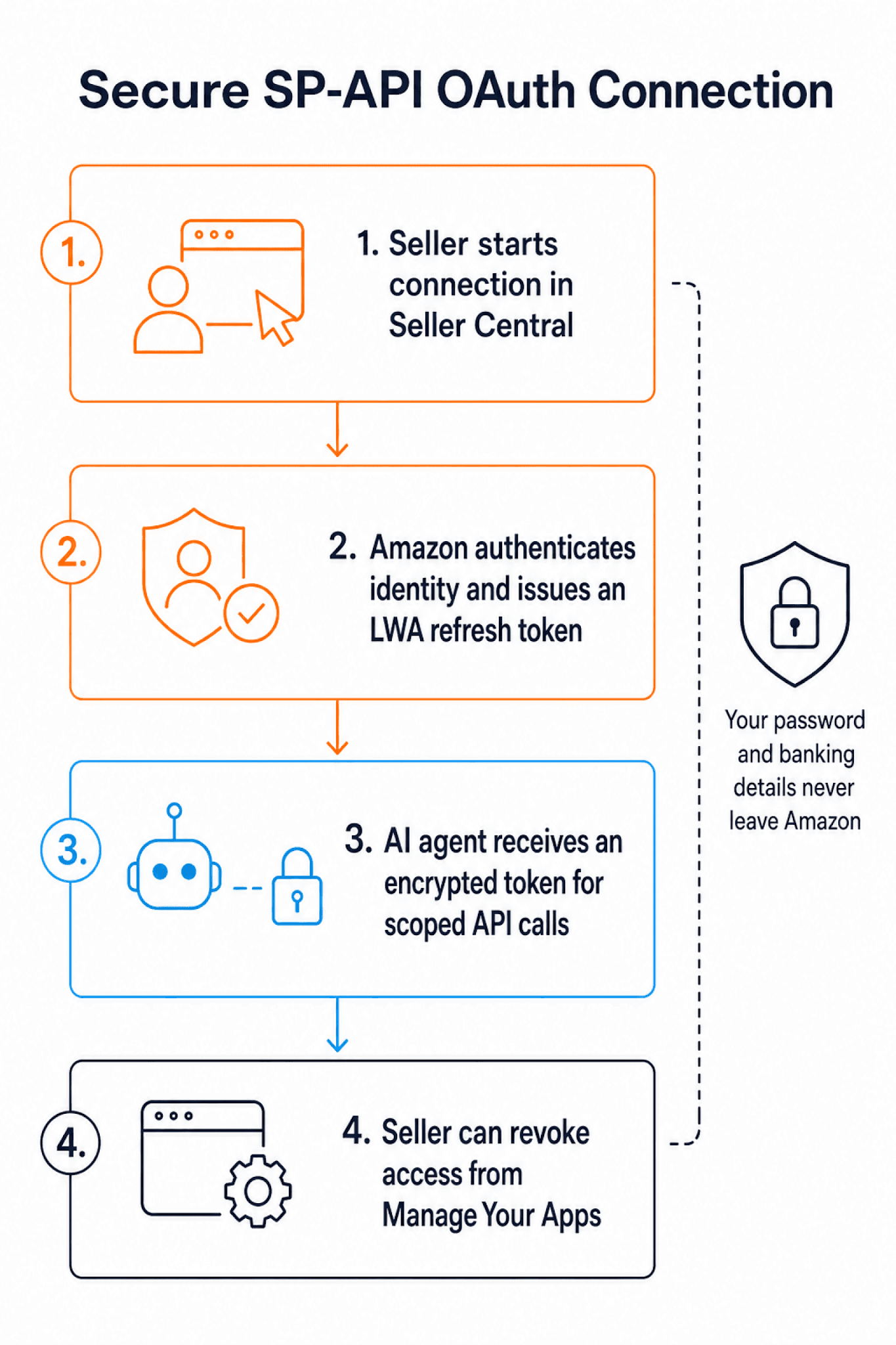
During onboarding, authorization occurs directly on Amazon's domain. Your primary administrator logs into Seller Central and approves access for the application. Amazon generates a tokenized credential (a Refresh Token) that allows the software to interact with the API on your behalf.
Under this architecture, your primary login credentials, secondary user passwords, bank account numbers, and disbursement settings are never transmitted to or stored by the third-party application. Furthermore, access can be revoked immediately from within Seller Central at any time.
Granular Permission Scopes: Limiting AI Access to Essential Modules
One of the major security advantages of SP-API is role-based granular permissions. Rather than granting full administrative access to your account, OAuth authorization allows brands to restrict AI agents to specific operational scopes.
When evaluating an AI agent, verify that the application requests access only to the data categories required for its specific operational role:
Advertising Management Scope: Allows the agent to process search term reports, harvest negative targets, and adjust pay-per-click (PPC) bids across Sponsored Products and Sponsored Brands campaigns.
Inventory & Supply Chain Scope: Enables the agent to track Fulfillment by Amazon (FBA) stock levels and sales velocity, allowing the system to throttle ad spend automatically if inventory approaches critical stockout thresholds.
Product Listing Scope: Grants access to catalog attributes, conversion rates (Unit Session Percentage), and Buy Box ownership tracking to detect listing suppressions in real time.
Sensitive administrative functions - such as changing bank payout details, modifying legal entity information, or requesting seller disbursements - are handled under entirely separate security layers and should never be accessible to advertising or catalog management agents.
Amazon's Data Protection Policy (DPP) and Encryption Mandates
To list an application in the Amazon Selling Partner Appstore, software developers must undergo security reviews and adhere to Amazon's strict Data Protection Policy (DPP).
Developers are required to implement enterprise-grade security controls to protect seller information:
Encryption Standards: Amazon's Data Protection Policy requires encryption in transit (TLS 1.2 or higher) and encryption at rest for all seller data. .
Personally Identifiable Information (PII) Isolation: Amazon enforces restricted access rules for buyer PII (such as customer names and shipping addresses). Applications that do not handle direct merchant fulfillment are blocked from requesting PII entirely, eliminating customer privacy exposure.
Data Retention Limits: Amazon mandates that customer order data must be permanently deleted or anonymized within 30 days of fulfillment, preventing long-term exposure of customer information, except where retention is required for legal or tax compliance
Sellers can review official developer authorization standards through the Amazon SP-API Authorization Guide to understand how Amazon restricts developer permissions.
Operational Execution Safety: Guardrails and Circuit Breakers
While API security protects data privacy, operational safety prevents execution mistakes. An AI agent might possess secure API access, but without parameter boundaries, an unconstrained algorithm could execute damaging price drops or overspend advertising budgets.
To contain execution risk, enterprise platforms combine API tokenization with four layers of internal risk containment:
1. Hard Parameter Caps
Before an AI agent executes active campaign changes, brand owners establish hard programmatic boundaries. These include maximum allowable keyword bids, daily campaign budget ceilings, and gross margin price floors. Any recommendation generated by the AI model that exceeds these caps is automatically blocked at the execution layer.
2. Automated Circuit Breakers
Market anomalies - such as sudden category fee changes, competitor stockouts, or API connection errors - can disrupt standard optimization models. Automated circuit breakers monitor account metrics continuously. If conversion rates or session volumes swing outside normal standard deviations, the system pauses active adjustments and flags the account for human review.
3. Human-in-the-Loop (HITL) Approval Gates
Not all account changes carry the same level of risk. Enterprise systems utilize multi-tier approval gates:
Tier 1 (Autonomous): Low-risk micro-adjustments (like negative keyword harvesting or minor bid tweaks within budget caps) execute automatically.
Tier 2 (Supervised): Medium-impact changes (such as expanding campaign structures) are queued for manager review.
Tier 3 (Mandatory Sign-off): High-consequence decisions (including price updates or brand registry edits) require explicit confirmation from human strategists.
4. Immutable Audit Logs and One-Click Rollbacks
Every API call dispatched by an AI agent should be logged in a transparent, time-stamped audit ledger. If an unexpected market shift invalidates a recent change, account operators can trigger a single-click rollback to restore historical campaign settings instantly.
Brands evaluating growth platforms can see how Lumian's guardrails and approval gates work within a hybrid management model.
Red Flags: When an Amazon AI Integration Is Unsafe
To protect your business, avoid software providers or agencies that display any of the following security red flags:
Requests for Master Account Passwords: Never share your primary Seller Central email, password, or two-factor authentication codes with any vendor or software tool.
Unverified Off-Marketplace Extensions: Avoid browser extensions or third-party tools that ask to scrape Seller Central screens directly using your active browser session rather than connecting through official SP-API endpoints.
Lack of Parameter Controls: Avoid automation tools that do not allow you to set strict price floors, bid caps, or daily budget limits.
Opaque Action Logs: If a tool changes bids, budgets, or listing attributes without maintaining an auditable, time-stamped log, verifying account changes becomes impossible.
For a detailed analysis of agency security and technology selection frameworks, see our guide to evaluating Amazon management agencies in 2026.
The Verdict: Safety Is Built on API Architecture and Governance
Connecting an AI agent to your Amazon Seller Central account is safe when built on official Amazon Selling Partner API infrastructure and enforced by strict operational governance.
By pairing OAuth 2.0 tokenization with granular permission scopes, TLS 1.3 encryption, parameter guardrails, and human-in-the-loop oversight, brands can leverage autonomous execution speed without exposing their business to security risks or automated execution errors.
To learn how safe, guardrailed AI execution can protect and scale your marketplace catalog, schedule a security review with Lumian Amazon Management Services.
Frequently Asked Questions
Can an AI agent steal or access my bank account details on Amazon?
No. Amazon's SP-API permissions and secondary user access structures strictly isolate financial disbursement settings, corporate tax documentation, and banking details. Advertising and catalog management integrations cannot access or modify payout settings.
Is connecting an AI agent compliant with Amazon's Terms of Service?
Yes, provided the AI agent connects through official Selling Partner API (SP-API) endpoints and complies with Amazon's Developer Agreement and Data Protection Policy. Connecting via official OAuth 2.0 applications is fully supported by Amazon.
What happens if an AI agent makes a mistake on my PPC campaigns?
Enterprise AI platforms prevent major errors through hard parameter guardrails, such as maximum bid caps and daily budget limits. Furthermore, every action is logged in an audit trail, allowing operators to execute a single-click rollback to restore previous settings.
Can I revoke an AI agent's access to my Seller Central account at any time?
Yes. You can revoke access instantly from within Seller Central by navigating to the "Manage Your Apps" section and choosing to revoke the application's authorization. This immediately invalidates the LWA refresh token.
Can Amazon suspend my account for using an AI agent?
No, not for using tools that connect through the official SP-API under Amazon's Developer Agreement. Suspension risk comes from what a tool does, not that you use one: policy-violating listing content, manipulative pricing, or review manipulation would be violations whether executed by a human or an agent. This is why guardrails matter.
How do human strategists oversee AI agents in a hybrid agency model?
Human strategists set overall business targets, configure safety guardrails, review high-impact Tier 3 approval queues, and handle strategic growth planning while autonomous AI agents manage continuous 24/7 data processing and bid execution.
Co-Founder & CEO, Lumian
Robin Lobo is Co-Founder and CEO of Lumian. He built and sold a seven-figure eyeglasses brand on Amazon and spent several years on the client side of traditional agencies before founding Lumian, an AI-native Amazon agency backed by $3M led by Bowery Capital.

AI Agent
Your Amazon business, fully managed.

Brand ManAger

Expert Team
Is It Safe to Connect an AI Agent to Your Amazon Seller Central Account?
Yes, if it connects via Amazon's official SP-API with OAuth 2.0: no password sharing, scoped permissions, instant revocation. Here's how to verify a tool is safe and spot red flags.
TL;DR
Yes, connecting an AI agent to Seller Central is safe when the platform uses Amazon's official SP-API with OAuth 2.0. Your password and banking details are never shared, permissions are scoped, and access is revocable instantly from Seller Central. The real safety question is execution governance: guardrails, approval gates, and audit logs. Here's how to verify all of it.
Key Takeaways
Zero Password Exposure: Official SP-API connections use Login with Amazon (LWA) OAuth 2.0, meaning your primary Seller Central password and banking details are never shared or stored.
Granular Scopes: Sellers can grant AI agents restricted access to specific operational modules - such as advertising or inventory velocity - while completely blocking sensitive financial or tax data.
Strict Compliance Mandates: Lumian exceeds the baseline with TLS 1.3 and AES-256.
Execution Containment: True enterprise platforms pair API-level permissions with deterministic parameter guardrails, gross margin price flo
Navigating Account Security in the Age of Agentic E-Commerce
Delegating operational control of an Amazon store to an automated system is one of the most critical decisions a brand leader can make. On marketplace platforms like Amazon, an undetected pricing error, an aggressive ad spend spike, or an unauthorized detail page modification can lead to immediate Buy Box loss, margin erosion, or account suspension.
As brand management transitions from static analytics dashboards to autonomous AI agents, security concerns have shifted from passive data privacy to active execution safety. Brand owners must evaluate not only how their data is stored, but also what actions an automated system is permitted to dispatch directly to Amazon's servers.
Evaluating the safety of an AI integration requires examining authentication protocols, permission scopes, Amazon compliance frameworks, and operational guardrails.
How Amazon's Selling Partner API (SP-API) Protects Your Credentials
The foundational security requirement for connecting any AI agent or software tool to Seller Central is the use of Amazon's official Selling Partner API (SP-API).
Historically, third-party software relied on legacy credentials or credential sharing, exposing sellers to significant security risks. Today, Amazon enforces an OAuth 2.0 authorization framework known as Login with Amazon (LWA).
During onboarding, authorization occurs directly on Amazon's domain. Your primary administrator logs into Seller Central and approves access for the application. Amazon generates a tokenized credential (a Refresh Token) that allows the software to interact with the API on your behalf.
Under this architecture, your primary login credentials, secondary user passwords, bank account numbers, and disbursement settings are never transmitted to or stored by the third-party application. Furthermore, access can be revoked immediately from within Seller Central at any time.
Granular Permission Scopes: Limiting AI Access to Essential Modules
One of the major security advantages of SP-API is role-based granular permissions. Rather than granting full administrative access to your account, OAuth authorization allows brands to restrict AI agents to specific operational scopes.
When evaluating an AI agent, verify that the application requests access only to the data categories required for its specific operational role:
Advertising Management Scope: Allows the agent to process search term reports, harvest negative targets, and adjust pay-per-click (PPC) bids across Sponsored Products and Sponsored Brands campaigns.
Inventory & Supply Chain Scope: Enables the agent to track Fulfillment by Amazon (FBA) stock levels and sales velocity, allowing the system to throttle ad spend automatically if inventory approaches critical stockout thresholds.
Product Listing Scope: Grants access to catalog attributes, conversion rates (Unit Session Percentage), and Buy Box ownership tracking to detect listing suppressions in real time.
Sensitive administrative functions - such as changing bank payout details, modifying legal entity information, or requesting seller disbursements - are handled under entirely separate security layers and should never be accessible to advertising or catalog management agents.
Amazon's Data Protection Policy (DPP) and Encryption Mandates
To list an application in the Amazon Selling Partner Appstore, software developers must undergo security reviews and adhere to Amazon's strict Data Protection Policy (DPP).
Developers are required to implement enterprise-grade security controls to protect seller information:
Encryption Standards: Amazon's Data Protection Policy requires encryption in transit (TLS 1.2 or higher) and encryption at rest for all seller data. .
Personally Identifiable Information (PII) Isolation: Amazon enforces restricted access rules for buyer PII (such as customer names and shipping addresses). Applications that do not handle direct merchant fulfillment are blocked from requesting PII entirely, eliminating customer privacy exposure.
Data Retention Limits: Amazon mandates that customer order data must be permanently deleted or anonymized within 30 days of fulfillment, preventing long-term exposure of customer information, except where retention is required for legal or tax compliance
Sellers can review official developer authorization standards through the Amazon SP-API Authorization Guide to understand how Amazon restricts developer permissions.
Operational Execution Safety: Guardrails and Circuit Breakers
While API security protects data privacy, operational safety prevents execution mistakes. An AI agent might possess secure API access, but without parameter boundaries, an unconstrained algorithm could execute damaging price drops or overspend advertising budgets.
To contain execution risk, enterprise platforms combine API tokenization with four layers of internal risk containment:
1. Hard Parameter Caps
Before an AI agent executes active campaign changes, brand owners establish hard programmatic boundaries. These include maximum allowable keyword bids, daily campaign budget ceilings, and gross margin price floors. Any recommendation generated by the AI model that exceeds these caps is automatically blocked at the execution layer.
2. Automated Circuit Breakers
Market anomalies - such as sudden category fee changes, competitor stockouts, or API connection errors - can disrupt standard optimization models. Automated circuit breakers monitor account metrics continuously. If conversion rates or session volumes swing outside normal standard deviations, the system pauses active adjustments and flags the account for human review.
3. Human-in-the-Loop (HITL) Approval Gates
Not all account changes carry the same level of risk. Enterprise systems utilize multi-tier approval gates:
Tier 1 (Autonomous): Low-risk micro-adjustments (like negative keyword harvesting or minor bid tweaks within budget caps) execute automatically.
Tier 2 (Supervised): Medium-impact changes (such as expanding campaign structures) are queued for manager review.
Tier 3 (Mandatory Sign-off): High-consequence decisions (including price updates or brand registry edits) require explicit confirmation from human strategists.
4. Immutable Audit Logs and One-Click Rollbacks
Every API call dispatched by an AI agent should be logged in a transparent, time-stamped audit ledger. If an unexpected market shift invalidates a recent change, account operators can trigger a single-click rollback to restore historical campaign settings instantly.
Brands evaluating growth platforms can see how Lumian's guardrails and approval gates work within a hybrid management model.
Red Flags: When an Amazon AI Integration Is Unsafe
To protect your business, avoid software providers or agencies that display any of the following security red flags:
Requests for Master Account Passwords: Never share your primary Seller Central email, password, or two-factor authentication codes with any vendor or software tool.
Unverified Off-Marketplace Extensions: Avoid browser extensions or third-party tools that ask to scrape Seller Central screens directly using your active browser session rather than connecting through official SP-API endpoints.
Lack of Parameter Controls: Avoid automation tools that do not allow you to set strict price floors, bid caps, or daily budget limits.
Opaque Action Logs: If a tool changes bids, budgets, or listing attributes without maintaining an auditable, time-stamped log, verifying account changes becomes impossible.
For a detailed analysis of agency security and technology selection frameworks, see our guide to evaluating Amazon management agencies in 2026.
The Verdict: Safety Is Built on API Architecture and Governance
Connecting an AI agent to your Amazon Seller Central account is safe when built on official Amazon Selling Partner API infrastructure and enforced by strict operational governance.
By pairing OAuth 2.0 tokenization with granular permission scopes, TLS 1.3 encryption, parameter guardrails, and human-in-the-loop oversight, brands can leverage autonomous execution speed without exposing their business to security risks or automated execution errors.
To learn how safe, guardrailed AI execution can protect and scale your marketplace catalog, schedule a security review with Lumian Amazon Management Services.
Frequently Asked Questions
Can an AI agent steal or access my bank account details on Amazon?
No. Amazon's SP-API permissions and secondary user access structures strictly isolate financial disbursement settings, corporate tax documentation, and banking details. Advertising and catalog management integrations cannot access or modify payout settings.
Is connecting an AI agent compliant with Amazon's Terms of Service?
Yes, provided the AI agent connects through official Selling Partner API (SP-API) endpoints and complies with Amazon's Developer Agreement and Data Protection Policy. Connecting via official OAuth 2.0 applications is fully supported by Amazon.
What happens if an AI agent makes a mistake on my PPC campaigns?
Enterprise AI platforms prevent major errors through hard parameter guardrails, such as maximum bid caps and daily budget limits. Furthermore, every action is logged in an audit trail, allowing operators to execute a single-click rollback to restore previous settings.
Can I revoke an AI agent's access to my Seller Central account at any time?
Yes. You can revoke access instantly from within Seller Central by navigating to the "Manage Your Apps" section and choosing to revoke the application's authorization. This immediately invalidates the LWA refresh token.
Can Amazon suspend my account for using an AI agent?
No, not for using tools that connect through the official SP-API under Amazon's Developer Agreement. Suspension risk comes from what a tool does, not that you use one: policy-violating listing content, manipulative pricing, or review manipulation would be violations whether executed by a human or an agent. This is why guardrails matter.
How do human strategists oversee AI agents in a hybrid agency model?
Human strategists set overall business targets, configure safety guardrails, review high-impact Tier 3 approval queues, and handle strategic growth planning while autonomous AI agents manage continuous 24/7 data processing and bid execution.
Co-Founder & CEO, Lumian
Robin Lobo is Co-Founder and CEO of Lumian. He built and sold a seven-figure eyeglasses brand on Amazon and spent several years on the client side of traditional agencies before founding Lumian, an AI-native Amazon agency backed by $3M led by Bowery Capital.
AI Agent
Your Amazon business, fully managed.
Brand ManAger
Expert Team
Is It Safe to Connect an AI Agent to Your Amazon Seller Central Account?
Yes, if it connects via Amazon's official SP-API with OAuth 2.0: no password sharing, scoped permissions, instant revocation. Here's how to verify a tool is safe and spot red flags.
TL;DR
Yes, connecting an AI agent to Seller Central is safe when the platform uses Amazon's official SP-API with OAuth 2.0. Your password and banking details are never shared, permissions are scoped, and access is revocable instantly from Seller Central. The real safety question is execution governance: guardrails, approval gates, and audit logs. Here's how to verify all of it.
Key Takeaways
Zero Password Exposure: Official SP-API connections use Login with Amazon (LWA) OAuth 2.0, meaning your primary Seller Central password and banking details are never shared or stored.
Granular Scopes: Sellers can grant AI agents restricted access to specific operational modules - such as advertising or inventory velocity - while completely blocking sensitive financial or tax data.
Strict Compliance Mandates: Lumian exceeds the baseline with TLS 1.3 and AES-256.
Execution Containment: True enterprise platforms pair API-level permissions with deterministic parameter guardrails, gross margin price flo
Navigating Account Security in the Age of Agentic E-Commerce
Delegating operational control of an Amazon store to an automated system is one of the most critical decisions a brand leader can make. On marketplace platforms like Amazon, an undetected pricing error, an aggressive ad spend spike, or an unauthorized detail page modification can lead to immediate Buy Box loss, margin erosion, or account suspension.
As brand management transitions from static analytics dashboards to autonomous AI agents, security concerns have shifted from passive data privacy to active execution safety. Brand owners must evaluate not only how their data is stored, but also what actions an automated system is permitted to dispatch directly to Amazon's servers.
Evaluating the safety of an AI integration requires examining authentication protocols, permission scopes, Amazon compliance frameworks, and operational guardrails.
How Amazon's Selling Partner API (SP-API) Protects Your Credentials
The foundational security requirement for connecting any AI agent or software tool to Seller Central is the use of Amazon's official Selling Partner API (SP-API).
Historically, third-party software relied on legacy credentials or credential sharing, exposing sellers to significant security risks. Today, Amazon enforces an OAuth 2.0 authorization framework known as Login with Amazon (LWA).
During onboarding, authorization occurs directly on Amazon's domain. Your primary administrator logs into Seller Central and approves access for the application. Amazon generates a tokenized credential (a Refresh Token) that allows the software to interact with the API on your behalf.
Under this architecture, your primary login credentials, secondary user passwords, bank account numbers, and disbursement settings are never transmitted to or stored by the third-party application. Furthermore, access can be revoked immediately from within Seller Central at any time.
Granular Permission Scopes: Limiting AI Access to Essential Modules
One of the major security advantages of SP-API is role-based granular permissions. Rather than granting full administrative access to your account, OAuth authorization allows brands to restrict AI agents to specific operational scopes.
When evaluating an AI agent, verify that the application requests access only to the data categories required for its specific operational role:
Advertising Management Scope: Allows the agent to process search term reports, harvest negative targets, and adjust pay-per-click (PPC) bids across Sponsored Products and Sponsored Brands campaigns.
Inventory & Supply Chain Scope: Enables the agent to track Fulfillment by Amazon (FBA) stock levels and sales velocity, allowing the system to throttle ad spend automatically if inventory approaches critical stockout thresholds.
Product Listing Scope: Grants access to catalog attributes, conversion rates (Unit Session Percentage), and Buy Box ownership tracking to detect listing suppressions in real time.
Sensitive administrative functions - such as changing bank payout details, modifying legal entity information, or requesting seller disbursements - are handled under entirely separate security layers and should never be accessible to advertising or catalog management agents.
Amazon's Data Protection Policy (DPP) and Encryption Mandates
To list an application in the Amazon Selling Partner Appstore, software developers must undergo security reviews and adhere to Amazon's strict Data Protection Policy (DPP).
Developers are required to implement enterprise-grade security controls to protect seller information:
Encryption Standards: Amazon's Data Protection Policy requires encryption in transit (TLS 1.2 or higher) and encryption at rest for all seller data. .
Personally Identifiable Information (PII) Isolation: Amazon enforces restricted access rules for buyer PII (such as customer names and shipping addresses). Applications that do not handle direct merchant fulfillment are blocked from requesting PII entirely, eliminating customer privacy exposure.
Data Retention Limits: Amazon mandates that customer order data must be permanently deleted or anonymized within 30 days of fulfillment, preventing long-term exposure of customer information, except where retention is required for legal or tax compliance
Sellers can review official developer authorization standards through the Amazon SP-API Authorization Guide to understand how Amazon restricts developer permissions.
Operational Execution Safety: Guardrails and Circuit Breakers
While API security protects data privacy, operational safety prevents execution mistakes. An AI agent might possess secure API access, but without parameter boundaries, an unconstrained algorithm could execute damaging price drops or overspend advertising budgets.
To contain execution risk, enterprise platforms combine API tokenization with four layers of internal risk containment:
1. Hard Parameter Caps
Before an AI agent executes active campaign changes, brand owners establish hard programmatic boundaries. These include maximum allowable keyword bids, daily campaign budget ceilings, and gross margin price floors. Any recommendation generated by the AI model that exceeds these caps is automatically blocked at the execution layer.
2. Automated Circuit Breakers
Market anomalies - such as sudden category fee changes, competitor stockouts, or API connection errors - can disrupt standard optimization models. Automated circuit breakers monitor account metrics continuously. If conversion rates or session volumes swing outside normal standard deviations, the system pauses active adjustments and flags the account for human review.
3. Human-in-the-Loop (HITL) Approval Gates
Not all account changes carry the same level of risk. Enterprise systems utilize multi-tier approval gates:
Tier 1 (Autonomous): Low-risk micro-adjustments (like negative keyword harvesting or minor bid tweaks within budget caps) execute automatically.
Tier 2 (Supervised): Medium-impact changes (such as expanding campaign structures) are queued for manager review.
Tier 3 (Mandatory Sign-off): High-consequence decisions (including price updates or brand registry edits) require explicit confirmation from human strategists.
4. Immutable Audit Logs and One-Click Rollbacks
Every API call dispatched by an AI agent should be logged in a transparent, time-stamped audit ledger. If an unexpected market shift invalidates a recent change, account operators can trigger a single-click rollback to restore historical campaign settings instantly.
Brands evaluating growth platforms can see how Lumian's guardrails and approval gates work within a hybrid management model.
Red Flags: When an Amazon AI Integration Is Unsafe
To protect your business, avoid software providers or agencies that display any of the following security red flags:
Requests for Master Account Passwords: Never share your primary Seller Central email, password, or two-factor authentication codes with any vendor or software tool.
Unverified Off-Marketplace Extensions: Avoid browser extensions or third-party tools that ask to scrape Seller Central screens directly using your active browser session rather than connecting through official SP-API endpoints.
Lack of Parameter Controls: Avoid automation tools that do not allow you to set strict price floors, bid caps, or daily budget limits.
Opaque Action Logs: If a tool changes bids, budgets, or listing attributes without maintaining an auditable, time-stamped log, verifying account changes becomes impossible.
For a detailed analysis of agency security and technology selection frameworks, see our guide to evaluating Amazon management agencies in 2026.
The Verdict: Safety Is Built on API Architecture and Governance
Connecting an AI agent to your Amazon Seller Central account is safe when built on official Amazon Selling Partner API infrastructure and enforced by strict operational governance.
By pairing OAuth 2.0 tokenization with granular permission scopes, TLS 1.3 encryption, parameter guardrails, and human-in-the-loop oversight, brands can leverage autonomous execution speed without exposing their business to security risks or automated execution errors.
To learn how safe, guardrailed AI execution can protect and scale your marketplace catalog, schedule a security review with Lumian Amazon Management Services.
Frequently Asked Questions
Can an AI agent steal or access my bank account details on Amazon?
No. Amazon's SP-API permissions and secondary user access structures strictly isolate financial disbursement settings, corporate tax documentation, and banking details. Advertising and catalog management integrations cannot access or modify payout settings.
Is connecting an AI agent compliant with Amazon's Terms of Service?
Yes, provided the AI agent connects through official Selling Partner API (SP-API) endpoints and complies with Amazon's Developer Agreement and Data Protection Policy. Connecting via official OAuth 2.0 applications is fully supported by Amazon.
What happens if an AI agent makes a mistake on my PPC campaigns?
Enterprise AI platforms prevent major errors through hard parameter guardrails, such as maximum bid caps and daily budget limits. Furthermore, every action is logged in an audit trail, allowing operators to execute a single-click rollback to restore previous settings.
Can I revoke an AI agent's access to my Seller Central account at any time?
Yes. You can revoke access instantly from within Seller Central by navigating to the "Manage Your Apps" section and choosing to revoke the application's authorization. This immediately invalidates the LWA refresh token.
Can Amazon suspend my account for using an AI agent?
No, not for using tools that connect through the official SP-API under Amazon's Developer Agreement. Suspension risk comes from what a tool does, not that you use one: policy-violating listing content, manipulative pricing, or review manipulation would be violations whether executed by a human or an agent. This is why guardrails matter.
How do human strategists oversee AI agents in a hybrid agency model?
Human strategists set overall business targets, configure safety guardrails, review high-impact Tier 3 approval queues, and handle strategic growth planning while autonomous AI agents manage continuous 24/7 data processing and bid execution.
Co-Founder & CEO, Lumian
Robin Lobo is Co-Founder and CEO of Lumian. He built and sold a seven-figure eyeglasses brand on Amazon and spent several years on the client side of traditional agencies before founding Lumian, an AI-native Amazon agency backed by $3M led by Bowery Capital.

AI Agent
Your Amazon business, fully managed.
Brand ManAger
Expert Team