Top Amazon Management Agencies for 2026: How to Choose Wisely
Discover the top Amazon management agencies for 2026. Learn how to evaluate full-service marketplace partners, analyze operating models, and protect net profit margins.

TL;DR
What to expect from this article:
An analytical guide designed to help mid-market and enterprise brands navigate the crowded Amazon service provider ecosystem. This article details what makes an agency effective, evaluates prevailing operational models, and provides a clear partner selection framework based on business needs.
Key Takeaways:
The modern Amazon ecosystem requires integrated data orchestration across logistics, Amazon Marketing Cloud (AMC) attribution, organic ranking, and advertising lanes.
Traditional agencies that operate on high account-to-manager ratios often fail to keep pace with algorithmic marketplace shifts, leading to delayed listing updates and missed inventory signals.
An effective evaluation process shifts the focus away from vanity acquisition lists, prioritizing partners that use unified technological architecture and senior operators to protect contribution margins.
Intro
Succeeding on the Amazon marketplace has become a more complex operational challenge for retail brands. In previous years, e-commerce companies could treat an Amazon agency as a specialized PPC vendor—someone tasked with adjusting keyword bids, managing text strings, and providing monthly performance summaries.
The marketplace has evolved past that limited scope. With the launch of intent-driven search models like the COSMO architecture and conversational tools like Alexa for Shopping (formerly Rufus), organic product discovery is deeply connected with advertising velocity, catalog accuracy, fulfillment metrics, and real-time inventory levels. For established businesses, choosing an Amazon management partner is a significant decision that impacts channel growth and long-term profitability. This guide examines the leading agency structures, core services, and partner evaluation frameworks for 2026.
The Strategic Importance of Agency Selection
The retail landscape on Amazon has become highly competitive, changing the dynamics of channel management. According to Marketplace Pulse research, the market has quietly reorganized itself: in 2023, roughly 15,000 sellers generated half of Amazon's U.S. third-party GMV, but by early 2026, that same threshold was held by fewer than 8,000 sellers — each doing over $5 million in annual sales.
As market share concentrates among sophisticated brands, the cost of operational delays grows higher. A single unaddressed listing suppression, an unresolved FBA receiving error, or a misconfigured advertising campaign can cause significant visibility losses within hours. Many traditional service agencies are built on client acquisition models where account coordinators handle fifteen to twenty brands simultaneously, leaving little time for deep daily account maintenance. When choosing an agency, brands must evaluate the underlying operational structure to ensure the partner can manage complex, fast-moving marketplace changes.
Core Services and Prevailing Agency Models
When evaluating third-party service providers, brands typically choose between full-service management companies, specialized advertising vendors, and advanced technology-native platforms.
1. Full-Service Marketplace Management
Full-service operators manage the entire Amazon ecosystem for a brand. Their scope includes running daily Amazon PPC and Amazon DSP media campaigns, managing search engine optimization (SEO), building detailed store assets, coordinating inventory restock alerts, and handling ongoing account health issues.
Exemplary Providers: Firms like Canopy Management and Seller Interactive operate within this comprehensive service category. They provide extensive operational breadth, making them reliable choices for mid-market brands that want to outsource their entire back-office Amazon administration to a large, structured organization.
What to Look For: Evaluate how the agency handles catalog variations and cross-department communication. Ensure the teams managing your advertising campaigns work directly with the logistics and inventory managers to avoid wasting ad spend on low-stock products.
2. Specialized Media and Analytics Platforms
These providers focus on paid search management, full-funnel customer acquisition, and technical data attribution through tools like the Amazon Marketing Cloud (AMC).
Exemplary Providers: Agencies like Acadia and specialized data platforms like Intentwise fit this analytical profile. They excel at managing high-volume programmatic ad spend, building media funnels, and setting up custom attribution dashboards for brands that already handle logistics in-house.
What to Look For: Review their approach to Total Advertising Cost of Sale (TACoS). A sophisticated media partner should focus on how paid campaigns drive organic keyword rankings and overall net profit margins, rather than focusing purely on isolated, campaign-level ACoS targets.
3. Integrated Commerce Growth Systems
The latest evolution in marketplace management involves platforms that combine automated data engines with senior brand managers. This hybrid model uses technology to handle routine data tasks while human specialists focus on high-level growth strategy.
Exemplary Providers: Eva Commerce illustrates this integrated approach, operating an all-in-one growth system that connects Amazon, Walmart, and TikTok Shop into a single unified workspace. Similarly, Lumian operates as an AI-native agency, deploying specialized software agents to monitor account health, draft buyer replies, and track FBA reimbursements 24/7, while senior human operators manage overall channel growth.
What to Look For: Verify that their software integrations use secure, official Selling Partner API connections, and confirm that their operating model is built to protect bottom-line contribution margins rather than just tracking top-line sales volume.
A Practical Framework for Evaluating Agency Partners
Selecting the right partner requires looking beyond basic case studies and positive reviews. Brands should use a structured evaluation process focused on operational transparency, technical capacity, and structural alignment.
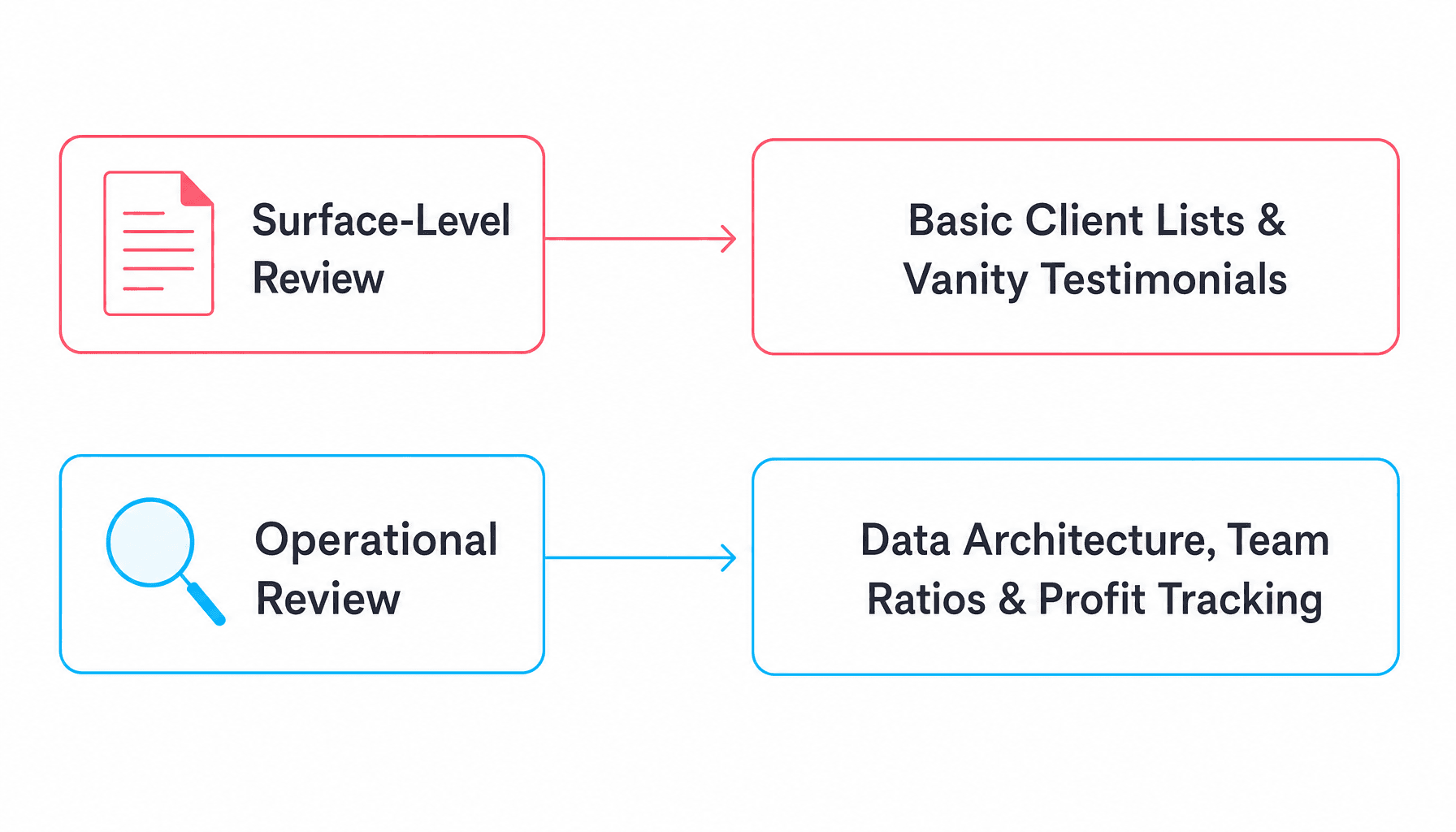
When interviewing prospective agencies, look closely at how they assign account ownership. If a provider routes your business to a junior account coordinator managing dozens of distinct brands, your store may only receive reactive maintenance.
A reliable partner will outline a clear account escalation path, present structured data frameworks for keyword tracking, and show a clear understanding of the relationship between ad spend, organic search placement, and inventory health. Avoid service groups that guarantee specific search rankings or attempt to lock your brand into long-term contracts that lack clear performance-based exit provisions.
8 Essential Questions to Ask Potential Amazon Agencies
To assess the technical capabilities and operational setup of a prospective partner, use this diagnostic framework during your evaluation meetings:
What is the precise account-to-manager ratio for the team handling our day-to-day operations? (Look for partners where managers handle fewer, high-volume brands to ensure deeper focus.)
How does your media team track inventory health before scaling programmatic ad spend? (Ensure they have automated systems to lower ad spend on low-stock items.)
Can you explain your methodology for separating organic brand demand from incremental growth? (A professional agency should use structured testing to show how ads generate new customers rather than just bidding on your own brand name.)
What specific reports and API streams do your automated optimization systems pull from? (Confirm they use official, secure Selling Partner API integrations rather than basic web scraping.)
How does your team handle unexpected listing suppressions or account health notifications on weekends? (Look for providers that use continuous monitoring tools to catch catalog issues before they cause extended downtime.)
What is your target metrics focus: are your optimization models built around ACoS, or do they prioritize TACoS and contribution margin? (Prioritize partners that focus on total profitability rather than isolated ad efficiency metrics.)
Who owns the creative assets, store designs, and A+ Content layouts built during the partnership? (Ensure your contracts state clearly that your brand retains full ownership of all intellectual property and design assets.)
What technical data systems do you use to manage advanced advertising metrics through the Amazon Marketing Cloud? (Confirm they have the technical capability to build custom attribution models for full-funnel campaigns.)
Conclusion
The evolution of the Amazon marketplace has changed the standards for e-commerce service providers. Brands can no longer rely on simple advertising optimization or basic listing updates to stay competitive. Success requires partnering with organizations that understand Amazon as a fully integrated operating system—where retail media, supply chain management, compliance tracking, and technical data attribution directly influence one another. By choosing partners that offer transparent account management, advanced technical integrations, and operational models focused on total profitability, brands can protect their margins and scale securely across global marketplaces.
Frequently Asked Questions
How do modern Amazon management agencies structure their service fees?
Most professional agencies use a fee structure that combines a fixed monthly base fee with a small percentage of gross marketplace sales or managed ad spend. This structure aligns the agency's goals with the brand's growth targets. Avoid fee structures that charge large upfront setup costs without clear operational milestones.
What is the difference between an account coordinator and a senior brand operator?
Account coordinators typically manage client onboarding, assemble standard performance reports, and route tasks to different departments, often handling up to twenty accounts simultaneously. A senior brand operator focuses on high-level growth strategy, manages capital allocation across ad networks, and works with fewer accounts to provide deeper operational focus.
Why is tracking TACoS more important than tracking standard ACoS?
ACoS tracks advertising efficiency in isolation by dividing ad spend by direct ad sales. TACoS measures total advertising cost of sale by dividing ad spend by your total revenue, including organic sales. Tracking TACoS provides a clearer picture of how your advertising campaigns influence your overall brand visibility and organic search growth.
How do automated operational agents assist human account managers?
Automated software agents handle routine, repetitive data tasks like scanning for listing suppressions, processing FBA inventory ledgers, and drafting basic customer service replies. This automation allows human managers to spend less time on administrative data entry and more time on high-level growth strategy and inventory planning.
Should an enterprise brand choose a specialized PPC vendor or a full-service agency?
If a brand already has internal teams handling logistics, customer service, and catalog compliance, a specialized media vendor can be an effective choice to optimize ad spend. However, if your team finds itself stretched across daily operations like tracking shipments, resolving listing issues, and managing compliance, a full-service partner is often better suited to manage the entire channel.
Co-Founder & CEO, Lumian
Robin Lobo is Co-Founder and CEO of Lumian. He built and sold a seven-figure eyeglasses brand on Amazon and spent several years on the client side of traditional agencies before founding Lumian, an AI-native Amazon agency backed by $3M led by Bowery Capital.

AI Agent
Your Amazon business, fully managed.

Brand ManAger

Expert Team
Top Amazon Management Agencies for 2026: How to Choose Wisely
Discover the top Amazon management agencies for 2026. Learn how to evaluate full-service marketplace partners, analyze operating models, and protect net profit margins.
TL;DR
What to expect from this article:
An analytical guide designed to help mid-market and enterprise brands navigate the crowded Amazon service provider ecosystem. This article details what makes an agency effective, evaluates prevailing operational models, and provides a clear partner selection framework based on business needs.
Key Takeaways:
The modern Amazon ecosystem requires integrated data orchestration across logistics, Amazon Marketing Cloud (AMC) attribution, organic ranking, and advertising lanes.
Traditional agencies that operate on high account-to-manager ratios often fail to keep pace with algorithmic marketplace shifts, leading to delayed listing updates and missed inventory signals.
An effective evaluation process shifts the focus away from vanity acquisition lists, prioritizing partners that use unified technological architecture and senior operators to protect contribution margins.
Intro
Succeeding on the Amazon marketplace has become a more complex operational challenge for retail brands. In previous years, e-commerce companies could treat an Amazon agency as a specialized PPC vendor—someone tasked with adjusting keyword bids, managing text strings, and providing monthly performance summaries.
The marketplace has evolved past that limited scope. With the launch of intent-driven search models like the COSMO architecture and conversational tools like Alexa for Shopping (formerly Rufus), organic product discovery is deeply connected with advertising velocity, catalog accuracy, fulfillment metrics, and real-time inventory levels. For established businesses, choosing an Amazon management partner is a significant decision that impacts channel growth and long-term profitability. This guide examines the leading agency structures, core services, and partner evaluation frameworks for 2026.
The Strategic Importance of Agency Selection
The retail landscape on Amazon has become highly competitive, changing the dynamics of channel management. According to Marketplace Pulse research, the market has quietly reorganized itself: in 2023, roughly 15,000 sellers generated half of Amazon's U.S. third-party GMV, but by early 2026, that same threshold was held by fewer than 8,000 sellers — each doing over $5 million in annual sales.
As market share concentrates among sophisticated brands, the cost of operational delays grows higher. A single unaddressed listing suppression, an unresolved FBA receiving error, or a misconfigured advertising campaign can cause significant visibility losses within hours. Many traditional service agencies are built on client acquisition models where account coordinators handle fifteen to twenty brands simultaneously, leaving little time for deep daily account maintenance. When choosing an agency, brands must evaluate the underlying operational structure to ensure the partner can manage complex, fast-moving marketplace changes.
Core Services and Prevailing Agency Models
When evaluating third-party service providers, brands typically choose between full-service management companies, specialized advertising vendors, and advanced technology-native platforms.
1. Full-Service Marketplace Management
Full-service operators manage the entire Amazon ecosystem for a brand. Their scope includes running daily Amazon PPC and Amazon DSP media campaigns, managing search engine optimization (SEO), building detailed store assets, coordinating inventory restock alerts, and handling ongoing account health issues.
Exemplary Providers: Firms like Canopy Management and Seller Interactive operate within this comprehensive service category. They provide extensive operational breadth, making them reliable choices for mid-market brands that want to outsource their entire back-office Amazon administration to a large, structured organization.
What to Look For: Evaluate how the agency handles catalog variations and cross-department communication. Ensure the teams managing your advertising campaigns work directly with the logistics and inventory managers to avoid wasting ad spend on low-stock products.
2. Specialized Media and Analytics Platforms
These providers focus on paid search management, full-funnel customer acquisition, and technical data attribution through tools like the Amazon Marketing Cloud (AMC).
Exemplary Providers: Agencies like Acadia and specialized data platforms like Intentwise fit this analytical profile. They excel at managing high-volume programmatic ad spend, building media funnels, and setting up custom attribution dashboards for brands that already handle logistics in-house.
What to Look For: Review their approach to Total Advertising Cost of Sale (TACoS). A sophisticated media partner should focus on how paid campaigns drive organic keyword rankings and overall net profit margins, rather than focusing purely on isolated, campaign-level ACoS targets.
3. Integrated Commerce Growth Systems
The latest evolution in marketplace management involves platforms that combine automated data engines with senior brand managers. This hybrid model uses technology to handle routine data tasks while human specialists focus on high-level growth strategy.
Exemplary Providers: Eva Commerce illustrates this integrated approach, operating an all-in-one growth system that connects Amazon, Walmart, and TikTok Shop into a single unified workspace. Similarly, Lumian operates as an AI-native agency, deploying specialized software agents to monitor account health, draft buyer replies, and track FBA reimbursements 24/7, while senior human operators manage overall channel growth.
What to Look For: Verify that their software integrations use secure, official Selling Partner API connections, and confirm that their operating model is built to protect bottom-line contribution margins rather than just tracking top-line sales volume.
A Practical Framework for Evaluating Agency Partners
Selecting the right partner requires looking beyond basic case studies and positive reviews. Brands should use a structured evaluation process focused on operational transparency, technical capacity, and structural alignment.
When interviewing prospective agencies, look closely at how they assign account ownership. If a provider routes your business to a junior account coordinator managing dozens of distinct brands, your store may only receive reactive maintenance.
A reliable partner will outline a clear account escalation path, present structured data frameworks for keyword tracking, and show a clear understanding of the relationship between ad spend, organic search placement, and inventory health. Avoid service groups that guarantee specific search rankings or attempt to lock your brand into long-term contracts that lack clear performance-based exit provisions.
8 Essential Questions to Ask Potential Amazon Agencies
To assess the technical capabilities and operational setup of a prospective partner, use this diagnostic framework during your evaluation meetings:
What is the precise account-to-manager ratio for the team handling our day-to-day operations? (Look for partners where managers handle fewer, high-volume brands to ensure deeper focus.)
How does your media team track inventory health before scaling programmatic ad spend? (Ensure they have automated systems to lower ad spend on low-stock items.)
Can you explain your methodology for separating organic brand demand from incremental growth? (A professional agency should use structured testing to show how ads generate new customers rather than just bidding on your own brand name.)
What specific reports and API streams do your automated optimization systems pull from? (Confirm they use official, secure Selling Partner API integrations rather than basic web scraping.)
How does your team handle unexpected listing suppressions or account health notifications on weekends? (Look for providers that use continuous monitoring tools to catch catalog issues before they cause extended downtime.)
What is your target metrics focus: are your optimization models built around ACoS, or do they prioritize TACoS and contribution margin? (Prioritize partners that focus on total profitability rather than isolated ad efficiency metrics.)
Who owns the creative assets, store designs, and A+ Content layouts built during the partnership? (Ensure your contracts state clearly that your brand retains full ownership of all intellectual property and design assets.)
What technical data systems do you use to manage advanced advertising metrics through the Amazon Marketing Cloud? (Confirm they have the technical capability to build custom attribution models for full-funnel campaigns.)
Conclusion
The evolution of the Amazon marketplace has changed the standards for e-commerce service providers. Brands can no longer rely on simple advertising optimization or basic listing updates to stay competitive. Success requires partnering with organizations that understand Amazon as a fully integrated operating system—where retail media, supply chain management, compliance tracking, and technical data attribution directly influence one another. By choosing partners that offer transparent account management, advanced technical integrations, and operational models focused on total profitability, brands can protect their margins and scale securely across global marketplaces.
Frequently Asked Questions
How do modern Amazon management agencies structure their service fees?
Most professional agencies use a fee structure that combines a fixed monthly base fee with a small percentage of gross marketplace sales or managed ad spend. This structure aligns the agency's goals with the brand's growth targets. Avoid fee structures that charge large upfront setup costs without clear operational milestones.
What is the difference between an account coordinator and a senior brand operator?
Account coordinators typically manage client onboarding, assemble standard performance reports, and route tasks to different departments, often handling up to twenty accounts simultaneously. A senior brand operator focuses on high-level growth strategy, manages capital allocation across ad networks, and works with fewer accounts to provide deeper operational focus.
Why is tracking TACoS more important than tracking standard ACoS?
ACoS tracks advertising efficiency in isolation by dividing ad spend by direct ad sales. TACoS measures total advertising cost of sale by dividing ad spend by your total revenue, including organic sales. Tracking TACoS provides a clearer picture of how your advertising campaigns influence your overall brand visibility and organic search growth.
How do automated operational agents assist human account managers?
Automated software agents handle routine, repetitive data tasks like scanning for listing suppressions, processing FBA inventory ledgers, and drafting basic customer service replies. This automation allows human managers to spend less time on administrative data entry and more time on high-level growth strategy and inventory planning.
Should an enterprise brand choose a specialized PPC vendor or a full-service agency?
If a brand already has internal teams handling logistics, customer service, and catalog compliance, a specialized media vendor can be an effective choice to optimize ad spend. However, if your team finds itself stretched across daily operations like tracking shipments, resolving listing issues, and managing compliance, a full-service partner is often better suited to manage the entire channel.
Co-Founder & CEO, Lumian
Robin Lobo is Co-Founder and CEO of Lumian. He built and sold a seven-figure eyeglasses brand on Amazon and spent several years on the client side of traditional agencies before founding Lumian, an AI-native Amazon agency backed by $3M led by Bowery Capital.
AI Agent
Your Amazon business, fully managed.
Brand ManAger
Expert Team
Top Amazon Management Agencies for 2026: How to Choose Wisely
Discover the top Amazon management agencies for 2026. Learn how to evaluate full-service marketplace partners, analyze operating models, and protect net profit margins.
TL;DR
What to expect from this article:
An analytical guide designed to help mid-market and enterprise brands navigate the crowded Amazon service provider ecosystem. This article details what makes an agency effective, evaluates prevailing operational models, and provides a clear partner selection framework based on business needs.
Key Takeaways:
The modern Amazon ecosystem requires integrated data orchestration across logistics, Amazon Marketing Cloud (AMC) attribution, organic ranking, and advertising lanes.
Traditional agencies that operate on high account-to-manager ratios often fail to keep pace with algorithmic marketplace shifts, leading to delayed listing updates and missed inventory signals.
An effective evaluation process shifts the focus away from vanity acquisition lists, prioritizing partners that use unified technological architecture and senior operators to protect contribution margins.
Intro
Succeeding on the Amazon marketplace has become a more complex operational challenge for retail brands. In previous years, e-commerce companies could treat an Amazon agency as a specialized PPC vendor—someone tasked with adjusting keyword bids, managing text strings, and providing monthly performance summaries.
The marketplace has evolved past that limited scope. With the launch of intent-driven search models like the COSMO architecture and conversational tools like Alexa for Shopping (formerly Rufus), organic product discovery is deeply connected with advertising velocity, catalog accuracy, fulfillment metrics, and real-time inventory levels. For established businesses, choosing an Amazon management partner is a significant decision that impacts channel growth and long-term profitability. This guide examines the leading agency structures, core services, and partner evaluation frameworks for 2026.
The Strategic Importance of Agency Selection
The retail landscape on Amazon has become highly competitive, changing the dynamics of channel management. According to Marketplace Pulse research, the market has quietly reorganized itself: in 2023, roughly 15,000 sellers generated half of Amazon's U.S. third-party GMV, but by early 2026, that same threshold was held by fewer than 8,000 sellers — each doing over $5 million in annual sales.
As market share concentrates among sophisticated brands, the cost of operational delays grows higher. A single unaddressed listing suppression, an unresolved FBA receiving error, or a misconfigured advertising campaign can cause significant visibility losses within hours. Many traditional service agencies are built on client acquisition models where account coordinators handle fifteen to twenty brands simultaneously, leaving little time for deep daily account maintenance. When choosing an agency, brands must evaluate the underlying operational structure to ensure the partner can manage complex, fast-moving marketplace changes.
Core Services and Prevailing Agency Models
When evaluating third-party service providers, brands typically choose between full-service management companies, specialized advertising vendors, and advanced technology-native platforms.
1. Full-Service Marketplace Management
Full-service operators manage the entire Amazon ecosystem for a brand. Their scope includes running daily Amazon PPC and Amazon DSP media campaigns, managing search engine optimization (SEO), building detailed store assets, coordinating inventory restock alerts, and handling ongoing account health issues.
Exemplary Providers: Firms like Canopy Management and Seller Interactive operate within this comprehensive service category. They provide extensive operational breadth, making them reliable choices for mid-market brands that want to outsource their entire back-office Amazon administration to a large, structured organization.
What to Look For: Evaluate how the agency handles catalog variations and cross-department communication. Ensure the teams managing your advertising campaigns work directly with the logistics and inventory managers to avoid wasting ad spend on low-stock products.
2. Specialized Media and Analytics Platforms
These providers focus on paid search management, full-funnel customer acquisition, and technical data attribution through tools like the Amazon Marketing Cloud (AMC).
Exemplary Providers: Agencies like Acadia and specialized data platforms like Intentwise fit this analytical profile. They excel at managing high-volume programmatic ad spend, building media funnels, and setting up custom attribution dashboards for brands that already handle logistics in-house.
What to Look For: Review their approach to Total Advertising Cost of Sale (TACoS). A sophisticated media partner should focus on how paid campaigns drive organic keyword rankings and overall net profit margins, rather than focusing purely on isolated, campaign-level ACoS targets.
3. Integrated Commerce Growth Systems
The latest evolution in marketplace management involves platforms that combine automated data engines with senior brand managers. This hybrid model uses technology to handle routine data tasks while human specialists focus on high-level growth strategy.
Exemplary Providers: Eva Commerce illustrates this integrated approach, operating an all-in-one growth system that connects Amazon, Walmart, and TikTok Shop into a single unified workspace. Similarly, Lumian operates as an AI-native agency, deploying specialized software agents to monitor account health, draft buyer replies, and track FBA reimbursements 24/7, while senior human operators manage overall channel growth.
What to Look For: Verify that their software integrations use secure, official Selling Partner API connections, and confirm that their operating model is built to protect bottom-line contribution margins rather than just tracking top-line sales volume.
A Practical Framework for Evaluating Agency Partners
Selecting the right partner requires looking beyond basic case studies and positive reviews. Brands should use a structured evaluation process focused on operational transparency, technical capacity, and structural alignment.
When interviewing prospective agencies, look closely at how they assign account ownership. If a provider routes your business to a junior account coordinator managing dozens of distinct brands, your store may only receive reactive maintenance.
A reliable partner will outline a clear account escalation path, present structured data frameworks for keyword tracking, and show a clear understanding of the relationship between ad spend, organic search placement, and inventory health. Avoid service groups that guarantee specific search rankings or attempt to lock your brand into long-term contracts that lack clear performance-based exit provisions.
8 Essential Questions to Ask Potential Amazon Agencies
To assess the technical capabilities and operational setup of a prospective partner, use this diagnostic framework during your evaluation meetings:
What is the precise account-to-manager ratio for the team handling our day-to-day operations? (Look for partners where managers handle fewer, high-volume brands to ensure deeper focus.)
How does your media team track inventory health before scaling programmatic ad spend? (Ensure they have automated systems to lower ad spend on low-stock items.)
Can you explain your methodology for separating organic brand demand from incremental growth? (A professional agency should use structured testing to show how ads generate new customers rather than just bidding on your own brand name.)
What specific reports and API streams do your automated optimization systems pull from? (Confirm they use official, secure Selling Partner API integrations rather than basic web scraping.)
How does your team handle unexpected listing suppressions or account health notifications on weekends? (Look for providers that use continuous monitoring tools to catch catalog issues before they cause extended downtime.)
What is your target metrics focus: are your optimization models built around ACoS, or do they prioritize TACoS and contribution margin? (Prioritize partners that focus on total profitability rather than isolated ad efficiency metrics.)
Who owns the creative assets, store designs, and A+ Content layouts built during the partnership? (Ensure your contracts state clearly that your brand retains full ownership of all intellectual property and design assets.)
What technical data systems do you use to manage advanced advertising metrics through the Amazon Marketing Cloud? (Confirm they have the technical capability to build custom attribution models for full-funnel campaigns.)
Conclusion
The evolution of the Amazon marketplace has changed the standards for e-commerce service providers. Brands can no longer rely on simple advertising optimization or basic listing updates to stay competitive. Success requires partnering with organizations that understand Amazon as a fully integrated operating system—where retail media, supply chain management, compliance tracking, and technical data attribution directly influence one another. By choosing partners that offer transparent account management, advanced technical integrations, and operational models focused on total profitability, brands can protect their margins and scale securely across global marketplaces.
Frequently Asked Questions
How do modern Amazon management agencies structure their service fees?
Most professional agencies use a fee structure that combines a fixed monthly base fee with a small percentage of gross marketplace sales or managed ad spend. This structure aligns the agency's goals with the brand's growth targets. Avoid fee structures that charge large upfront setup costs without clear operational milestones.
What is the difference between an account coordinator and a senior brand operator?
Account coordinators typically manage client onboarding, assemble standard performance reports, and route tasks to different departments, often handling up to twenty accounts simultaneously. A senior brand operator focuses on high-level growth strategy, manages capital allocation across ad networks, and works with fewer accounts to provide deeper operational focus.
Why is tracking TACoS more important than tracking standard ACoS?
ACoS tracks advertising efficiency in isolation by dividing ad spend by direct ad sales. TACoS measures total advertising cost of sale by dividing ad spend by your total revenue, including organic sales. Tracking TACoS provides a clearer picture of how your advertising campaigns influence your overall brand visibility and organic search growth.
How do automated operational agents assist human account managers?
Automated software agents handle routine, repetitive data tasks like scanning for listing suppressions, processing FBA inventory ledgers, and drafting basic customer service replies. This automation allows human managers to spend less time on administrative data entry and more time on high-level growth strategy and inventory planning.
Should an enterprise brand choose a specialized PPC vendor or a full-service agency?
If a brand already has internal teams handling logistics, customer service, and catalog compliance, a specialized media vendor can be an effective choice to optimize ad spend. However, if your team finds itself stretched across daily operations like tracking shipments, resolving listing issues, and managing compliance, a full-service partner is often better suited to manage the entire channel.
Co-Founder & CEO, Lumian
Robin Lobo is Co-Founder and CEO of Lumian. He built and sold a seven-figure eyeglasses brand on Amazon and spent several years on the client side of traditional agencies before founding Lumian, an AI-native Amazon agency backed by $3M led by Bowery Capital.

AI Agent
Your Amazon business, fully managed.
Brand ManAger
Expert Team