Top AI Agents Revolutionizing Amazon Selling in 2026
Discover the top autonomous AI agents for Amazon sellers in 2026. Compare how multi-agent stacks, MCP architecture, and SP-API automations optimize FBA businesses.

TL;DR
What to expect from this article:
An analytical evaluation of the leading autonomous AI agents shaping the Amazon e-commerce ecosystem in 2026. This review explains how modern software moves past simple software dashboards to execute tasks independently.
Key Takeaways:
Software development in 2026 has transitioned from passive charts to autonomous AI agents that handle operations via direct API calls.
Choosing the right software requires assessing data access levels, such as checking for comprehensive Model Context Protocol (MCP) integrations and real-time Selling Partner API (SP-API) connections.
The current market includes specialized solutions like Amazon’s internal operations tools, open multi-agent frameworks, and dedicated systems like Lumian Agent that protect account margins.
Intro
The e-commerce operational landscape has shifted away from traditional analytics software that simply displays information on a screen. Modern Amazon brands no longer have the time to log into multiple dashboards, export text files, and manually execute routine updates inside Seller Central.
The introduction of autonomous AI agents has changed how companies manage their online stores. These systems do not just display data; they connect directly to marketplace APIs to analyze trends, organize customer communications, and protect seller accounts independently. This guide reviews the top AI agents for Amazon sellers in 2026, providing an objective look at their technical capabilities, operational benefits, and system architectures.
Understanding AI Agents in the Amazon Ecosystem
An autonomous AI agent is a software application designed to review its digital environment, assess options, and execute multi-step operational tasks without requiring a human user to approve every step.
Traditional software platforms require a human analyst to interpret charts and manually input adjustments inside Seller Central. In contrast, an AI agent uses direct API connections to complete workflows on its own. It can identify a sudden shift in sales, track the issue to an underlying listing error, and draft the necessary correction independently.
Private-label brands and Fulfillment by Amazon (FBA) businesses frequently face operational challenges that can strain human resources, including:
Operational Volume: Managing customer inquiries across multiple international stores while maintaining a low customer response time score.
Compliance Monitoring: Checking for unannounced product suppressions or account health policy violations daily.
Financial Auditing: Tracking inventory variances across multiple fulfillment centers to submit timely FBA reimbursement requests before lookback deadlines expire.
Deploying autonomous agents allows brands to transition these repetitive operational tasks to automated systems, helping to reduce manual errors and protect net operating margins.
Top AI Agents Revolutionizing the Amazon Marketplace in 2026
The software options available in 2026 range from native tools built directly into the Amazon ecosystem to independent third-party applications designed for specialized operational tasks.
1. Lumian Agent (Autonomous Account Protection & FBA Operations)
Lumian Agent connects directly to the Amazon Selling Partner API to serve as an autonomous operational assistant. The platform focuses on running pre-scheduled tasks to automate day-to-day store administration, combining account health monitoring, multi-language buyer message triaging, and systematic FBA reimbursement auditing within a unified system.
Key Functionalities: Features a tiered "Daily Smoke Alarm" that sends instant alerts to Slack or email when high-severity account health threats occur; automatically generates policy-compliant customer response drafts; and reviews inventory ledgers to build verified dispute packages for lost or damaged FBA inventory.
User Experience: The platform provides a hands-off experience by running automated routines in the background, abstracting complex reports into a natural-language chat interface and automated workflows.
Comparative Advantage: Lumian Agent operates as a margin-focused system. While other applications focus primarily on generating listing text or managing ad bids, Lumian automates the back-office administrative tasks required to protect capital and maintain account health.
2. Nova Analytics + Claude (MCP-Connected Analytics)
Nova Analytics (novadata.io) is building an integration that uses Anthropic's Model Context Protocol (MCP) to connect Claude directly to a seller's reconciled Amazon dataset — orders, fee types, ad spend, and inventory across marketplaces. As of mid-2026 the integration is in private waitlist rather than general availability.
Key Functionalities: Evaluates data across dozens of distinct Amazon fee types, ad spend records, and cost-of-goods-sold (COGS) figures at the individual SKU level, running automated checks across global marketplaces.
User Experience: Built for teams with technical resources, this solution allows operators to query live corporate databases using natural language commands directly inside the chat interface.
Comparative Advantage: Provides deep analytical flexibility for data-heavy teams. However, the connection is read-only analytics — it answers questions about the data but does not execute operational workflows like message handling or reimbursement filing.
3. Amazon Ads Agent & Native Systems
Amazon has updated its developer ecosystem by introducing the native Amazon Ads Agent (November 2025) alongside its official Ads MCP Server infrastructure (February 2, 2026). These built-in tools are designed to help sellers manage programmatic advertising directly inside the platform.
Key Functionalities: Connects directly with internal Amazon ad networks to adjust bids, reallocate budgets across campaigns based on target ACoS guidelines, and identify converting search terms.
User Experience: Ads Agent operates inside the Amazon Ads console, while the Ads MCP Server (open beta since February 2026) lets sellers connect external AI assistants like Claude or ChatGPT to their ad account through a single integration.
Comparative Advantage: Offers reliable data accuracy for advertising metrics. However, it sees advertising data only - no inventory, margin, or account health visibility - so it cannot protect decisions that depend on the rest of the business.
4. Open-Source Multi-Agent Frameworks (CrewAI, LangGraph, and AutoGen)
For enterprise brands with dedicated development teams, open-source multi-agent frameworks allow companies to build customized internal automation systems.
Key Functionalities: Allows developers to assign specific operational roles to individual AI agents (e.g., assigning one agent to monitor keyword indexing and another to track competitor pricing changes).
User Experience: Requires regular engineering support, code updates, and manual API management, making it an advanced option for technical teams.
Comparative Advantage: Provides complete control over your code base and data workflows, but involves high upfront development costs and ongoing maintenance requirements.
Real-World Applications: Operational Efficiency and Volume Gains
Implementing autonomous agents can lead to measurable improvements in operational efficiency and overhead reduction. Data from supply chain research indicates that deploying automated demand forecasting and inventory tracking models can reduce warehouse stockouts by up to 65% while reducing inventory levels by 20 to 50 percent.
Consider the operational case of a private-label home decor brand managing over 150 active product variants across multiple regional warehouses. Before automating their processes, the brand required two full-time employee positions dedicated entirely to running manual catalog audits, managing weekend customer inquiries, and cross-referencing FBA inventory ledger files.
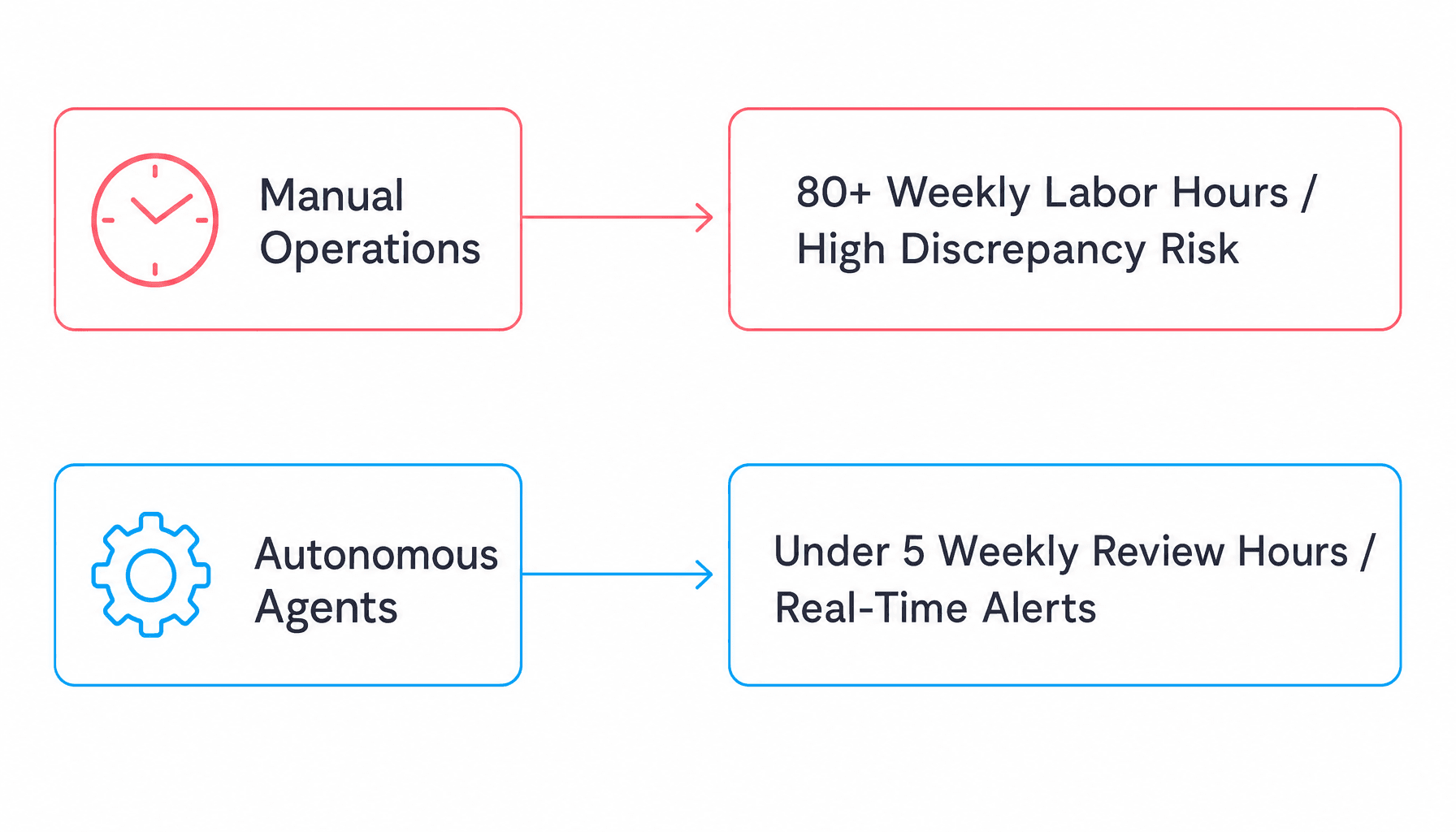
By deploying a connected AI agent stack to manage these administrative tasks, the brand cut its weekly manual catalog management time from eighty hours down to under five hours of human review. The automated system identified listing suppressions within an hour of occurrence, caught inbound inventory shortages before lookback windows expired, and prepared compliant customer service drafts automatically, allowing the brand to scale its catalog without increasing administrative overhead.
Essential Features to Look for in AI Agents
When evaluating autonomous applications for your business, consider the following technical capabilities:
[ ] Direct Selling Partner API Access: Ensure the platform uses secure, official connection protocols rather than brittle browser-scraping methods.
[ ] Real-Time Event Monitoring: The platform should include automated alert systems, like a dedicated smoke alarm feature, to flag high-severity account health risks instantly.
[ ] Data Security Safeguards: Confirm the platform uses isolated data environments to ensure your brand's operational metrics are never shared or aggregated.
[ ] Human-in-the-Loop Controls: The system should allow operators to review and approve major actions—such as customer messages or case submissions—before they are sent.
[ ] Cross-Functional Capabilities: Look for tools that can handle multiple operational areas, such as tracking compliance, auditing logistics, and managing feedback, within a single integration.
Conclusion
The growth of autonomous AI agents represents a significant change in how modern Amazon businesses manage daily operations. Moving beyond passive data displays, these systems help brands automate complex processes across account health monitoring, customer relations, and financial recovery. Success in this automated landscape relies on choosing platforms that connect securely to official marketplace APIs, provide clear oversight controls, and protect your core operating margins.
Frequently Asked Questions
What is the core difference between an AI tool and an autonomous AI agent?
Standard AI tools operate on a single-input model, requiring a human user to enter a prompt, export a report, or paste text to generate a specific output. An autonomous AI agent connects directly to live data feeds, monitors metrics continuously in the background, and executes multi-step workflows independently without needing step-by-step human intervention.
Is it safe to allow an AI agent to connect to my Seller Central account?
It is, provided the software connects using official Amazon Selling Partner API integrations. This secure authorization process runs within Amazon's developer guidelines, allowing you to control data permissions and revoke access at any time through your Seller Central dashboard. Avoid tools that require you to share primary login credentials.
Does an autonomous agent make active changes to my product prices or listings?
Most operational agents focus on reading data, analyzing trends, and drafting work for your review, ensuring no direct changes are made to your live listings or customer communications without operator approval. Specialized repricing applications can make direct changes, but they require you to set strict minimum profit rules first.
How do multi-agent stacks collaborate within an e-commerce business?
A multi-agent architecture assigns individual, specialized AI agents to manage separate business functions. For example, one agent tracks search visibility, another monitors inventory levels, and a central coordinating system summarizes their findings into a single report for the business owner.
Can an AI agent help recover missing funds from FBA warehouse errors?
Yes. The agent continuously audits your inventory ledger reports, customer returns, and inbound receiving data via the SP-API. If it finds an uncredited discrepancy—such as an item lost in a warehouse or an unreturned customer refund—it compiles the necessary tracking codes into a verified dispute package for easy submission.
Co-Founder & CEO, Lumian
Robin Lobo is Co-Founder and CEO of Lumian. He built and sold a seven-figure eyeglasses brand on Amazon and spent several years on the client side of traditional agencies before founding Lumian, an AI-native Amazon agency backed by $3M led by Bowery Capital.

AI Agent
Your Amazon business, fully managed.

Brand ManAger

Expert Team
Top AI Agents Revolutionizing Amazon Selling in 2026
Discover the top autonomous AI agents for Amazon sellers in 2026. Compare how multi-agent stacks, MCP architecture, and SP-API automations optimize FBA businesses.
TL;DR
What to expect from this article:
An analytical evaluation of the leading autonomous AI agents shaping the Amazon e-commerce ecosystem in 2026. This review explains how modern software moves past simple software dashboards to execute tasks independently.
Key Takeaways:
Software development in 2026 has transitioned from passive charts to autonomous AI agents that handle operations via direct API calls.
Choosing the right software requires assessing data access levels, such as checking for comprehensive Model Context Protocol (MCP) integrations and real-time Selling Partner API (SP-API) connections.
The current market includes specialized solutions like Amazon’s internal operations tools, open multi-agent frameworks, and dedicated systems like Lumian Agent that protect account margins.
Intro
The e-commerce operational landscape has shifted away from traditional analytics software that simply displays information on a screen. Modern Amazon brands no longer have the time to log into multiple dashboards, export text files, and manually execute routine updates inside Seller Central.
The introduction of autonomous AI agents has changed how companies manage their online stores. These systems do not just display data; they connect directly to marketplace APIs to analyze trends, organize customer communications, and protect seller accounts independently. This guide reviews the top AI agents for Amazon sellers in 2026, providing an objective look at their technical capabilities, operational benefits, and system architectures.
Understanding AI Agents in the Amazon Ecosystem
An autonomous AI agent is a software application designed to review its digital environment, assess options, and execute multi-step operational tasks without requiring a human user to approve every step.
Traditional software platforms require a human analyst to interpret charts and manually input adjustments inside Seller Central. In contrast, an AI agent uses direct API connections to complete workflows on its own. It can identify a sudden shift in sales, track the issue to an underlying listing error, and draft the necessary correction independently.
Private-label brands and Fulfillment by Amazon (FBA) businesses frequently face operational challenges that can strain human resources, including:
Operational Volume: Managing customer inquiries across multiple international stores while maintaining a low customer response time score.
Compliance Monitoring: Checking for unannounced product suppressions or account health policy violations daily.
Financial Auditing: Tracking inventory variances across multiple fulfillment centers to submit timely FBA reimbursement requests before lookback deadlines expire.
Deploying autonomous agents allows brands to transition these repetitive operational tasks to automated systems, helping to reduce manual errors and protect net operating margins.
Top AI Agents Revolutionizing the Amazon Marketplace in 2026
The software options available in 2026 range from native tools built directly into the Amazon ecosystem to independent third-party applications designed for specialized operational tasks.
1. Lumian Agent (Autonomous Account Protection & FBA Operations)
Lumian Agent connects directly to the Amazon Selling Partner API to serve as an autonomous operational assistant. The platform focuses on running pre-scheduled tasks to automate day-to-day store administration, combining account health monitoring, multi-language buyer message triaging, and systematic FBA reimbursement auditing within a unified system.
Key Functionalities: Features a tiered "Daily Smoke Alarm" that sends instant alerts to Slack or email when high-severity account health threats occur; automatically generates policy-compliant customer response drafts; and reviews inventory ledgers to build verified dispute packages for lost or damaged FBA inventory.
User Experience: The platform provides a hands-off experience by running automated routines in the background, abstracting complex reports into a natural-language chat interface and automated workflows.
Comparative Advantage: Lumian Agent operates as a margin-focused system. While other applications focus primarily on generating listing text or managing ad bids, Lumian automates the back-office administrative tasks required to protect capital and maintain account health.
2. Nova Analytics + Claude (MCP-Connected Analytics)
Nova Analytics (novadata.io) is building an integration that uses Anthropic's Model Context Protocol (MCP) to connect Claude directly to a seller's reconciled Amazon dataset — orders, fee types, ad spend, and inventory across marketplaces. As of mid-2026 the integration is in private waitlist rather than general availability.
Key Functionalities: Evaluates data across dozens of distinct Amazon fee types, ad spend records, and cost-of-goods-sold (COGS) figures at the individual SKU level, running automated checks across global marketplaces.
User Experience: Built for teams with technical resources, this solution allows operators to query live corporate databases using natural language commands directly inside the chat interface.
Comparative Advantage: Provides deep analytical flexibility for data-heavy teams. However, the connection is read-only analytics — it answers questions about the data but does not execute operational workflows like message handling or reimbursement filing.
3. Amazon Ads Agent & Native Systems
Amazon has updated its developer ecosystem by introducing the native Amazon Ads Agent (November 2025) alongside its official Ads MCP Server infrastructure (February 2, 2026). These built-in tools are designed to help sellers manage programmatic advertising directly inside the platform.
Key Functionalities: Connects directly with internal Amazon ad networks to adjust bids, reallocate budgets across campaigns based on target ACoS guidelines, and identify converting search terms.
User Experience: Ads Agent operates inside the Amazon Ads console, while the Ads MCP Server (open beta since February 2026) lets sellers connect external AI assistants like Claude or ChatGPT to their ad account through a single integration.
Comparative Advantage: Offers reliable data accuracy for advertising metrics. However, it sees advertising data only - no inventory, margin, or account health visibility - so it cannot protect decisions that depend on the rest of the business.
4. Open-Source Multi-Agent Frameworks (CrewAI, LangGraph, and AutoGen)
For enterprise brands with dedicated development teams, open-source multi-agent frameworks allow companies to build customized internal automation systems.
Key Functionalities: Allows developers to assign specific operational roles to individual AI agents (e.g., assigning one agent to monitor keyword indexing and another to track competitor pricing changes).
User Experience: Requires regular engineering support, code updates, and manual API management, making it an advanced option for technical teams.
Comparative Advantage: Provides complete control over your code base and data workflows, but involves high upfront development costs and ongoing maintenance requirements.
Real-World Applications: Operational Efficiency and Volume Gains
Implementing autonomous agents can lead to measurable improvements in operational efficiency and overhead reduction. Data from supply chain research indicates that deploying automated demand forecasting and inventory tracking models can reduce warehouse stockouts by up to 65% while reducing inventory levels by 20 to 50 percent.
Consider the operational case of a private-label home decor brand managing over 150 active product variants across multiple regional warehouses. Before automating their processes, the brand required two full-time employee positions dedicated entirely to running manual catalog audits, managing weekend customer inquiries, and cross-referencing FBA inventory ledger files.
By deploying a connected AI agent stack to manage these administrative tasks, the brand cut its weekly manual catalog management time from eighty hours down to under five hours of human review. The automated system identified listing suppressions within an hour of occurrence, caught inbound inventory shortages before lookback windows expired, and prepared compliant customer service drafts automatically, allowing the brand to scale its catalog without increasing administrative overhead.
Essential Features to Look for in AI Agents
When evaluating autonomous applications for your business, consider the following technical capabilities:
[ ] Direct Selling Partner API Access: Ensure the platform uses secure, official connection protocols rather than brittle browser-scraping methods.
[ ] Real-Time Event Monitoring: The platform should include automated alert systems, like a dedicated smoke alarm feature, to flag high-severity account health risks instantly.
[ ] Data Security Safeguards: Confirm the platform uses isolated data environments to ensure your brand's operational metrics are never shared or aggregated.
[ ] Human-in-the-Loop Controls: The system should allow operators to review and approve major actions—such as customer messages or case submissions—before they are sent.
[ ] Cross-Functional Capabilities: Look for tools that can handle multiple operational areas, such as tracking compliance, auditing logistics, and managing feedback, within a single integration.
Conclusion
The growth of autonomous AI agents represents a significant change in how modern Amazon businesses manage daily operations. Moving beyond passive data displays, these systems help brands automate complex processes across account health monitoring, customer relations, and financial recovery. Success in this automated landscape relies on choosing platforms that connect securely to official marketplace APIs, provide clear oversight controls, and protect your core operating margins.
Frequently Asked Questions
What is the core difference between an AI tool and an autonomous AI agent?
Standard AI tools operate on a single-input model, requiring a human user to enter a prompt, export a report, or paste text to generate a specific output. An autonomous AI agent connects directly to live data feeds, monitors metrics continuously in the background, and executes multi-step workflows independently without needing step-by-step human intervention.
Is it safe to allow an AI agent to connect to my Seller Central account?
It is, provided the software connects using official Amazon Selling Partner API integrations. This secure authorization process runs within Amazon's developer guidelines, allowing you to control data permissions and revoke access at any time through your Seller Central dashboard. Avoid tools that require you to share primary login credentials.
Does an autonomous agent make active changes to my product prices or listings?
Most operational agents focus on reading data, analyzing trends, and drafting work for your review, ensuring no direct changes are made to your live listings or customer communications without operator approval. Specialized repricing applications can make direct changes, but they require you to set strict minimum profit rules first.
How do multi-agent stacks collaborate within an e-commerce business?
A multi-agent architecture assigns individual, specialized AI agents to manage separate business functions. For example, one agent tracks search visibility, another monitors inventory levels, and a central coordinating system summarizes their findings into a single report for the business owner.
Can an AI agent help recover missing funds from FBA warehouse errors?
Yes. The agent continuously audits your inventory ledger reports, customer returns, and inbound receiving data via the SP-API. If it finds an uncredited discrepancy—such as an item lost in a warehouse or an unreturned customer refund—it compiles the necessary tracking codes into a verified dispute package for easy submission.
Co-Founder & CEO, Lumian
Robin Lobo is Co-Founder and CEO of Lumian. He built and sold a seven-figure eyeglasses brand on Amazon and spent several years on the client side of traditional agencies before founding Lumian, an AI-native Amazon agency backed by $3M led by Bowery Capital.
AI Agent
Your Amazon business, fully managed.
Brand ManAger
Expert Team
Top AI Agents Revolutionizing Amazon Selling in 2026
Discover the top autonomous AI agents for Amazon sellers in 2026. Compare how multi-agent stacks, MCP architecture, and SP-API automations optimize FBA businesses.
TL;DR
What to expect from this article:
An analytical evaluation of the leading autonomous AI agents shaping the Amazon e-commerce ecosystem in 2026. This review explains how modern software moves past simple software dashboards to execute tasks independently.
Key Takeaways:
Software development in 2026 has transitioned from passive charts to autonomous AI agents that handle operations via direct API calls.
Choosing the right software requires assessing data access levels, such as checking for comprehensive Model Context Protocol (MCP) integrations and real-time Selling Partner API (SP-API) connections.
The current market includes specialized solutions like Amazon’s internal operations tools, open multi-agent frameworks, and dedicated systems like Lumian Agent that protect account margins.
Intro
The e-commerce operational landscape has shifted away from traditional analytics software that simply displays information on a screen. Modern Amazon brands no longer have the time to log into multiple dashboards, export text files, and manually execute routine updates inside Seller Central.
The introduction of autonomous AI agents has changed how companies manage their online stores. These systems do not just display data; they connect directly to marketplace APIs to analyze trends, organize customer communications, and protect seller accounts independently. This guide reviews the top AI agents for Amazon sellers in 2026, providing an objective look at their technical capabilities, operational benefits, and system architectures.
Understanding AI Agents in the Amazon Ecosystem
An autonomous AI agent is a software application designed to review its digital environment, assess options, and execute multi-step operational tasks without requiring a human user to approve every step.
Traditional software platforms require a human analyst to interpret charts and manually input adjustments inside Seller Central. In contrast, an AI agent uses direct API connections to complete workflows on its own. It can identify a sudden shift in sales, track the issue to an underlying listing error, and draft the necessary correction independently.
Private-label brands and Fulfillment by Amazon (FBA) businesses frequently face operational challenges that can strain human resources, including:
Operational Volume: Managing customer inquiries across multiple international stores while maintaining a low customer response time score.
Compliance Monitoring: Checking for unannounced product suppressions or account health policy violations daily.
Financial Auditing: Tracking inventory variances across multiple fulfillment centers to submit timely FBA reimbursement requests before lookback deadlines expire.
Deploying autonomous agents allows brands to transition these repetitive operational tasks to automated systems, helping to reduce manual errors and protect net operating margins.
Top AI Agents Revolutionizing the Amazon Marketplace in 2026
The software options available in 2026 range from native tools built directly into the Amazon ecosystem to independent third-party applications designed for specialized operational tasks.
1. Lumian Agent (Autonomous Account Protection & FBA Operations)
Lumian Agent connects directly to the Amazon Selling Partner API to serve as an autonomous operational assistant. The platform focuses on running pre-scheduled tasks to automate day-to-day store administration, combining account health monitoring, multi-language buyer message triaging, and systematic FBA reimbursement auditing within a unified system.
Key Functionalities: Features a tiered "Daily Smoke Alarm" that sends instant alerts to Slack or email when high-severity account health threats occur; automatically generates policy-compliant customer response drafts; and reviews inventory ledgers to build verified dispute packages for lost or damaged FBA inventory.
User Experience: The platform provides a hands-off experience by running automated routines in the background, abstracting complex reports into a natural-language chat interface and automated workflows.
Comparative Advantage: Lumian Agent operates as a margin-focused system. While other applications focus primarily on generating listing text or managing ad bids, Lumian automates the back-office administrative tasks required to protect capital and maintain account health.
2. Nova Analytics + Claude (MCP-Connected Analytics)
Nova Analytics (novadata.io) is building an integration that uses Anthropic's Model Context Protocol (MCP) to connect Claude directly to a seller's reconciled Amazon dataset — orders, fee types, ad spend, and inventory across marketplaces. As of mid-2026 the integration is in private waitlist rather than general availability.
Key Functionalities: Evaluates data across dozens of distinct Amazon fee types, ad spend records, and cost-of-goods-sold (COGS) figures at the individual SKU level, running automated checks across global marketplaces.
User Experience: Built for teams with technical resources, this solution allows operators to query live corporate databases using natural language commands directly inside the chat interface.
Comparative Advantage: Provides deep analytical flexibility for data-heavy teams. However, the connection is read-only analytics — it answers questions about the data but does not execute operational workflows like message handling or reimbursement filing.
3. Amazon Ads Agent & Native Systems
Amazon has updated its developer ecosystem by introducing the native Amazon Ads Agent (November 2025) alongside its official Ads MCP Server infrastructure (February 2, 2026). These built-in tools are designed to help sellers manage programmatic advertising directly inside the platform.
Key Functionalities: Connects directly with internal Amazon ad networks to adjust bids, reallocate budgets across campaigns based on target ACoS guidelines, and identify converting search terms.
User Experience: Ads Agent operates inside the Amazon Ads console, while the Ads MCP Server (open beta since February 2026) lets sellers connect external AI assistants like Claude or ChatGPT to their ad account through a single integration.
Comparative Advantage: Offers reliable data accuracy for advertising metrics. However, it sees advertising data only - no inventory, margin, or account health visibility - so it cannot protect decisions that depend on the rest of the business.
4. Open-Source Multi-Agent Frameworks (CrewAI, LangGraph, and AutoGen)
For enterprise brands with dedicated development teams, open-source multi-agent frameworks allow companies to build customized internal automation systems.
Key Functionalities: Allows developers to assign specific operational roles to individual AI agents (e.g., assigning one agent to monitor keyword indexing and another to track competitor pricing changes).
User Experience: Requires regular engineering support, code updates, and manual API management, making it an advanced option for technical teams.
Comparative Advantage: Provides complete control over your code base and data workflows, but involves high upfront development costs and ongoing maintenance requirements.
Real-World Applications: Operational Efficiency and Volume Gains
Implementing autonomous agents can lead to measurable improvements in operational efficiency and overhead reduction. Data from supply chain research indicates that deploying automated demand forecasting and inventory tracking models can reduce warehouse stockouts by up to 65% while reducing inventory levels by 20 to 50 percent.
Consider the operational case of a private-label home decor brand managing over 150 active product variants across multiple regional warehouses. Before automating their processes, the brand required two full-time employee positions dedicated entirely to running manual catalog audits, managing weekend customer inquiries, and cross-referencing FBA inventory ledger files.
By deploying a connected AI agent stack to manage these administrative tasks, the brand cut its weekly manual catalog management time from eighty hours down to under five hours of human review. The automated system identified listing suppressions within an hour of occurrence, caught inbound inventory shortages before lookback windows expired, and prepared compliant customer service drafts automatically, allowing the brand to scale its catalog without increasing administrative overhead.
Essential Features to Look for in AI Agents
When evaluating autonomous applications for your business, consider the following technical capabilities:
[ ] Direct Selling Partner API Access: Ensure the platform uses secure, official connection protocols rather than brittle browser-scraping methods.
[ ] Real-Time Event Monitoring: The platform should include automated alert systems, like a dedicated smoke alarm feature, to flag high-severity account health risks instantly.
[ ] Data Security Safeguards: Confirm the platform uses isolated data environments to ensure your brand's operational metrics are never shared or aggregated.
[ ] Human-in-the-Loop Controls: The system should allow operators to review and approve major actions—such as customer messages or case submissions—before they are sent.
[ ] Cross-Functional Capabilities: Look for tools that can handle multiple operational areas, such as tracking compliance, auditing logistics, and managing feedback, within a single integration.
Conclusion
The growth of autonomous AI agents represents a significant change in how modern Amazon businesses manage daily operations. Moving beyond passive data displays, these systems help brands automate complex processes across account health monitoring, customer relations, and financial recovery. Success in this automated landscape relies on choosing platforms that connect securely to official marketplace APIs, provide clear oversight controls, and protect your core operating margins.
Frequently Asked Questions
What is the core difference between an AI tool and an autonomous AI agent?
Standard AI tools operate on a single-input model, requiring a human user to enter a prompt, export a report, or paste text to generate a specific output. An autonomous AI agent connects directly to live data feeds, monitors metrics continuously in the background, and executes multi-step workflows independently without needing step-by-step human intervention.
Is it safe to allow an AI agent to connect to my Seller Central account?
It is, provided the software connects using official Amazon Selling Partner API integrations. This secure authorization process runs within Amazon's developer guidelines, allowing you to control data permissions and revoke access at any time through your Seller Central dashboard. Avoid tools that require you to share primary login credentials.
Does an autonomous agent make active changes to my product prices or listings?
Most operational agents focus on reading data, analyzing trends, and drafting work for your review, ensuring no direct changes are made to your live listings or customer communications without operator approval. Specialized repricing applications can make direct changes, but they require you to set strict minimum profit rules first.
How do multi-agent stacks collaborate within an e-commerce business?
A multi-agent architecture assigns individual, specialized AI agents to manage separate business functions. For example, one agent tracks search visibility, another monitors inventory levels, and a central coordinating system summarizes their findings into a single report for the business owner.
Can an AI agent help recover missing funds from FBA warehouse errors?
Yes. The agent continuously audits your inventory ledger reports, customer returns, and inbound receiving data via the SP-API. If it finds an uncredited discrepancy—such as an item lost in a warehouse or an unreturned customer refund—it compiles the necessary tracking codes into a verified dispute package for easy submission.
Co-Founder & CEO, Lumian
Robin Lobo is Co-Founder and CEO of Lumian. He built and sold a seven-figure eyeglasses brand on Amazon and spent several years on the client side of traditional agencies before founding Lumian, an AI-native Amazon agency backed by $3M led by Bowery Capital.

AI Agent
Your Amazon business, fully managed.
Brand ManAger
Expert Team