Top AI Tools for Amazon Sellers in 2026: Unlocking Sales Potential
Discover the best AI tools for Amazon sellers in 2026. Compare features for listing optimization, PPC automation, and autonomous operations to scale your business.

TL;DR
What to expect from this article:
An objective evaluation of the leading artificial intelligence applications available to Amazon e-commerce brands in 2026. This analysis breaks down both native Amazon features and third-party software suites, providing a practical framework for selecting tools based on operational bottlenecks and business size.
Key Takeaways:
More than 900,000 sellers now use Amazon's native AI listing tools, which generated over 12 million product listings in 2025 alone.
Third-party applications provide specialized capabilities for complex programmatic tasks such as keyword mapping, granular PPC bid optimization, and dynamic repricing.
The software landscape is shifting toward autonomous execution, where platforms move beyond displaying charts to managing workflows like customer messaging and account protection automatically.
Intro
The e-commerce landscape across the Amazon marketplace has undergone a noticeable transition driven by machine learning and natural language processing. Systems that previously functioned as simple data visualization filters have evolved into advanced systems capable of generating high-converting copy, adjusting advertising bids, and monitoring inventory metrics.
For modern brands, using automation software is no longer just a way to improve efficiency; it is an operational necessity required to maintain visibility in highly competitive categories. This article reviews the top AI tools for Amazon sellers in 2026, examining their specific functional strengths, structural limitations, and practical deployment strategies.
Why AI Applications Matter for E-Commerce Operations
Managing an online brand involves balancing a wide variety of daily tasks, including regular keyword research, customer message management, and advertising bid updates. Handling these processes manually across dozens of product variants can create operational bottlenecks that slow down business growth.
Deploying specialized algorithms across these tasks can lead to measurable improvements in performance. According to data released by Amazon, sellers accept AI-generated listing content with little to no edits roughly 90% of the time, and Amazon reports Premium A+ Content can lift sales by up to 20%. Automating these routine data tasks helps companies reduce overhead, minimize manual data entry errors, and respond faster to shifting market conditions.
Detailed Evaluation of the Best AI Solutions in 2026
The software options available to Amazon businesses fall into two main types: native infrastructure built directly into Seller Central, and independent third-party applications designed for specialized operational tasks.
1. Amazon Seller Assistant & Native AI Tools (formerly Project Amelia)
Amazon has built artificial intelligence directly into Seller Central. Seller Assistant (which began as Project Amelia in 2024) is now an agentic assistant that answers questions from a brand's own performance data and, as of 2026, generates interactive dashboard canvases on request. Alongside it, Amazon's listing generation tools create titles, bullets, and full detail pages from a few words, an image, or a URL, and the Enhance My Listing feature suggests updates to existing listings based on seasonal trends.
Pros: Native tools require no paid subscriptions or API tokens; they sync instantly with active catalog data; and the bulk listing generation feature allows sellers to create multiple optimized product listings simultaneously from minimal spreadsheet data.
Cons: Seller Assistant only operates inside Amazon and cannot take actions across your other sales channels or tools; the creative image tools can produce generic visual outputs; and the feature set lacks automated options for non-Amazon sales channels.
2. Helium 10 (Listing Optimization & Search Mining)
Helium 10 remains a widely used software suite for product research, search term mining, and search engine optimization. Its integrated Listing Builder tool uses advanced language models to analyze top competitor listings, map keyword density, and predict search ranking scores before changes go live.
Pros: Provides comprehensive keyword indexing tracking; offers deep historical data on competitor traffic trends; and includes advanced filters for tracking listing health.
Cons: Subscription pricing tiers can be expensive for smaller brands; the wide range of features requires a learning curve for new users; and text generation requires manual inputs to avoid repetitive phrasing.
3. CopyMonkey (Specialized Content Generation)
CopyMonkey focuses specifically on generating search-optimized product copy for e-commerce stores. The platform analyzes search query performance data to place critical terms systematically within product titles, bullet points, and description sections.
Pros: Automates bulk text creation across extensive product catalogs; features built-in keyword density checks to prevent search penalties; and supports multiple languages for global expansion.
Cons: The tool is limited to text generation and does not manage imagery or advertising campaigns; users must audit outputs to ensure brand voice consistency; and it requires separate software for tracking inventory metrics.
4. SellerSnap (Algorithmic Repricing & Buy Box Protection)
SellerSnap uses game theory algorithms to automate pricing adjustments on shared listings. The system analyzes competitor pricing changes every few minutes to maximize Buy Box ownership while maintaining defined profit floors.
Pros: Adjusts pricing dynamically based on competitor behavior patterns; avoids long downward price wars that drop margins; and offers clear profit tracking metrics.
Cons: High monthly subscription costs limit its accessibility for newer brands; its features are less relevant for private-label brands that do not share detail pages; and setup requires careful configuration of minimum profit rules.
5. Lumian Agent (Autonomous Operations & Infrastructure Management)
Lumian Agent uses a direct connection with the Selling Partner API to function as an autonomous operational assistant. Instead of simply displaying analytics dashboards, the system runs pre-scheduled tasks to manage operations like automated account health monitoring, multi-language buyer message triaging, and systematic FBA reimbursement auditing.
Pros: Works autonomously right out of the box without complex workflow building; features a tiered "Daily Smoke Alarm" to send rapid risk notifications to Slack and email; and includes a built-in workflow to prepare verified dispute packages for inventory recovery.
Cons: The system requires manual operator sign-off before submitting customer replies or opening support cases; the tool focuses on operations rather than deep upfront product sourcing research; and full catalog access requires an active API connection.
Best Practices for Deploying AI Tools in E-Commerce
While automation software can significantly reduce manual work, relying entirely on automated systems without human oversight can create operational risks. Brands should consider the following guidelines when integrating these tools into daily processes:
Maintain Human Overview: Automated copy tools can occasionally include incorrect information or introduce non-compliant product claims. Always review auto-generated text to ensure accuracy and policy compliance before publishing.
Set Firm Financial Boundaries: When using automated PPC tools or repricing systems, define clear maximum budgets and minimum profit margins to protect your bottom line from unexpected market fluctuations.
Audit API Integrations Regularly: Ensure external software connections use official, secure access methods like the Selling Partner API, and review data access permissions periodically.
Strategic Framework: Selecting the Right Software Solution
Every brand faces unique operational bottlenecks depending on its catalog size, fulfillment model, and team structure. This checklist provides a framework for evaluating software investments against current operational needs.
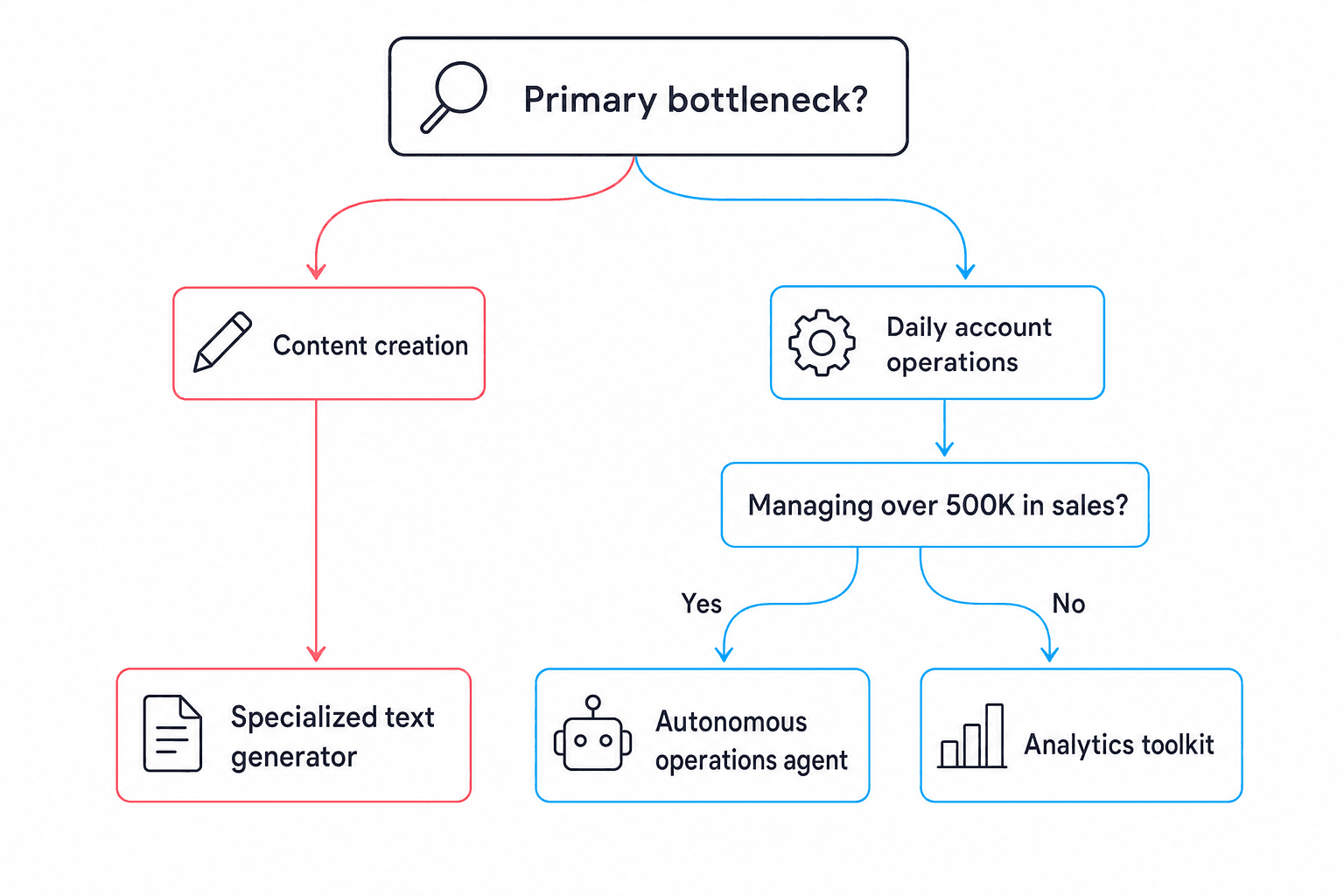
1. Define Core Bottlenecks
Identify where your team spends the most time (e.g., keyword research, customer message management, or reconciling inventory discrepancies).
Select tools that target those specific time sinks rather than buying broad software suites with unused features.
2. Assess Budget and Scale
For new brands with fewer resources, leverage free native options like Project Amelia alongside basic keyword trackers.
For established brands with larger catalogs, prioritize tools that handle bulk processing and automate operational tasks to save labor costs.
3. Verify System Integration
Choose platforms that fit into your existing communication systems (e.g., tools that can send direct alerts to Slack or email).
Confirm the software uses secure data environments to protect your brand's operational information.
Conclusion
The evolution of automated software has changed how brands manage their presence on the Amazon marketplace. From simple data filters to autonomous operational assistants, these systems help sellers handle complex workflows across listing creation, advertising management, and account protection. Success in this automated landscape relies on choosing tools that align with your specific operational needs and maintaining human oversight to ensure compliance and quality control.
Frequently Asked Questions
Can using third-party AI tools risk my Amazon seller account status?
Not if the software utilizes the official Amazon Selling Partner API for data access. Platforms that adhere to authorized developer standards run completely within marketplace guidelines. Security risks only arise if a tool requires you to share your primary account passwords or uses unauthorized scraping methods to pull data.
How do automated PPC tools optimize advertising spend?
Advertising algorithms track performance metrics like click-through rates and conversion percentages in real time. The system automatically shifts budget toward keywords generating strong returns while lowering bids on non-converting terms, helping reduce wasted ad spend without requiring daily manual adjustments.
Do automated listing generators understand Amazon compliance policies?
While native tools and advanced third-party listing generators include basic policy guardrails, they do not guarantee complete compliance. Generative tools can occasionally include restricted keywords or non-compliant product claims. It is important to review all text before updating live listings.
What is the difference between an analytical tool and an autonomous agent?
Analytical tools pull data and display metrics on a dashboard, leaving the tasks of interpretation and action to a human operator. An autonomous agent connects directly to active data feeds to run scheduled workflows independently, such as drafting customer replies, auditing inventory errors, and tracking compliance flags.
How long does it take for automated tools to show measurable results?
Listing optimization software can show impacts on search indexing within days of updating content. Advertising and repricing tools typically require two to four weeks of active data collection to optimize bids and pricing models based on category traffic trends.
Co-Founder & CEO, Lumian
Robin Lobo is Co-Founder and CEO of Lumian. He built and sold a seven-figure eyeglasses brand on Amazon and spent several years on the client side of traditional agencies before founding Lumian, an AI-native Amazon agency backed by $3M led by Bowery Capital.

AI Agent
Your Amazon business, fully managed.

Brand ManAger

Expert Team
Top AI Tools for Amazon Sellers in 2026: Unlocking Sales Potential
Discover the best AI tools for Amazon sellers in 2026. Compare features for listing optimization, PPC automation, and autonomous operations to scale your business.
TL;DR
What to expect from this article:
An objective evaluation of the leading artificial intelligence applications available to Amazon e-commerce brands in 2026. This analysis breaks down both native Amazon features and third-party software suites, providing a practical framework for selecting tools based on operational bottlenecks and business size.
Key Takeaways:
More than 900,000 sellers now use Amazon's native AI listing tools, which generated over 12 million product listings in 2025 alone.
Third-party applications provide specialized capabilities for complex programmatic tasks such as keyword mapping, granular PPC bid optimization, and dynamic repricing.
The software landscape is shifting toward autonomous execution, where platforms move beyond displaying charts to managing workflows like customer messaging and account protection automatically.
Intro
The e-commerce landscape across the Amazon marketplace has undergone a noticeable transition driven by machine learning and natural language processing. Systems that previously functioned as simple data visualization filters have evolved into advanced systems capable of generating high-converting copy, adjusting advertising bids, and monitoring inventory metrics.
For modern brands, using automation software is no longer just a way to improve efficiency; it is an operational necessity required to maintain visibility in highly competitive categories. This article reviews the top AI tools for Amazon sellers in 2026, examining their specific functional strengths, structural limitations, and practical deployment strategies.
Why AI Applications Matter for E-Commerce Operations
Managing an online brand involves balancing a wide variety of daily tasks, including regular keyword research, customer message management, and advertising bid updates. Handling these processes manually across dozens of product variants can create operational bottlenecks that slow down business growth.
Deploying specialized algorithms across these tasks can lead to measurable improvements in performance. According to data released by Amazon, sellers accept AI-generated listing content with little to no edits roughly 90% of the time, and Amazon reports Premium A+ Content can lift sales by up to 20%. Automating these routine data tasks helps companies reduce overhead, minimize manual data entry errors, and respond faster to shifting market conditions.
Detailed Evaluation of the Best AI Solutions in 2026
The software options available to Amazon businesses fall into two main types: native infrastructure built directly into Seller Central, and independent third-party applications designed for specialized operational tasks.
1. Amazon Seller Assistant & Native AI Tools (formerly Project Amelia)
Amazon has built artificial intelligence directly into Seller Central. Seller Assistant (which began as Project Amelia in 2024) is now an agentic assistant that answers questions from a brand's own performance data and, as of 2026, generates interactive dashboard canvases on request. Alongside it, Amazon's listing generation tools create titles, bullets, and full detail pages from a few words, an image, or a URL, and the Enhance My Listing feature suggests updates to existing listings based on seasonal trends.
Pros: Native tools require no paid subscriptions or API tokens; they sync instantly with active catalog data; and the bulk listing generation feature allows sellers to create multiple optimized product listings simultaneously from minimal spreadsheet data.
Cons: Seller Assistant only operates inside Amazon and cannot take actions across your other sales channels or tools; the creative image tools can produce generic visual outputs; and the feature set lacks automated options for non-Amazon sales channels.
2. Helium 10 (Listing Optimization & Search Mining)
Helium 10 remains a widely used software suite for product research, search term mining, and search engine optimization. Its integrated Listing Builder tool uses advanced language models to analyze top competitor listings, map keyword density, and predict search ranking scores before changes go live.
Pros: Provides comprehensive keyword indexing tracking; offers deep historical data on competitor traffic trends; and includes advanced filters for tracking listing health.
Cons: Subscription pricing tiers can be expensive for smaller brands; the wide range of features requires a learning curve for new users; and text generation requires manual inputs to avoid repetitive phrasing.
3. CopyMonkey (Specialized Content Generation)
CopyMonkey focuses specifically on generating search-optimized product copy for e-commerce stores. The platform analyzes search query performance data to place critical terms systematically within product titles, bullet points, and description sections.
Pros: Automates bulk text creation across extensive product catalogs; features built-in keyword density checks to prevent search penalties; and supports multiple languages for global expansion.
Cons: The tool is limited to text generation and does not manage imagery or advertising campaigns; users must audit outputs to ensure brand voice consistency; and it requires separate software for tracking inventory metrics.
4. SellerSnap (Algorithmic Repricing & Buy Box Protection)
SellerSnap uses game theory algorithms to automate pricing adjustments on shared listings. The system analyzes competitor pricing changes every few minutes to maximize Buy Box ownership while maintaining defined profit floors.
Pros: Adjusts pricing dynamically based on competitor behavior patterns; avoids long downward price wars that drop margins; and offers clear profit tracking metrics.
Cons: High monthly subscription costs limit its accessibility for newer brands; its features are less relevant for private-label brands that do not share detail pages; and setup requires careful configuration of minimum profit rules.
5. Lumian Agent (Autonomous Operations & Infrastructure Management)
Lumian Agent uses a direct connection with the Selling Partner API to function as an autonomous operational assistant. Instead of simply displaying analytics dashboards, the system runs pre-scheduled tasks to manage operations like automated account health monitoring, multi-language buyer message triaging, and systematic FBA reimbursement auditing.
Pros: Works autonomously right out of the box without complex workflow building; features a tiered "Daily Smoke Alarm" to send rapid risk notifications to Slack and email; and includes a built-in workflow to prepare verified dispute packages for inventory recovery.
Cons: The system requires manual operator sign-off before submitting customer replies or opening support cases; the tool focuses on operations rather than deep upfront product sourcing research; and full catalog access requires an active API connection.
Best Practices for Deploying AI Tools in E-Commerce
While automation software can significantly reduce manual work, relying entirely on automated systems without human oversight can create operational risks. Brands should consider the following guidelines when integrating these tools into daily processes:
Maintain Human Overview: Automated copy tools can occasionally include incorrect information or introduce non-compliant product claims. Always review auto-generated text to ensure accuracy and policy compliance before publishing.
Set Firm Financial Boundaries: When using automated PPC tools or repricing systems, define clear maximum budgets and minimum profit margins to protect your bottom line from unexpected market fluctuations.
Audit API Integrations Regularly: Ensure external software connections use official, secure access methods like the Selling Partner API, and review data access permissions periodically.
Strategic Framework: Selecting the Right Software Solution
Every brand faces unique operational bottlenecks depending on its catalog size, fulfillment model, and team structure. This checklist provides a framework for evaluating software investments against current operational needs.
1. Define Core Bottlenecks
Identify where your team spends the most time (e.g., keyword research, customer message management, or reconciling inventory discrepancies).
Select tools that target those specific time sinks rather than buying broad software suites with unused features.
2. Assess Budget and Scale
For new brands with fewer resources, leverage free native options like Project Amelia alongside basic keyword trackers.
For established brands with larger catalogs, prioritize tools that handle bulk processing and automate operational tasks to save labor costs.
3. Verify System Integration
Choose platforms that fit into your existing communication systems (e.g., tools that can send direct alerts to Slack or email).
Confirm the software uses secure data environments to protect your brand's operational information.
Conclusion
The evolution of automated software has changed how brands manage their presence on the Amazon marketplace. From simple data filters to autonomous operational assistants, these systems help sellers handle complex workflows across listing creation, advertising management, and account protection. Success in this automated landscape relies on choosing tools that align with your specific operational needs and maintaining human oversight to ensure compliance and quality control.
Frequently Asked Questions
Can using third-party AI tools risk my Amazon seller account status?
Not if the software utilizes the official Amazon Selling Partner API for data access. Platforms that adhere to authorized developer standards run completely within marketplace guidelines. Security risks only arise if a tool requires you to share your primary account passwords or uses unauthorized scraping methods to pull data.
How do automated PPC tools optimize advertising spend?
Advertising algorithms track performance metrics like click-through rates and conversion percentages in real time. The system automatically shifts budget toward keywords generating strong returns while lowering bids on non-converting terms, helping reduce wasted ad spend without requiring daily manual adjustments.
Do automated listing generators understand Amazon compliance policies?
While native tools and advanced third-party listing generators include basic policy guardrails, they do not guarantee complete compliance. Generative tools can occasionally include restricted keywords or non-compliant product claims. It is important to review all text before updating live listings.
What is the difference between an analytical tool and an autonomous agent?
Analytical tools pull data and display metrics on a dashboard, leaving the tasks of interpretation and action to a human operator. An autonomous agent connects directly to active data feeds to run scheduled workflows independently, such as drafting customer replies, auditing inventory errors, and tracking compliance flags.
How long does it take for automated tools to show measurable results?
Listing optimization software can show impacts on search indexing within days of updating content. Advertising and repricing tools typically require two to four weeks of active data collection to optimize bids and pricing models based on category traffic trends.
Co-Founder & CEO, Lumian
Robin Lobo is Co-Founder and CEO of Lumian. He built and sold a seven-figure eyeglasses brand on Amazon and spent several years on the client side of traditional agencies before founding Lumian, an AI-native Amazon agency backed by $3M led by Bowery Capital.
AI Agent
Your Amazon business, fully managed.
Brand ManAger
Expert Team
Top AI Tools for Amazon Sellers in 2026: Unlocking Sales Potential
Discover the best AI tools for Amazon sellers in 2026. Compare features for listing optimization, PPC automation, and autonomous operations to scale your business.
TL;DR
What to expect from this article:
An objective evaluation of the leading artificial intelligence applications available to Amazon e-commerce brands in 2026. This analysis breaks down both native Amazon features and third-party software suites, providing a practical framework for selecting tools based on operational bottlenecks and business size.
Key Takeaways:
More than 900,000 sellers now use Amazon's native AI listing tools, which generated over 12 million product listings in 2025 alone.
Third-party applications provide specialized capabilities for complex programmatic tasks such as keyword mapping, granular PPC bid optimization, and dynamic repricing.
The software landscape is shifting toward autonomous execution, where platforms move beyond displaying charts to managing workflows like customer messaging and account protection automatically.
Intro
The e-commerce landscape across the Amazon marketplace has undergone a noticeable transition driven by machine learning and natural language processing. Systems that previously functioned as simple data visualization filters have evolved into advanced systems capable of generating high-converting copy, adjusting advertising bids, and monitoring inventory metrics.
For modern brands, using automation software is no longer just a way to improve efficiency; it is an operational necessity required to maintain visibility in highly competitive categories. This article reviews the top AI tools for Amazon sellers in 2026, examining their specific functional strengths, structural limitations, and practical deployment strategies.
Why AI Applications Matter for E-Commerce Operations
Managing an online brand involves balancing a wide variety of daily tasks, including regular keyword research, customer message management, and advertising bid updates. Handling these processes manually across dozens of product variants can create operational bottlenecks that slow down business growth.
Deploying specialized algorithms across these tasks can lead to measurable improvements in performance. According to data released by Amazon, sellers accept AI-generated listing content with little to no edits roughly 90% of the time, and Amazon reports Premium A+ Content can lift sales by up to 20%. Automating these routine data tasks helps companies reduce overhead, minimize manual data entry errors, and respond faster to shifting market conditions.
Detailed Evaluation of the Best AI Solutions in 2026
The software options available to Amazon businesses fall into two main types: native infrastructure built directly into Seller Central, and independent third-party applications designed for specialized operational tasks.
1. Amazon Seller Assistant & Native AI Tools (formerly Project Amelia)
Amazon has built artificial intelligence directly into Seller Central. Seller Assistant (which began as Project Amelia in 2024) is now an agentic assistant that answers questions from a brand's own performance data and, as of 2026, generates interactive dashboard canvases on request. Alongside it, Amazon's listing generation tools create titles, bullets, and full detail pages from a few words, an image, or a URL, and the Enhance My Listing feature suggests updates to existing listings based on seasonal trends.
Pros: Native tools require no paid subscriptions or API tokens; they sync instantly with active catalog data; and the bulk listing generation feature allows sellers to create multiple optimized product listings simultaneously from minimal spreadsheet data.
Cons: Seller Assistant only operates inside Amazon and cannot take actions across your other sales channels or tools; the creative image tools can produce generic visual outputs; and the feature set lacks automated options for non-Amazon sales channels.
2. Helium 10 (Listing Optimization & Search Mining)
Helium 10 remains a widely used software suite for product research, search term mining, and search engine optimization. Its integrated Listing Builder tool uses advanced language models to analyze top competitor listings, map keyword density, and predict search ranking scores before changes go live.
Pros: Provides comprehensive keyword indexing tracking; offers deep historical data on competitor traffic trends; and includes advanced filters for tracking listing health.
Cons: Subscription pricing tiers can be expensive for smaller brands; the wide range of features requires a learning curve for new users; and text generation requires manual inputs to avoid repetitive phrasing.
3. CopyMonkey (Specialized Content Generation)
CopyMonkey focuses specifically on generating search-optimized product copy for e-commerce stores. The platform analyzes search query performance data to place critical terms systematically within product titles, bullet points, and description sections.
Pros: Automates bulk text creation across extensive product catalogs; features built-in keyword density checks to prevent search penalties; and supports multiple languages for global expansion.
Cons: The tool is limited to text generation and does not manage imagery or advertising campaigns; users must audit outputs to ensure brand voice consistency; and it requires separate software for tracking inventory metrics.
4. SellerSnap (Algorithmic Repricing & Buy Box Protection)
SellerSnap uses game theory algorithms to automate pricing adjustments on shared listings. The system analyzes competitor pricing changes every few minutes to maximize Buy Box ownership while maintaining defined profit floors.
Pros: Adjusts pricing dynamically based on competitor behavior patterns; avoids long downward price wars that drop margins; and offers clear profit tracking metrics.
Cons: High monthly subscription costs limit its accessibility for newer brands; its features are less relevant for private-label brands that do not share detail pages; and setup requires careful configuration of minimum profit rules.
5. Lumian Agent (Autonomous Operations & Infrastructure Management)
Lumian Agent uses a direct connection with the Selling Partner API to function as an autonomous operational assistant. Instead of simply displaying analytics dashboards, the system runs pre-scheduled tasks to manage operations like automated account health monitoring, multi-language buyer message triaging, and systematic FBA reimbursement auditing.
Pros: Works autonomously right out of the box without complex workflow building; features a tiered "Daily Smoke Alarm" to send rapid risk notifications to Slack and email; and includes a built-in workflow to prepare verified dispute packages for inventory recovery.
Cons: The system requires manual operator sign-off before submitting customer replies or opening support cases; the tool focuses on operations rather than deep upfront product sourcing research; and full catalog access requires an active API connection.
Best Practices for Deploying AI Tools in E-Commerce
While automation software can significantly reduce manual work, relying entirely on automated systems without human oversight can create operational risks. Brands should consider the following guidelines when integrating these tools into daily processes:
Maintain Human Overview: Automated copy tools can occasionally include incorrect information or introduce non-compliant product claims. Always review auto-generated text to ensure accuracy and policy compliance before publishing.
Set Firm Financial Boundaries: When using automated PPC tools or repricing systems, define clear maximum budgets and minimum profit margins to protect your bottom line from unexpected market fluctuations.
Audit API Integrations Regularly: Ensure external software connections use official, secure access methods like the Selling Partner API, and review data access permissions periodically.
Strategic Framework: Selecting the Right Software Solution
Every brand faces unique operational bottlenecks depending on its catalog size, fulfillment model, and team structure. This checklist provides a framework for evaluating software investments against current operational needs.
1. Define Core Bottlenecks
Identify where your team spends the most time (e.g., keyword research, customer message management, or reconciling inventory discrepancies).
Select tools that target those specific time sinks rather than buying broad software suites with unused features.
2. Assess Budget and Scale
For new brands with fewer resources, leverage free native options like Project Amelia alongside basic keyword trackers.
For established brands with larger catalogs, prioritize tools that handle bulk processing and automate operational tasks to save labor costs.
3. Verify System Integration
Choose platforms that fit into your existing communication systems (e.g., tools that can send direct alerts to Slack or email).
Confirm the software uses secure data environments to protect your brand's operational information.
Conclusion
The evolution of automated software has changed how brands manage their presence on the Amazon marketplace. From simple data filters to autonomous operational assistants, these systems help sellers handle complex workflows across listing creation, advertising management, and account protection. Success in this automated landscape relies on choosing tools that align with your specific operational needs and maintaining human oversight to ensure compliance and quality control.
Frequently Asked Questions
Can using third-party AI tools risk my Amazon seller account status?
Not if the software utilizes the official Amazon Selling Partner API for data access. Platforms that adhere to authorized developer standards run completely within marketplace guidelines. Security risks only arise if a tool requires you to share your primary account passwords or uses unauthorized scraping methods to pull data.
How do automated PPC tools optimize advertising spend?
Advertising algorithms track performance metrics like click-through rates and conversion percentages in real time. The system automatically shifts budget toward keywords generating strong returns while lowering bids on non-converting terms, helping reduce wasted ad spend without requiring daily manual adjustments.
Do automated listing generators understand Amazon compliance policies?
While native tools and advanced third-party listing generators include basic policy guardrails, they do not guarantee complete compliance. Generative tools can occasionally include restricted keywords or non-compliant product claims. It is important to review all text before updating live listings.
What is the difference between an analytical tool and an autonomous agent?
Analytical tools pull data and display metrics on a dashboard, leaving the tasks of interpretation and action to a human operator. An autonomous agent connects directly to active data feeds to run scheduled workflows independently, such as drafting customer replies, auditing inventory errors, and tracking compliance flags.
How long does it take for automated tools to show measurable results?
Listing optimization software can show impacts on search indexing within days of updating content. Advertising and repricing tools typically require two to four weeks of active data collection to optimize bids and pricing models based on category traffic trends.
Co-Founder & CEO, Lumian
Robin Lobo is Co-Founder and CEO of Lumian. He built and sold a seven-figure eyeglasses brand on Amazon and spent several years on the client side of traditional agencies before founding Lumian, an AI-native Amazon agency backed by $3M led by Bowery Capital.

AI Agent
Your Amazon business, fully managed.
Brand ManAger
Expert Team